Political Ideology Atlas · All people · Take the test
Europe · born 1859, historical
Wilhelm II
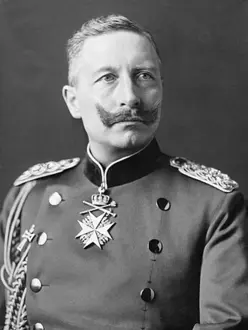
German Emperor and King of Prussia (1888-1918)
Wilhelm II ruled as a monarch who claimed his crown by God's grace, distrusted parliament and the Social Democrats, and personally promoted the army, the navy and Weltpolitik. He backed worker-protection legislation while treating socialism as the enemy, and in exile voiced antisemitic and conspiratorial views. He also took a conservative line on art, religion, women's roles and education.
Closest ideologies
Based on the 61 statements where Wilhelm II has a known position.
- Neo-fascism (89% match)
- Apartheid (88% match)
- Corporate statism (87% match)
- Maurrassisme (87% match)
- Militarism (87% match)
Similar people
- Otto von Bismarck (90% alike)
- Henry VIII of England (89% alike)
- Charlemagne (89% alike)
- Augustus (88% alike)
- Alexander I of Yugoslavia (88% alike)
Known positions
- Strongly: A lord's political authority should be grounded in the personal loyalty sworn by followers.
- Strongly: A minority group is working in secret to harm the nation.
- Strongly: Someone who actually governs a state may hand that power on to their own child, whether as a king or as a republic's leader.
- Strongly: The law may treat people differently according to such things as birth, sex, race and status.
- Strongly: God is the ultimate source of the right to exercise political authority.
- Strongly: The military should have a political role in protecting the constitution and public order, stepping in when they are threatened.
- Strongly: It is acceptable for a monarch who inherits the throne to be the country's symbolic head while others govern.
- Strongly: Consent of the governed is not the only basis of legitimate political authority.
- Strongly: Special ranks held by birth, such as noble titles and hereditary crowns, may continue to exist.
- Strongly: The head of state should not have to be chosen by election.
- Strongly: The country would benefit from a strong leader with the power to act despite deadlock among its political institutions.
- Strongly: Real authority to command the military should rest with the head of state.
- Strongly: Democracy is not the best form of government when voters choose badly.
- Strongly: My country may join a military alliance led by one of the great powers.
- Strongly: Religious values and institutions should shape laws, schools and public life.
- Strongly: Some institutional ties between government and religion are acceptable.
- Strongly: The government should be able to require citizens to serve in the military.
- Strongly: A country may join permanent military alliances.
- Strongly: Another body may have the final say over what the legislature passes.
- Strongly: Employers and workers should treat each other as partners whose cooperation comes before conflict, even where their interests differ.
- Strongly: Where they conflict, religious faith should count for at least as much as evidence and reasoning.
- Strongly: Schools should cultivate patriotic feeling: loyalty to and pride in the nation, expressed for example through respect for its flag and anthem.
- Strongly: Equality of outcomes should not be society's goal.
- Strongly: The holy scripture of one's faith is not God's own error-free word.
- Strongly: Whatever their circumstances, everyone should be able to count on the state for enough to live decently, through benefits, pensions or public services.
- Strongly: Political violence is sometimes justified.
- Strongly: School history should mostly tell the story of the student's own nation.
- Strongly: Religion does not offer illusory comfort for material suffering.
- Strongly: Soldiers and conscripts need not refuse to fight when their state goes to war.
- Strongly: Keeping a nation's inherited culture alive, including its language, customs and traditions, matters.
- Strongly: In a war between great powers, workers need not seek their own government's defeat.
- Strongly: Countries should keep their armed forces.
- Strongly: People without property should also have the right to vote.
- Strongly: Museums, libraries and other inherited culture should not be destroyed, even when they stand in the way of new creation.
- Leans: The person holding the highest state office should be treated as holy.
- Leans: Temporary rule by a more developed society is justified when it helps the ruled to progress.
- Leans: A state may force a minority it sees as hostile to leave the country.
- Leans: The leader should bypass parties and organised interest groups in dealing with the people.
- Leans: The government should stop its political opponents from organising, speaking or competing for power.
- Leans: A powerful country should bring more land within its borders.
- Leans: A person's sex should affect the public roles legally assigned to them.
- Leans: A nation should be mainly one ethnic people.
- Leans: A national emergency sometimes justifies temporarily withdrawing normal legal safeguards against people the government regards as internal enemies, such as protections against detention without trial.
- Leans: Workers' solidarity with their own nation should take priority over solidarity with workers across borders.
- Leans: Changes to society should be introduced a little at a time.
- Leans: The nation's figurehead should be non-partisan and belong to everyone.
- Leans: My country's military strength should exceed that of its rivals.
- Leans: Besides its directly elected parliament, a legislature should have a second chamber, such as a senate.
- Leans: Inherited religious teachings should be understood anew in light of present conditions.
- Leans: Rich people have an obligation to help those worse off than they are.
- Leans: A government should outlaw political parties that aim to do away with its constitutional order.
- Leans: A country may accept its present border with a neighbour even if it lost land in an old war.
- Leans: Land claimed as the historic homeland should not be traded away, even for peace.
- Leans: Government should impose strict rules on how corporations operate.
- Leans: An ancestral bond to a land gives a people a claim that outweighs the claims of other peoples who now live there.
- Leans: A healthy society depends on the traditional family, such as a married mother and father raising their children.
- Leans: The nation's cause and the cause of its ordinary working people are one and the same.