Political Ideology Atlas · All ideologies · Take the test
Militarism
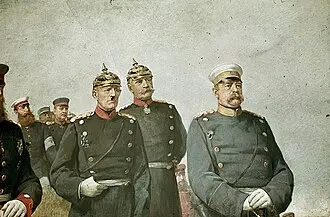
Militarism holds that war is a permanent and even ennobling feature of relations between states, that a state's highest end is power, and that the armed forces and martial virtues (obedience, duty, self-sacrifice) deserve primacy in state and society. Its classical theorists rejected arbitration, disarmament and the peace movement, defended conquest and colonies as the right of the stronger, and wanted universal service, a military-minded education and a government or monarch above parliamentary politics. Scholars such as Vagts distinguish it from the ordinary 'military way' of preparing for war under civilian direction.
What it stands for
- A powerful country should bring more land within its borders.
- War develops virtues in a nation, such as courage and discipline.
- Consent of the governed is not the only basis of legitimate political authority.
- Rivalry and conflict between nations or peoples do more than anything else to drive humanity forward.
- Young people should belong to uniformed, drilled organisations that prepare them to serve the nation.
- A country should be ready to use military force abroad on its own judgment, even if the UN Security Council has not authorized it.
Key figures
- Friedrich von Bernhardi: Prussian general whose Germany and the Next War (1912) is the classic statement of militarist doctrine
- Heinrich von Treitschke: Historian whose lectures on politics defined the state as power and praised war
- Erich Ludendorff: General who ran Germany's war effort in 1916-18 and theorised total war
Closest ideologies
- İttihadism (91% match)
- Corporate statism (90% match)
- Revisionist Maximalism (89% match)
- Italian fascism (89% match)
- Fascism (89% match)
People closest to it
- Jorge Rafael Videla (93% alike)
- Napoleon (91% alike)
- Reinhard Heydrich (88% alike)
- Catherine II of Russia (88% alike)
- Otto von Bismarck (88% alike)
Key positions
- Strongly: A powerful country should bring more land within its borders.
- Strongly: War develops virtues in a nation, such as courage and discipline.
- Strongly: Consent of the governed is not the only basis of legitimate political authority.
- Strongly: Rivalry and conflict between nations or peoples do more than anything else to drive humanity forward.
- Strongly: Young people should belong to uniformed, drilled organisations that prepare them to serve the nation.
- Strongly: A country should be ready to use military force abroad on its own judgment, even if the UN Security Council has not authorized it.
- Strongly: A ruler's unconstitutional acts do not give people a right to resist.
- Strongly: Land that a state declares its own against its people's will is not illegally occupied by that state.
- Strongly: The country would benefit from a strong leader with the power to act despite deadlock among its political institutions.
- Strongly: Real authority to command the military should rest with the head of state.
- Strongly: Collective goals can justify treating a person merely as a tool.
- Strongly: My country's military strength should exceed that of its rivals.
- Strongly: Armaments need not be limited to the minimum needed for national safety.
- Strongly: When national priorities conflict with working together internationally, my country should choose its own priorities.
- Strongly: Foreign powers sometimes have a right to intervene in a country's internal affairs.
- Strongly: The government should be able to require citizens to serve in the military.
- Strongly: Armed forces may sometimes be used for purposes beyond defending the country against attack.
- Strongly: What you owe your community matters more than your personal rights.
- Strongly: A country's constitution should prevail when it conflicts with international legal obligations.
- Strongly: Another body may have the final say over what the legislature passes.
- Strongly: Some cultures are superior to others.
- Strongly: Employers and workers should treat each other as partners whose cooperation comes before conflict, even where their interests differ.
- Strongly: Capitalism does not inevitably cause wars between great powers.
- Strongly: People who give their lives for the nation deserve to be remembered as martyrs, with reverence beyond ordinary thanks.
- Strongly: A country may keep all its decisions in its own hands rather than pooling them with other nations.
- Strongly: Schools should cultivate patriotic feeling: loyalty to and pride in the nation, expressed for example through respect for its flag and anthem.
- Strongly: Spreading democracy does not bring peace.
- Strongly: Being the law gives a rule a moral claim to be obeyed.
- Strongly: Other forces move history at least as much as conflict between classes does.
- Strongly: Member states should keep the final decision on whether to follow UN decisions.
- Strongly: Political violence is sometimes justified.
- Strongly: Groups have rights of their own.
- Strongly: Being the first to use force can be right, depending on what it is meant to achieve.
- Strongly: Soldiers and conscripts need not refuse to fight when their state goes to war.
- Strongly: In a war between great powers, workers need not seek their own government's defeat.
- Strongly: Police forces should continue to exist.
- Strongly: Society needs government of some kind.
- Strongly: Countries should keep their armed forces.
- Strongly: Killing another person can be right in self-defence or in defence of others.
- Strongly: Courts need not be handed over to private businesses.
- Leans: The person holding the highest state office should be treated as holy.
- Leans: Colonies should be run mainly to supply markets, materials and outlets for the ruling country.
- Leans: Women's political rights may differ from men's.
- Leans: Temporary rule by a more developed society is justified when it helps the ruled to progress.
- Leans: Every part of life should be subject to state direction.
- Leans: The people in power should decide what the country's news media publish.
- Leans: A minority group is working in secret to harm the nation.
- Leans: Someone who actually governs a state may hand that power on to their own child, whether as a king or as a republic's leader.
- Leans: The law may treat people differently according to such things as birth, sex, race and status.
- Leans: The mother country and its colonies should meet their economic needs within their own bloc instead of trading with the outside world.
- Leans: The leader should bypass parties and organised interest groups in dealing with the people.
- Leans: The military should have a political role in protecting the constitution and public order, stepping in when they are threatened.
- Leans: The government should stop its political opponents from organising, speaking or competing for power.
- Leans: Having a shared national identity does not by itself entitle a people to its own self-governing state.
- Leans: A person's sex should affect the public roles legally assigned to them.
- Leans: Some people are better suited by nature to govern.
- Leans: It is acceptable to praise a national leader openly as the one who stands for the whole nation.
- Leans: Special ranks held by birth, such as noble titles and hereditary crowns, may continue to exist.
- Leans: The head of state should not have to be chosen by election.
- Leans: There should be legal limits on strike action.
- Leans: The government may spend public money without first getting its budget approved by an elected legislature.
- Leans: No moral truths hold across all cultures.
- Leans: Women should have different military draft obligations from men.
- Leans: A national emergency sometimes justifies temporarily withdrawing normal legal safeguards against people the government regards as internal enemies, such as protections against detention without trial.
- Leans: Workers' solidarity with their own nation should take priority over solidarity with workers across borders.
- Leans: The nation's figurehead should be non-partisan and belong to everyone.
- Leans: Democracy is not the best form of government when voters choose badly.
- Leans: Whoever takes natural resources for their own use does not owe compensation to everyone else.
- Leans: Only the state's armed forces and police should have permission to carry weapons.
- Leans: A country has the right to stop a region becoming independent by using its military.
- Leans: New oil and gas wells and coal mines should be permitted.
- Leans: Rich people have an obligation to help those worse off than they are.
- Leans: Allies are bound to defend one another against armed attack.
- Leans: The nation has decayed and must be reborn.
- Leans: The goods people consume should mainly come from nearby producers.
- Leans: The state should give families money to have more children, such as through payments and tax breaks.
- Leans: Belonging to the nation ties a person's life to a sacred community that goes on after their death.
- Leans: The government should steer investment into industries it sees as key to the country's future.
- Leans: A country may join permanent military alliances.
- Leans: Land claimed as the historic homeland should not be traded away, even for peace.
- Leans: Parties and offices should cut across religious lines.
- Leans: Free trade does not benefit everyone in the long run.
- Leans: Countries that had colonies should not have to compensate the countries they colonized.
- Leans: Defense should not rest with armed ordinary citizens in place of a standing force.
- Leans: Society should use modern technology together with revived values inherited from its ancestors.
- Leans: Officials decide what gets made and who gets it at least as well as prices and competition do.
- Leans: A healthy society depends on the traditional family, such as a married mother and father raising their children.
- Leans: A country may keep a region that wants to leave.
- Leans: A people split by an imposed border should be brought together in a single state.
- Leans: A state should take responsibility for the welfare of its national communities across neighbouring borders.
- Leans: Each country should hold ultimate authority over its natural resources, without foreign interests controlling them.
- Leans: Constantly seeking additional possessions is harmful overall, despite any benefits it brings.
- Leans: Historical change does not come mainly from changes in how society produces and exchanges goods.
- Leans: The state should guarantee health care to everyone, whether it runs the services itself or pays for them.
- Leans: Industrial society has done at least as much good as harm to humanity.
- Leans: The armed forces may be controlled by someone other than the governing party's leadership.
- Leans: Politics should support people's spiritual well-being.
- Leans: Keeping a nation's inherited culture alive, including its language, customs and traditions, matters.
- Leans: Whatever their circumstances, everyone should be able to count on the state for enough to live decently, through benefits, pensions or public services.
- Leans: Looking after your own interests is not a moral good in itself.
- Leans: Laws should not be required to follow religious texts.
- Leans: School history should mostly tell the story of the student's own nation.