Political Ideology Atlas · All people · Take the test
Europe · born 1491, historical
Henry VIII of England
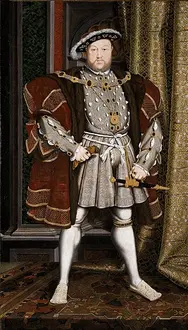
King of England and Ireland (1509–1547)
An absolute-minded Tudor monarch whose recorded positions centre on royal and national sovereignty: he broke with Rome, made himself supreme head of the English church, and enforced doctrinal conformity and loyalty by treason law and execution. His written record is mostly statutes and one late speech urging charity in religious dispute, so economic and social questions are largely unaddressed.
Closest ideologies
Based on the 56 statements where Henry VIII of England has a known position.
- Ruscism (91% match)
- Kokkashugi (90% match)
- Apartheid (87% match)
- Italian fascism (87% match)
- Neo-fascism (86% match)
Similar people
- Charlemagne (94% alike)
- Louis XIV of France (92% alike)
- Wilhelm II (89% alike)
- Rudolf Hess (88% alike)
- Francisco Franco (88% alike)
Known positions
- Strongly: A weaker state should openly acknowledge a stronger power as its superior.
- Strongly: A state may force a minority it sees as hostile to leave the country.
- Strongly: Same-sex relations between consenting adults should be punishable by law.
- Strongly: Overthrowing a government by revolution is never justified, whatever the cause.
- Strongly: Someone who actually governs a state may hand that power on to their own child, whether as a king or as a republic's leader.
- Strongly: God is the ultimate source of the right to exercise political authority.
- Strongly: The government should stop its political opponents from organising, speaking or competing for power.
- Strongly: A powerful country should bring more land within its borders.
- Strongly: Consent of the governed is not the only basis of legitimate political authority.
- Strongly: Special ranks held by birth, such as noble titles and hereditary crowns, may continue to exist.
- Strongly: The national church is recognised in law above other religions.
- Strongly: The government should have authority over religious institutions' internal affairs.
- Strongly: The head of state should not have to be chosen by election.
- Strongly: A ruler's unconstitutional acts do not give people a right to resist.
- Strongly: The national church should have episcopal government, with its bishops holding governing authority.
- Strongly: Real authority to command the military should rest with the head of state.
- Strongly: Democracy is not the best form of government when voters choose badly.
- Strongly: The state may give legal precedence to one stream of a religion over the others.
- Strongly: Religious values and institutions should shape laws, schools and public life.
- Strongly: The worst crimes can be punished by death.
- Strongly: A woman who has sex outside marriage is doing something wrong.
- Strongly: Some institutional ties between government and religion are acceptable.
- Strongly: Foreign powers sometimes have a right to intervene in a country's internal affairs.
- Strongly: Armed forces may sometimes be used for purposes beyond defending the country against attack.
- Strongly: Owners' rights to their property need not be protected against being overridden for public goals.
- Strongly: The head of state should not be elected directly by the voters.
- Strongly: Where they conflict, religious faith should count for at least as much as evidence and reasoning.
- Strongly: Being the law gives a rule a moral claim to be obeyed.
- Strongly: Grown children owe care to parents who need it.
- Strongly: Collecting taxes does not in itself amount to stealing people's money.
- Strongly: Killing another person can be right in self-defence or in defence of others.
- Strongly: Final authority over a state's laws need not belong to its most senior religious scholars.
- Leans: Abandoning the faith is a crime that the state may punish.
- Leans: The person holding the highest state office should be treated as holy.
- Leans: Colonies should be run mainly to supply markets, materials and outlets for the ruling country.
- Leans: The ruler should not be bound by the country's laws, including those made by that ruler and by earlier ones.
- Leans: The law limits or polices changing religion, for example to prevent pressure or inducement.
- Leans: The state should encourage people of the majority group to move into areas where minority groups are in the majority.
- Leans: Laws should follow religious texts.
- Leans: Belonging to the nation goes with sharing its religion.
- Leans: Having a shared national identity does not by itself entitle a people to its own self-governing state.
- Leans: Some people are better suited by nature to govern.
- Leans: A right to return to former homes should not apply to all refugees displaced during a conflict.
- Leans: A national emergency sometimes justifies temporarily withdrawing normal legal safeguards against people the government regards as internal enemies, such as protections against detention without trial.
- Leans: A country should press its neighbour to give back land taken from it in an old war.
- Leans: Many political decisions should rest with national or wider authorities, even where a smaller community could handle them.
- Leans: My country's military strength should exceed that of its rivals.
- Leans: Political power may be concentrated in one body.
- Leans: Rich people have an obligation to help those worse off than they are.
- Leans: The government should steer investment into industries it sees as key to the country's future.
- Leans: Another body may have the final say over what the legislature passes.
- Leans: An elected legislature must approve the government's budget before the government spends public money.
- Leans: Government should have other tasks besides protecting people from physical violence.
- Leans: Politics should support people's spiritual well-being.
- Leans: Political violence is sometimes justified.