Political Ideology Atlas · All people · Take the test
Europe · born 742, historical
Charlemagne
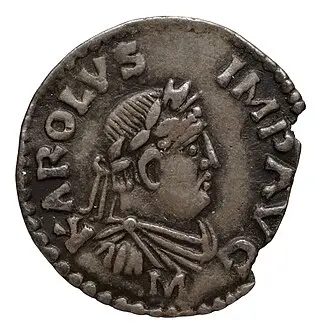
King of the Franks (768-814) and Emperor (800-814)
Charlemagne unified most of Western Europe by conquest and used royal capitularies to order the church, the law and the royal estates. His record combines forced conversion and executions for pagan practice in Saxony with a programme of church reform and learning.
Closest ideologies
Based on the 42 statements where Charlemagne has a known position.
- Kokkashugi (91% match)
- Ruscism (90% match)
- Clerical Fascism (88% match)
- Metaxism (87% match)
- Rexism (87% match)
Similar people
- Henry VIII of England (94% alike)
- Louis XIV of France (92% alike)
- Wilhelm II (89% alike)
- Francisco Franco (88% alike)
- Rudolf Hess (88% alike)
Known positions
- Strongly: People farming an estate should lack the legal freedom to leave that estate.
- Strongly: A lord's political authority should be grounded in the personal loyalty sworn by followers.
- Strongly: The law limits or polices changing religion, for example to prevent pressure or inducement.
- Strongly: Laws should follow religious texts.
- Strongly: Charging interest on loans is banned by law.
- Strongly: Someone who actually governs a state may hand that power on to their own child, whether as a king or as a republic's leader.
- Strongly: Belonging to the nation goes with sharing its religion.
- Strongly: The law may treat people differently according to such things as birth, sex, race and status.
- Strongly: God is the ultimate source of the right to exercise political authority.
- Strongly: The government should stop its political opponents from organising, speaking or competing for power.
- Strongly: A powerful country should bring more land within its borders.
- Strongly: Having a shared national identity does not by itself entitle a people to its own self-governing state.
- Strongly: The head of state should not have to be chosen by election.
- Strongly: Real authority to command the military should rest with the head of state.
- Strongly: Governments should set legal price ceilings on essential foods when supplies are scarce.
- Strongly: The state may give legal precedence to one stream of a religion over the others.
- Strongly: A country has the right to stop a region becoming independent by using its military.
- Strongly: Rich people have an obligation to help those worse off than they are.
- Strongly: Inherited religious teachings may stay as handed down, without being rethought for present conditions.
- Strongly: State schools may teach pupils a religious faith, for example through lessons in its beliefs and practice.
- Strongly: Religious values and institutions should shape laws, schools and public life.
- Strongly: The worst crimes can be punished by death.
- Strongly: Some institutional ties between government and religion are acceptable.
- Strongly: Foreign powers sometimes have a right to intervene in a country's internal affairs.
- Strongly: The government should be able to require citizens to serve in the military.
- Strongly: Armed forces may sometimes be used for purposes beyond defending the country against attack.
- Strongly: Religious minorities should not be exempt from general laws that burden their practice.
- Strongly: A country may keep a region that wants to leave.
- Strongly: The state may restrict what adults do for reasons other than preventing harm to others.
- Strongly: Politics should support people's spiritual well-being.
- Strongly: Being the first to use force can be right, depending on what it is meant to achieve.
- Strongly: Government should have other tasks besides protecting people from physical violence.
- Strongly: State schools need not steer pupils away from belief in God.
- Strongly: Final authority over a state's laws need not belong to its most senior religious scholars.
- Leans: A state may force a minority it sees as hostile to leave the country.
- Leans: Political power may be concentrated in one body.
- Leans: People able to work should get welfare benefits only in return for some work, such as a job or a work scheme.
- Leans: Where they conflict, religious faith should count for at least as much as evidence and reasoning.
- Leans: A healthy society depends on the traditional family, such as a married mother and father raising their children.
- Leans: Rulers must act under lasting, publicly known laws administered by recognised courts.
- Leans: Private ownership is legitimate only insofar as it benefits society.
- Leans: Keeping a nation's inherited culture alive, including its language, customs and traditions, matters.