Political Ideology Atlas · All people · Take the test
Europe · born 1815, historical
Otto von Bismarck
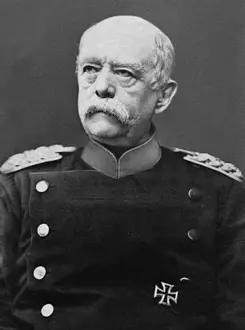
Minister President of Prussia (1862-1890) and first Chancellor of the German Empire (1871-1890)
Prussian conservative statesman who unified Germany under the Prussian crown through the wars of 1864-71, ruled through the monarch with a weakened Reichstag, and fought political Catholicism and Social Democracy. He also created state sickness, accident and old-age insurance and moved from free trade to protective tariffs, while avoiding European war after 1871.
Closest ideologies
Based on the 69 statements where Otto von Bismarck has a known position.
- Corporate statism (90% match)
- Apartheid (89% match)
- İttihadism (88% match)
- Neo-fascism (88% match)
- Militarism (88% match)
Similar people
- Wilhelm II (90% alike)
- Augustus (89% alike)
- Oliver Cromwell (89% alike)
- Napoleon (88% alike)
- Alexander I of Yugoslavia (87% alike)
Known positions
- Strongly: The government should have authority over religious institutions' internal affairs.
- Strongly: Public institutions do not need to help minority languages be used in public life.
- Strongly: Real authority to command the military should rest with the head of state.
- Strongly: Democracy is not the best form of government when voters choose badly.
- Strongly: Judge policies by what they achieve, independently of whether they match an ideology.
- Strongly: Governments should be able to keep some international agreements secret.
- Strongly: My country may join a military alliance led by one of the great powers.
- Strongly: My country's military strength should exceed that of its rivals.
- Strongly: The state should offer public work to anyone who wants a job and cannot find one.
- Strongly: Taxes on imports should shield domestic producers from foreign competition.
- Strongly: Armaments need not be limited to the minimum needed for national safety.
- Strongly: Rich people have an obligation to help those worse off than they are.
- Strongly: When national priorities conflict with working together internationally, my country should choose its own priorities.
- Strongly: The government should be able to require citizens to serve in the military.
- Strongly: Cultural life inside a state should not be placed under the control of each national minority.
- Strongly: A government should outlaw political parties that aim to do away with its constitutional order.
- Strongly: A country may join permanent military alliances.
- Strongly: Free trade does not benefit everyone in the long run.
- Strongly: Another body may have the final say over what the legislature passes.
- Strongly: Defense should not rest with armed ordinary citizens in place of a standing force.
- Strongly: Employers and workers should treat each other as partners whose cooperation comes before conflict, even where their interests differ.
- Strongly: Where they conflict, religious faith should count for at least as much as evidence and reasoning.
- Strongly: Private charity does not help people in poverty better than government programs do.
- Strongly: Whatever their circumstances, everyone should be able to count on the state for enough to live decently, through benefits, pensions or public services.
- Strongly: State pensions funded by current workers' contributions should stay in place rather than be replaced by privately managed individual accounts.
- Strongly: Being the first to use force can be right, depending on what it is meant to achieve.
- Strongly: Religion does not offer illusory comfort for material suffering.
- Strongly: No party's ideology should give it an exclusive right to lead the state.
- Strongly: Society needs government of some kind.
- Strongly: Countries should keep their armed forces.
- Strongly: Government should have other tasks besides protecting people from physical violence.
- Strongly: Courts need not be handed over to private businesses.
- Strongly: Final authority over a state's laws need not belong to its most senior religious scholars.
- Leans: A state may force a minority it sees as hostile to leave the country.
- Leans: A minority group is working in secret to harm the nation.
- Leans: God is the ultimate source of the right to exercise political authority.
- Leans: A free society can coexist with very large concentrations of wealth.
- Leans: Rivalry and conflict between nations or peoples do more than anything else to drive humanity forward.
- Leans: People should gain political representation through social bodies such as families, local communities and occupational associations instead of political parties.
- Leans: The state should make one language the only common language of government, schooling and public life, limiting the use of others.
- Leans: The country would benefit from a strong leader with the power to act despite deadlock among its political institutions.
- Leans: A national emergency sometimes justifies temporarily withdrawing normal legal safeguards against people the government regards as internal enemies, such as protections against detention without trial.
- Leans: Workers' solidarity with their own nation should take priority over solidarity with workers across borders.
- Leans: Changes to society should be introduced a little at a time.
- Leans: Private businesses and markets should run most of the economy, while the government supports people who cannot meet their basic needs.
- Leans: Force is for self-defence alone.
- Leans: Businesses should belong to the people who work in them, for example as cooperatives.
- Leans: Allies are bound to defend one another against armed attack.
- Leans: Political power should be split among separate branches and levels that can each limit the others.
- Leans: Religious values and institutions should shape laws, schools and public life.
- Leans: Some institutional ties between government and religion are acceptable.
- Leans: Industries such as energy, rail and utilities should be owned by the state or public bodies, not private companies.
- Leans: Marriage, inheritance and family law should be the same for everyone, not set by each religious community.
- Leans: What you owe your community matters more than your personal rights.
- Leans: People without property should also have the right to vote.
- Leans: An elected legislature must approve the government's budget before the government spends public money.
- Leans: Owners' rights to their property need not be protected against being overridden for public goals.
- Leans: Officials decide what gets made and who gets it at least as well as prices and competition do.
- Leans: The ruler should be subject to the country's laws.
- Leans: Being free requires having the practical resources to act on one's choices, such as an adequate livelihood.
- Leans: Meeting poor people's needs should be the first consideration in public policy.
- Leans: The state should guarantee health care to everyone, whether it runs the services itself or pays for them.
- Leans: Private ownership is legitimate only insofar as it benefits society.
- Leans: Being powerful does not mean a country should bring more land within its borders.