Political Ideology Atlas · All people · Take the test
Europe · born 1888, historical
Alexander I of Yugoslavia
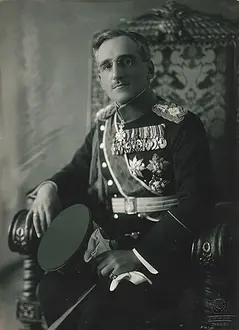
Regent of Serbia and the South Slav kingdom (1914–1921); king (1921–1934)
Alexander promoted a centralized Yugoslav national identity and imposed royal dictatorship in 1929, later retaining extensive royal powers under his 1931 constitution. He supported peasant land redistribution and sought security through France, the Little Entente and Balkan cooperation.
Closest ideologies
Based on the 45 statements where Alexander I of Yugoslavia has a known position.
- Falangism (90% match)
- Eurasianism (89% match)
- Neo-fascism (89% match)
- Russian imperialism (89% match)
- National Syndicalism (88% match)
Similar people
- Oliver Cromwell (90% alike)
- Vladislav Surkov (90% alike)
- Bashar al-Assad (89% alike)
- Wilhelm II (88% alike)
- Mohammed bin Salman Al Saud (88% alike)
Known positions
- Strongly: Someone who actually governs a state may hand that power on to their own child, whether as a king or as a republic's leader.
- Strongly: The leader should bypass parties and organised interest groups in dealing with the people.
- Strongly: The government should stop its political opponents from organising, speaking or competing for power.
- Strongly: It is acceptable for a monarch who inherits the throne to be the country's symbolic head while others govern.
- Strongly: The presence of people belonging to the same nation gives a state a legitimate territorial claim outside its borders.
- Strongly: The head of state should not have to be chosen by election.
- Strongly: The country would benefit from a strong leader with the power to act despite deadlock among its political institutions.
- Strongly: A national emergency sometimes justifies temporarily withdrawing normal legal safeguards against people the government regards as internal enemies, such as protections against detention without trial.
- Strongly: Real authority to command the military should rest with the head of state.
- Strongly: The farmers who work large estates should take ownership from the landowners, with the transfer compulsory if owners refuse.
- Strongly: Areas where an ethnic minority is the majority may be governed in the same way as the rest of the state.
- Strongly: Besides its directly elected parliament, a legislature should have a second chamber, such as a senate.
- Strongly: Property should belong to many people in small holdings.
- Strongly: Trade unions may be subject to state direction of their affairs.
- Strongly: The government should be able to require citizens to serve in the military.
- Strongly: A constitution does not have to be drafted by an assembly elected for that purpose.
- Strongly: Parties and offices should cut across religious lines.
- Strongly: Religious minorities should not be exempt from general laws that burden their practice.
- Strongly: Another body may have the final say over what the legislature passes.
- Strongly: A country may keep a region that wants to leave.
- Strongly: Schools should cultivate patriotic feeling: loyalty to and pride in the nation, expressed for example through respect for its flag and anthem.
- Strongly: A people split by an imposed border should be brought together in a single state.
- Strongly: Meeting poor people's needs should be the first consideration in public policy.
- Strongly: Farmers should have the legal freedom to leave the estates they work.
- Leans: Women's political rights may differ from men's.
- Leans: A ruler's unconstitutional acts do not give people a right to resist.
- Leans: The state should make one language the only common language of government, schooling and public life, limiting the use of others.
- Leans: The national parliament stays the final authority and can take powers back from the regions.
- Leans: The nation's figurehead should be non-partisan and belong to everyone.
- Leans: Democracy is not the best form of government when voters choose badly.
- Leans: Marriage, inheritance and family law may differ between religious communities.
- Leans: Many political decisions should rest with national or wider authorities, even where a smaller community could handle them.
- Leans: A country has the right to stop a region becoming independent by using its military.
- Leans: Political power may be concentrated in one body.
- Leans: Government should not be bound by a written bill of rights protected against easy amendment by ordinary majorities.
- Leans: Some institutional ties between government and religion are acceptable.
- Leans: Cultural life inside a state should not be placed under the control of each national minority.
- Leans: The government should steer investment into industries it sees as key to the country's future.
- Leans: People who give their lives for the nation deserve to be remembered as martyrs, with reverence beyond ordinary thanks.
- Leans: Naturalized citizens may hold public office as well as people born in the country.
- Leans: The law should treat everyone as an equal, whatever their birth, sex, race or status.