Political Ideology Atlas · All people · Take the test
Europe · born -62, historical
Augustus
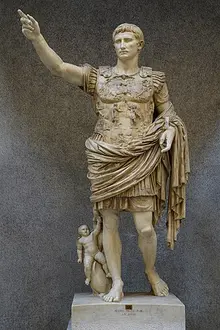
First Roman emperor (27 BC–AD 14)
Augustus ended the civil wars and built a monarchy in republican dress, keeping the Senate and magistracies while holding the army and decisive powers himself. He presented his rule as a restoration of ancestral custom, backing it with religious revival, marriage and morals laws, and a permanent professional army. He expanded the empire widely but left advice to keep it within existing limits.
Closest ideologies
Based on the 57 statements where Augustus has a known position.
- Integral nationalism (88% match)
- Maurrassisme (88% match)
- Corporate statism (88% match)
- Neo-fascism (88% match)
- Integralismo Lusitano (88% match)
Similar people
- Nicholas II of Russia (92% alike)
- Stephen Miller (89% alike)
- Otto von Bismarck (89% alike)
- James VI and I (89% alike)
- Napoleon (88% alike)
Known positions
- Strongly: A weaker state should openly acknowledge a stronger power as its superior.
- Strongly: The law may treat people differently according to such things as birth, sex, race and status.
- Strongly: A powerful country should bring more land within its borders.
- Strongly: Special ranks held by birth, such as noble titles and hereditary crowns, may continue to exist.
- Strongly: Real authority to command the military should rest with the head of state.
- Strongly: My country's military strength should exceed that of its rivals.
- Strongly: Religious values and institutions should shape laws, schools and public life.
- Strongly: A woman who has sex outside marriage is doing something wrong.
- Strongly: Some institutional ties between government and religion are acceptable.
- Strongly: Foreign powers sometimes have a right to intervene in a country's internal affairs.
- Strongly: The state should give families money to have more children, such as through payments and tax breaks.
- Strongly: The government should be able to require citizens to serve in the military.
- Strongly: Armed forces may sometimes be used for purposes beyond defending the country against attack.
- Strongly: Defense should not rest with armed ordinary citizens in place of a standing force.
- Strongly: Government should rely at least as much on legal enforcement as on its rulers' moral example.
- Strongly: A healthy society depends on the traditional family, such as a married mother and father raising their children.
- Strongly: The state may restrict what adults do for reasons other than preventing harm to others.
- Strongly: Population growth may be left to run its course.
- Strongly: Political violence is sometimes justified.
- Strongly: Being the first to use force can be right, depending on what it is meant to achieve.
- Strongly: Keeping a nation's inherited culture alive, including its language, customs and traditions, matters.
- Strongly: Marriage should retain legal recognition.
- Strongly: Society needs government of some kind.
- Strongly: Countries should keep their armed forces.
- Strongly: Government should have other tasks besides protecting people from physical violence.
- Strongly: Museums, libraries and other inherited culture should not be destroyed, even when they stand in the way of new creation.
- Leans: The person holding the highest state office should be treated as holy.
- Leans: Someone who actually governs a state may hand that power on to their own child, whether as a king or as a republic's leader.
- Leans: Having a shared national identity does not by itself entitle a people to its own self-governing state.
- Leans: A person's sex should affect the public roles legally assigned to them.
- Leans: Recovering how society used to be matters more than moving forward.
- Leans: The national church is recognised in law above other religions.
- Leans: The head of state should not have to be chosen by election.
- Leans: The country would benefit from a strong leader with the power to act despite deadlock among its political institutions.
- Leans: A national emergency sometimes justifies temporarily withdrawing normal legal safeguards against people the government regards as internal enemies, such as protections against detention without trial.
- Leans: Changes to society should be introduced a little at a time.
- Leans: Whether citizens may see government information can be left to the government to decide.
- Leans: A president should be free to stand for re-election as many times as they like.
- Leans: Only the state's armed forces and police should have permission to carry weapons.
- Leans: Rich people have an obligation to help those worse off than they are.
- Leans: Countries should maintain only the weapons needed for national safety.
- Leans: The worst crimes can be punished by death.
- Leans: Ending a marriage should not be possible without proving fault.
- Leans: What you owe your community matters more than your personal rights.
- Leans: Government should take sides on how people live, backing the ways of life it judges good.
- Leans: Religious institutions should be independent of government direction in their internal affairs.
- Leans: The ruler should be subject to the country's laws.
- Leans: Where they conflict, religious faith should count for at least as much as evidence and reasoning.
- Leans: Society need not promote ways of living that differ from custom.
- Leans: Constantly seeking additional possessions is harmful overall, despite any benefits it brings.