Political Ideology Atlas · All people · Take the test
North America · born 1959
Robert Barron
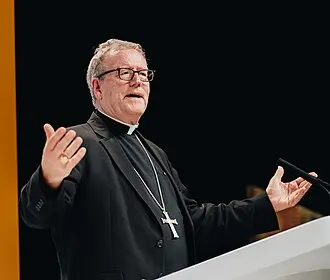
American Catholic bishop of Winona-Rochester and founder of Word on Fire
Barron advocates a market economy bounded by moral duties, public welfare and dispersed political and economic power. He defends religious participation and conscience protections while rejecting an established state religion. His public interventions oppose abortion, assisted suicide and gender-transition policies, while supporting racial justice and qualified border enforcement.
Closest ideologies
Based on the 54 statements where Robert Barron has a known position.
- Catholic social teaching (94% match)
- Christian Democracy (93% match)
- Neo-Thomism (91% match)
- New Confucianism (91% match)
- Islamic modernism (90% match)
Similar people
- John Paul II (93% alike)
- Benedict XVI (91% alike)
- Pius XII (90% alike)
- Péter Magyar (89% alike)
- Herbert Hoover (89% alike)
Known positions
- Strongly: Believers can be excused from rules, such as dress or work-day rules, that conflict with their faith.
- Strongly: Private businesses and markets should run most of the economy, while the government supports people who cannot meet their basic needs.
- Strongly: People do not have full ownership of their own bodies.
- Strongly: The state should be barred from executing people convicted of the gravest crimes, such as terrorism.
- Strongly: Businesses should be legally barred from agreements with competitors to suppress competition, such as fixing prices.
- Strongly: Rich people have an obligation to help those worse off than they are.
- Strongly: Political power should be split among separate branches and levels that can each limit the others.
- Strongly: Religious values and institutions should shape laws, schools and public life.
- Strongly: Abortion should be illegal in most cases.
- Strongly: Society should take active steps to make up for the harm done by past racial injustices.
- Strongly: Ideas of what men and women are like do not come mostly from culture.
- Strongly: At least some religious leadership offices should have different eligibility rules for women than for men.
- Strongly: Human rights come from the nature that all human beings share.
- Strongly: Public monuments honouring widely condemned historical figures should stay publicly displayed rather than be removed from display.
- Strongly: Some things are right or wrong for everyone, in every culture and era.
- Strongly: Nature matters for its own sake, not only because it is useful to people.
- Strongly: The law may forbid medical help for terminally ill adults who want to end their lives.
- Strongly: Profit made from owning businesses does not come from exploiting the workers who produce it.
- Strongly: In law, a country's traditional national church should rank no higher than other religious bodies.
- Strongly: Where they conflict, religious faith should count for at least as much as evidence and reasoning.
- Strongly: Publicly honouring a national leader as the personification of the nation is not acceptable.
- Strongly: Population growth may be left to run its course.
- Strongly: Private ownership is legitimate only insofar as it benefits society.
- Strongly: Very large concentrations of wealth threaten a free society.
- Strongly: Politics should support people's spiritual well-being.
- Strongly: The government should let its political opponents organise, speak and compete for power.
- Strongly: The law should treat everyone as an equal, whatever their birth, sex, race or status.
- Strongly: Classifying people by sex tracks differences that exist whatever society says.
- Strongly: No party's ideology should give it an exclusive right to lead the state.
- Strongly: Countries may keep controls on who enters and settles, even in the long run.
- Strongly: Some areas of life should remain outside state direction.
- Strongly: Government should have other tasks besides protecting people from physical violence.
- Strongly: Collecting taxes does not in itself amount to stealing people's money.
- Strongly: Killing another person can be right in self-defence or in defence of others.
- Leans: Looking after your own interests is right, not just allowed.
- Leans: Publicly funded services such as hospitals and schools should be run by private companies and charities as well as the state.
- Leans: Judge policies by what they achieve, independently of whether they match an ideology.
- Leans: Force is for self-defence alone.
- Leans: Working together internationally should count at least as much as my country's own priorities.
- Leans: Property should belong to many people in small holdings.
- Leans: Technology will not solve most of humanity's problems.
- Leans: Political decisions should rest with the smallest local community able to handle them, with wider authorities handling matters that need a wider reach.
- Leans: Democracy is best even when voters make poor choices.
- Leans: Firms in a market economy need not be owned by the people who work in them.
- Leans: A healthy society depends on the traditional family, such as a married mother and father raising their children.
- Leans: The state may restrict what adults do for reasons other than preventing harm to others.
- Leans: Art should not be censored for its effect on people's moral character.
- Leans: Keeping a nation's inherited culture alive, including its language, customs and traditions, matters.
- Leans: Whatever their circumstances, everyone should be able to count on the state for enough to live decently, through benefits, pensions or public services.
- Leans: Businesses gain too much influence over government policy from their lobbying.