Political Ideology Atlas · All ideologies · Take the test
Christian Democracy
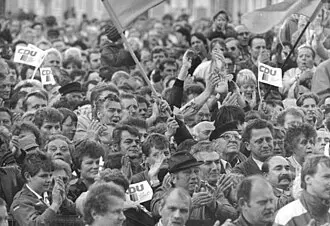
Christian democracy is the political tradition that grew from Catholic social teaching (Rerum novarum, called its Magna Charta, and Quadragesimo anno) and from Dutch neo-Calvinism (Kuyper), with Sturzo's popularism and Maritain's personalism as its philosophers. It holds that the person and the family come before the state, that property is a natural right bound to the common good, that classes should cooperate and workers organize, that subsidiarity limits every higher body, and that democracy rests on natural rights and conscience. It is socially conservative on family and life questions.
What it stands for
- God is the ultimate source of the right to exercise political authority.
- Owners' rights to their property should almost never be overridden, even for public goals.
- Rich people have an obligation to help those worse off than they are.
- Property should belong to many people in small holdings.
- Government should serve people's good while respecting each person as more than an instrument of the state or community.
- Political decisions should rest with the smallest local community able to handle them, with wider authorities handling matters that need a wider reach.
Key figures
- Luigi Sturzo: Italian priest who founded the Italian People's Party and developed popularism.
- Jacques Maritain: Philosopher of integral humanism and personalism whose ideas shaped post-war Christian democracy.
- Abraham Kuyper: Dutch neo-Calvinist theologian and statesman who developed sphere sovereignty.
Closest ideologies
- Christian corporatism (92% match)
- Catholic social teaching (92% match)
- Neo-Thomism (91% match)
- Distributism (90% match)
- Neo-Ottomanism (90% match)
People closest to it
- Robert Barron (93% alike)
- John Paul II (90% alike)
- Marcus Aurelius (89% alike)
- Santiago Peña Palacios (89% alike)
- Pius XII (89% alike)
Key positions
- Strongly: God is the ultimate source of the right to exercise political authority.
- Strongly: Owners' rights to their property should almost never be overridden, even for public goals.
- Strongly: Rich people have an obligation to help those worse off than they are.
- Strongly: Property should belong to many people in small holdings.
- Strongly: Government should serve people's good while respecting each person as more than an instrument of the state or community.
- Strongly: Political decisions should rest with the smallest local community able to handle them, with wider authorities handling matters that need a wider reach.
- Strongly: One worker's pay should cover the living needs of that worker's family, including the worker.
- Strongly: Human rights come from the nature that all human beings share.
- Strongly: Employers and workers should treat each other as partners whose cooperation comes before conflict, even where their interests differ.
- Strongly: Religious institutions should be independent of government direction in their internal affairs.
- Strongly: Workers are better off for having labor unions.
- Strongly: The people who own the economy and hold power are not the ones the state mainly serves.
- Strongly: Meeting poor people's needs should be the first consideration in public policy.
- Strongly: The government should let its political opponents organise, speak and compete for power.
- Strongly: Groups have rights of their own.
- Strongly: The law should treat everyone as an equal, whatever their birth, sex, race or status.
- Strongly: No party's ideology should give it an exclusive right to lead the state.
- Strongly: Religious conversion should be free of legal restriction.
- Strongly: Some areas of life should remain outside state direction.
- Strongly: Adults may marry across religions without legal restriction.
- Strongly: Society needs government of some kind.
- Strongly: The ruler should be subject to the country's laws.
- Strongly: Government should have other tasks besides protecting people from physical violence.
- Strongly: Collecting taxes does not in itself amount to stealing people's money.
- Strongly: Voting should not be limited to members of one ethnic group.
- Strongly: People without property should also have the right to vote.
- Strongly: State schools need not steer pupils away from belief in God.
- Strongly: Public spaces such as schools and facilities should not be separated by race under the law.
- Strongly: Final authority over a state's laws need not belong to its most senior religious scholars.
- Strongly: People must be free to leave their religion without legal penalty.
- Strongly: Suspected drug dealers should never be put to death without a trial.
- Strongly: Farmers should have the legal freedom to leave the estates they work.
- Leans: It is acceptable for a monarch who inherits the throne to be the country's symbolic head while others govern.
- Leans: Countries should hand part of their decision-making power to a union of nations, such as the European Union.
- Leans: A country's constitution should not automatically take precedence over international law.
- Leans: Working together internationally should count at least as much as my country's own priorities.
- Leans: State schools may teach pupils a religious faith, for example through lessons in its beliefs and practice.
- Leans: The worst crimes can be punished by death.
- Leans: Ending a marriage should not be possible without proving fault.
- Leans: Abortion should be illegal in most cases.
- Leans: The government should be able to require citizens to serve in the military.
- Leans: A law imposes no moral duty to obey it if the law is unjust.
- Leans: A healthy society depends on the traditional family, such as a married mother and father raising their children.
- Leans: Rulers must act under lasting, publicly known laws administered by recognised courts.
- Leans: Women should be able to vote and stand for office on the same terms as men.
- Leans: The state may restrict what adults do for reasons other than preventing harm to others.
- Leans: Rulers have a right to rule only because the people they rule have agreed to it.
- Leans: Very large concentrations of wealth threaten a free society.