Political Ideology Atlas · All people · Take the test
North America · born 1874, historical
Herbert Hoover
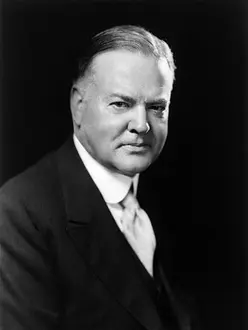
31st US president (1929–1933); Secretary of Commerce (1921–1928); relief administrator
Republican president and former engineer who described his outlook as American individualism: equality of opportunity, voluntary cooperation, regulation to prevent domination, and a refusal to put government into commercial business. He backed protective tariffs and immigration limits, signed the Smoot-Hawley tariff and founded the Reconstruction Finance Corporation, and after 1933 attacked the New Deal as regimentation.
Closest ideologies
Based on the 74 statements where Herbert Hoover has a known position.
- Progressive conservatism (92% match)
- Nigerian nationalism (91% match)
- New Confucianism (91% match)
- Centrism (90% match)
- Radical Centrism (90% match)
Similar people
- Calvin Coolidge (91% alike)
- Warren G. Harding (90% alike)
- James Madison (90% alike)
- Alexis de Tocqueville (89% alike)
- Robert Barron (89% alike)
Known positions
- Strongly: Free citizens need the freedom to own property, trade and choose work, or political freedom cannot last.
- Strongly: The government may leave it to investors to decide which industries receive investment.
- Strongly: At least some unjust laws impose a moral duty of obedience.
- Strongly: Industries such as energy, rail and utilities do not need to be publicly owned.
- Strongly: Communist one-party regimes should be condemned as severely as fascist regimes.
- Strongly: Taxes on imports should shield domestic producers from foreign competition.
- Strongly: Countries should maintain only the weapons needed for national safety.
- Strongly: Political power should be split among separate branches and levels that can each limit the others.
- Strongly: The Soviet economy was not capitalism under state ownership with the state in place of private capitalists.
- Strongly: Government should serve people's good while respecting each person as more than an instrument of the state or community.
- Strongly: Political decisions should rest with the smallest local community able to handle them, with wider authorities handling matters that need a wider reach.
- Strongly: Governments should not borrow heavily, spending much more than they collect in taxes, to boost the economy.
- Strongly: The country should impose strict limits on immigration.
- Strongly: Employers and workers should treat each other as partners whose cooperation comes before conflict, even where their interests differ.
- Strongly: The people who own the economy and hold power are not the ones the state mainly serves.
- Strongly: Nobody should hold a special rank by birth, such as a noble title, a hereditary crown or a caste position, or the special rights attached to one.
- Strongly: Wages need not be set through negotiating bodies that the state officially recognizes.
- Strongly: Being the law gives a rule a moral claim to be obeyed.
- Strongly: Equality of outcomes should not be society's goal.
- Strongly: Restoring a lost social order does not matter more than pursuing progress.
- Strongly: Politics should support people's spiritual well-being.
- Strongly: An economy directed by a central plan is not capable of working better than one directed by market exchange.
- Strongly: War does not strengthen a nation's character.
- Strongly: Being powerful does not mean a country should bring more land within its borders.
- Strongly: The government should let its political opponents organise, speak and compete for power.
- Strongly: Someone who actually governs a state should not hand that power on to their own child.
- Strongly: Religion does not offer illusory comfort for material suffering.
- Strongly: News media should decide for themselves what they publish, whoever holds power.
- Strongly: Central banks should keep a role in controlling the money supply.
- Strongly: Industrial society has done at least as much good as harm to humanity.
- Strongly: Some areas of life should remain outside state direction.
- Strongly: A workers' state does not need to suppress the old ruling class, even for a time.
- Strongly: Police forces should continue to exist.
- Strongly: Society needs government of some kind.
- Strongly: Countries should keep their armed forces.
- Strongly: The ruler should be subject to the country's laws.
- Strongly: Government should have other tasks besides protecting people from physical violence.
- Strongly: Collecting taxes does not in itself amount to stealing people's money.
- Strongly: The holder of the highest state office need not be treated as holy.
- Leans: Individuals hold rights; groups have no rights of their own beyond the rights of their members.
- Leans: Some people are better suited by nature to govern.
- Leans: The pursuit of ever more possessions does not cause more harm than good overall.
- Leans: Voluntary charitable help does a better job of helping people in poverty than government aid does.
- Leans: Specialists should have more weight in decisions than public opinion.
- Leans: Prices and competition generally decide better than officials what gets made and who gets it.
- Leans: Changes to society should be introduced a little at a time.
- Leans: Those who inherit a large fortune should hand over a big share of it in tax.
- Leans: The political goal should be victory over communism ahead of accommodation with it.
- Leans: Failing companies should not always be left to fail.
- Leans: Outside governments have no entitlement to interfere in another country's internal affairs for any purpose.
- Leans: People may want more than the fewest material things possible.
- Leans: Businesses should be legally barred from agreements with competitors to suppress competition, such as fixing prices.
- Leans: Farmers should not be given state protection against swings in the prices they receive.
- Leans: Capitalism is not bound to suffer a general collapse.
- Leans: Rich people have an obligation to help those worse off than they are.
- Leans: High earners and the very rich should pay tax at a much higher rate than everyone else.
- Leans: My country may keep a military no stronger than its rivals'.
- Leans: Capitalism built the productive power and wealth that later and better societies rest on.
- Leans: Human rights come from the nature that all human beings share.
- Leans: Government should impose strict rules on how corporations operate.
- Leans: Free trade does not benefit everyone in the long run.
- Leans: A country can get through deadlock among its institutions without a leader who overrides them.
- Leans: Owners' rights to their property need not be protected against being overridden for public goals.
- Leans: Where they conflict, religious faith should count for at least as much as evidence and reasoning.
- Leans: Being free requires having the practical resources to act on one's choices, such as an adequate livelihood.
- Leans: Private ownership is legitimate only insofar as it benefits society.
- Leans: Member states should keep the final decision on whether to follow UN decisions.
- Leans: Very large concentrations of wealth threaten a free society.
- Leans: A people with a shared national identity is entitled to its own self-governing state.
- Leans: The law should treat everyone as an equal, whatever their birth, sex, race or status.