Political Ideology Atlas · All people · Take the test
Europe · born 1876, historical
Pius XII
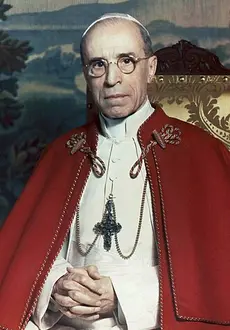
Pope of the Roman Catholic Church 1939-1958 (born Eugenio Pacelli, 1876-1958)
Pius XII taught that State authority is bounded by natural law, that the human race is one, that wars of aggression must be banned by an international authority with real power, and that the Church accepts any form of government capable of securing the common good, including democracy; he condemned relativism and polygenism.
Closest ideologies
Based on the 33 statements where Pius XII has a known position.
- Catholic social teaching (90% match)
- Christian humanism (89% match)
- Christian Democracy (89% match)
- Popolarismo (88% match)
- Distributism (88% match)
Similar people
- John Paul II (94% alike)
- Benedict XVI (91% alike)
- Robert Barron (90% alike)
- Óscar Romero (90% alike)
- Leo XIV (89% alike)
Known positions
- Strongly: The UN should have authority to compel member states to comply with its decisions.
- Strongly: Countries should hand part of their decision-making power to a union of nations, such as the European Union.
- Strongly: A country's constitution should not automatically take precedence over international law.
- Strongly: Force is for self-defence alone.
- Strongly: Rich people have an obligation to help those worse off than they are.
- Strongly: Inherited religious teachings may stay as handed down, without being rethought for present conditions.
- Strongly: Property should belong to many people in small holdings.
- Strongly: Abortion should be illegal in most cases.
- Strongly: Some institutional ties between government and religion are acceptable.
- Strongly: Government should serve people's good while respecting each person as more than an instrument of the state or community.
- Strongly: One worker's pay should cover the living needs of that worker's family, including the worker.
- Strongly: Some things are right or wrong for everyone, in every culture and era.
- Strongly: The law may forbid medical help for terminally ill adults who want to end their lives.
- Strongly: Religious institutions should be independent of government direction in their internal affairs.
- Strongly: Workers are better off for having labor unions.
- Strongly: A healthy society depends on the traditional family, such as a married mother and father raising their children.
- Strongly: Private ownership is legitimate only insofar as it benefits society.
- Strongly: The law should treat everyone as an equal, whatever their birth, sex, race or status.
- Strongly: Some areas of life should remain outside state direction.
- Strongly: Society needs government of some kind.
- Strongly: The ruler should be subject to the country's laws.
- Strongly: Public policy should not be used to reduce the passing on of inherited disabilities.
- Leans: Owners' rights to their property should almost never be overridden, even for public goals.
- Leans: A national minority should run its own schools, language and cultural institutions inside the state it lives in.
- Leans: Full-time work at the legal wage floor should pay enough to meet basic living costs.
- Leans: A national church need not be ruled by its bishops.
- Leans: A country can get through deadlock among its institutions without a leader who overrides them.
- Leans: Where they conflict, religious faith should count for at least as much as evidence and reasoning.
- Leans: Keeping a nation's inherited culture alive, including its language, customs and traditions, matters.
- Leans: Whatever their circumstances, everyone should be able to count on the state for enough to live decently, through benefits, pensions or public services.
- Leans: A people with a shared national identity is entitled to its own self-governing state.