Political Ideology Atlas · All people · Take the test
Europe · born 1920, historical
John Paul II
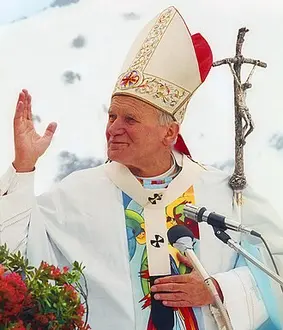
Pope of the Catholic Church (1978-2005)
John Paul II held strongly traditional views on life, family, sexual morality and church order, while his social teaching criticized both Marxist collectivism and unbridled capitalism. He defended workers' rights, unions, the universal destination of goods and a preferential love for the poor, opposed communism and totalitarianism, backed human rights and the rights of nations, and opposed war, notably the 2003 Iraq invasion.
Closest ideologies
Based on the 103 statements where John Paul II has a known position.
- Catholic social teaching (92% match)
- Christian Democracy (90% match)
- Christian humanism (90% match)
- Popolarismo (89% match)
- Distributism (88% match)
Similar people
- Pius XII (94% alike)
- Robert Barron (93% alike)
- Benedict XVI (92% alike)
- Leo XIV (88% alike)
- Óscar Romero (88% alike)
Known positions
- Strongly: Working together internationally should count at least as much as my country's own priorities.
- Strongly: Distance and nationality do not weaken the duty of the rich to help the poor abroad.
- Strongly: Trade unions should control their own affairs without state direction.
- Strongly: Rich people have an obligation to help those worse off than they are.
- Strongly: Countries should maintain only the weapons needed for national safety.
- Strongly: Inherited religious teachings may stay as handed down, without being rethought for present conditions.
- Strongly: Religious values and institutions should shape laws, schools and public life.
- Strongly: Ending a marriage should not be possible without proving fault.
- Strongly: Abortion should be illegal in most cases.
- Strongly: A woman who has sex outside marriage is doing something wrong.
- Strongly: Government should serve people's good while respecting each person as more than an instrument of the state or community.
- Strongly: The foreign debts of poor countries should be written off, ending their obligation to repay them.
- Strongly: A law imposes no moral duty to obey it if the law is unjust.
- Strongly: Some knowledge is neutral.
- Strongly: One worker's pay should cover the living needs of that worker's family, including the worker.
- Strongly: At least some religious leadership offices should have different eligibility rules for women than for men.
- Strongly: Human rights come from the nature that all human beings share.
- Strongly: Some things are right or wrong for everyone, in every culture and era.
- Strongly: Employers and workers should treat each other as partners whose cooperation comes before conflict, even where their interests differ.
- Strongly: The law may forbid medical help for terminally ill adults who want to end their lives.
- Strongly: A country should not be ready to use military force abroad without UN Security Council authorization.
- Strongly: Religious institutions should be independent of government direction in their internal affairs.
- Strongly: Profit made from owning businesses does not come from exploiting the workers who produce it.
- Strongly: Workers are better off for having labor unions.
- Strongly: Where they conflict, religious faith should count for at least as much as evidence and reasoning.
- Strongly: A healthy society depends on the traditional family, such as a married mother and father raising their children.
- Strongly: The law should not extend marriage to same-sex couples.
- Strongly: Religion has not been a leading cause of women being kept in a lower position.
- Strongly: Meeting poor people's needs should be the first consideration in public policy.
- Strongly: Constantly seeking additional possessions is harmful overall, despite any benefits it brings.
- Strongly: Public institutions should have the power to constrain a national majority's decisions in a liberal democracy.
- Strongly: Spouses should make marital decisions as equals.
- Strongly: Population growth may be left to run its course.
- Strongly: Trade, finance and debt rules should be changed to give poorer countries a fairer share.
- Strongly: Other forces move history at least as much as conflict between classes does.
- Strongly: Private ownership is legitimate only insofar as it benefits society.
- Strongly: Politics should support people's spiritual well-being.
- Strongly: An economy directed by a central plan is not capable of working better than one directed by market exchange.
- Strongly: War does not strengthen a nation's character.
- Strongly: Being powerful does not mean a country should bring more land within its borders.
- Strongly: Groups have rights of their own.
- Strongly: The law should treat everyone as an equal, whatever their birth, sex, race or status.
- Strongly: Religion does not offer illusory comfort for material suffering.
- Strongly: We have a duty to leave the planet in good condition for those who come after us.
- Strongly: Keeping a nation's inherited culture alive, including its language, customs and traditions, matters.
- Strongly: Population growth does not mainly drive lasting poverty.
- Strongly: Some areas of life should remain outside state direction.
- Strongly: Marriage should retain legal recognition.
- Strongly: A workers' state does not need to suppress the old ruling class, even for a time.
- Strongly: Society needs government of some kind.
- Strongly: The ruler should be subject to the country's laws.
- Strongly: Government should have other tasks besides protecting people from physical violence.
- Strongly: Public policy should not be used to reduce the passing on of inherited disabilities.
- Strongly: Great powers should have no right to send troops against allied governments' wishes for the purpose of preserving those countries' political systems.
- Strongly: Killing another person can be right in self-defence or in defence of others.
- Strongly: State schools need not steer pupils away from belief in God.
- Strongly: Suspected drug dealers should never be put to death without a trial.
- Leans: Violence is never an acceptable way to pursue political goals.
- Leans: The UN should have authority to compel member states to comply with its decisions.
- Leans: Countries should hand part of their decision-making power to a union of nations, such as the European Union.
- Leans: Western political institutions are suitable for every civilization.
- Leans: Prices and competition generally decide better than officials what gets made and who gets it.
- Leans: Private businesses and markets should run most of the economy, while the government supports people who cannot meet their basic needs.
- Leans: Force is for self-defence alone.
- Leans: The political goal should be victory over communism ahead of accommodation with it.
- Leans: The Soviet economy was capitalist under state ownership, with the state taking the place of private capitalists.
- Leans: Industries such as energy, rail and utilities do not need to be publicly owned.
- Leans: The state should be barred from executing people convicted of the gravest crimes, such as terrorism.
- Leans: Speaking a common language is sufficient for people to constitute one nation.
- Leans: The state should offer public work to anyone who wants a job and cannot find one.
- Leans: Employees should have voting rights in the management of large companies.
- Leans: Wage work cuts people off from the meaning and creativity of what they make.
- Leans: Businesses should belong to the people who work in them, for example as cooperatives.
- Leans: Housework and care at home count as work and deserve wages.
- Leans: Prisons should mainly help offenders rejoin society.
- Leans: Politics should prioritise a single common good identified by reasoning over compromises among organised interests.
- Leans: The global economic system keeps poorer countries poor by directing their wealth toward richer countries.
- Leans: Some institutional ties between government and religion are acceptable.
- Leans: Laws, institutions and customs still favor men over women.
- Leans: School curricula should exclude sex education.
- Leans: People should want as few material things as possible.
- Leans: Technology will not solve most of humanity's problems.
- Leans: Political decisions should rest with the smallest local community able to handle them, with wider authorities handling matters that need a wider reach.
- Leans: Democracy is best even when voters make poor choices.
- Leans: Workers' pay should be settled in collective bargaining between their union and their employer.
- Leans: Courts need not be handed over to private businesses.
- Leans: Taking part in politics is at least as good a way to live as living privately away from public affairs.
- Leans: Government should impose strict rules on how corporations operate.
- Leans: Public institutions should help minority languages be used in public life, for example through teaching or services in those languages.
- Leans: Firms in a market economy need not be owned by the people who work in them.
- Leans: The law should impose no restrictions on strikes.
- Leans: People should have a direct role in making decisions where they work, live and study, rather than having those decisions made entirely for them.
- Leans: Women should be able to vote and stand for office on the same terms as men.
- Leans: Being the law gives a rule a moral claim to be obeyed.
- Leans: Whatever their circumstances, everyone should be able to count on the state for enough to live decently, through benefits, pensions or public services.
- Leans: Looking after your own interests is not a moral good in itself.
- Leans: Income from useful work should be rewarded ahead of income from merely owning property.
- Leans: A people with a shared national identity is entitled to its own self-governing state.
- Leans: Laws should not be required to follow religious texts.
- Leans: Poor countries should retain economic ties with rich countries.