Political Ideology Atlas · All people · Take the test
Europe · born 1927, historical
Benedict XVI
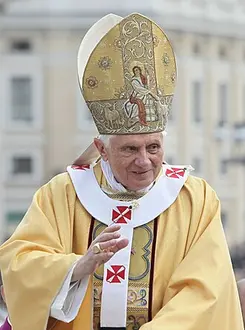
Pope of the Roman Catholic Church 2005-2013 (born Joseph Ratzinger, 1927-2022)
Benedict XVI taught that the economy needs ethics and a world authority with real powers, honoured workers' associations, opposed abortion and euthanasia, defined the family as marriage between a man and a woman, and defended a public role for religion while saying the Church cannot replace the State.
Closest ideologies
Based on the 36 statements where Benedict XVI has a known position.
- Catholic social teaching (91% match)
- Christian humanism (91% match)
- Nordic Social Democracy (91% match)
- Maternal feminism (91% match)
- Communitarianism (90% match)
Similar people
- John Paul II (92% alike)
- Pius XII (91% alike)
- Robert Barron (91% alike)
- Soong May-ling (90% alike)
- Leo XIV (89% alike)
Known positions
- Strongly: The UN should have authority to compel member states to comply with its decisions.
- Strongly: Working together internationally should count at least as much as my country's own priorities.
- Strongly: Distance and nationality do not weaken the duty of the rich to help the poor abroad.
- Strongly: Countries should maintain only the weapons needed for national safety.
- Strongly: Religious values and institutions should shape laws, schools and public life.
- Strongly: Abortion should be illegal in most cases.
- Strongly: Foreign powers sometimes have a right to intervene in a country's internal affairs.
- Strongly: Technology will not solve most of humanity's problems.
- Strongly: Military intervention abroad is sometimes necessary to protect human rights.
- Strongly: A law imposes no moral duty to obey it if the law is unjust.
- Strongly: Human rights come from the nature that all human beings share.
- Strongly: Some things are right or wrong for everyone, in every culture and era.
- Strongly: The law may forbid medical help for terminally ill adults who want to end their lives.
- Strongly: Workers are better off for having labor unions.
- Strongly: A healthy society depends on the traditional family, such as a married mother and father raising their children.
- Strongly: The law should not extend marriage to same-sex couples.
- Strongly: Constantly seeking additional possessions is harmful overall, despite any benefits it brings.
- Strongly: Public institutions should have the power to constrain a national majority's decisions in a liberal democracy.
- Strongly: The law should treat everyone as an equal, whatever their birth, sex, race or status.
- Strongly: Laws should not be required to follow religious texts.
- Strongly: We have a duty to leave the planet in good condition for those who come after us.
- Strongly: Society needs government of some kind.
- Strongly: The ruler should be subject to the country's laws.
- Strongly: Final authority over a state's laws need not belong to its most senior religious scholars.
- Leans: Voluntary charitable help does a better job of helping people in poverty than government aid does.
- Leans: Countries should hand part of their decision-making power to a union of nations, such as the European Union.
- Leans: Some institutional ties between government and religion are acceptable.
- Leans: Democracy is best even when voters make poor choices.
- Leans: Government should impose strict rules on how corporations operate.
- Leans: Some cultures are superior to others.
- Leans: Employers and workers should treat each other as partners whose cooperation comes before conflict, even where their interests differ.
- Leans: Religious institutions should be independent of government direction in their internal affairs.
- Leans: Rulers must act under lasting, publicly known laws administered by recognised courts.
- Leans: Very large concentrations of wealth threaten a free society.
- Leans: Keeping a nation's inherited culture alive, including its language, customs and traditions, matters.