Political Ideology Atlas · All ideologies · Take the test
Neo-Thomism
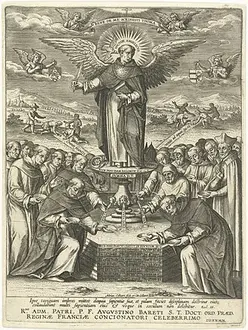
Neo-Thomism is the revival of Thomas Aquinas's philosophy that Leo XIII launched in 1879, and its political side rests on natural law, a common good ordered by reason, and the dignity of the person. Its adherents defend private property and the family against socialism, urge cooperation between capital and labour, and hold that authority comes ultimately from God and is limited by law. In Maritain's version it supports a pluralist democracy with human rights and cooperation between Church and state in separate spheres.
What it stands for
- God is the ultimate source of the right to exercise political authority.
- A woman who has sex outside marriage is doing something wrong.
- Government should serve people's good while respecting each person as more than an instrument of the state or community.
- A law imposes no moral duty to obey it if the law is unjust.
- Some knowledge is neutral.
- Human rights come from the nature that all human beings share.
Key figures
- Jacques Maritain: Leading Neo-Thomist political philosopher, author of Integral Humanism and Man and the State.
- Leo XIII: Pope whose Aeterni Patris (1879) launched the Thomist revival and whose Rerum Novarum (1891) set out its social teaching.
Closest ideologies
- Christian corporatism (91% match)
- Catholic social teaching (91% match)
- Christian Democracy (91% match)
- Neo-Ottomanism (90% match)
- Islamic modernism (90% match)
People closest to it
- Robert Barron (91% alike)
- George H. W. Bush (88% alike)
- Benedict XVI (88% alike)
- Herbert Hoover (88% alike)
- Alexis de Tocqueville (87% alike)
Key positions
- Strongly: God is the ultimate source of the right to exercise political authority.
- Strongly: A woman who has sex outside marriage is doing something wrong.
- Strongly: Government should serve people's good while respecting each person as more than an instrument of the state or community.
- Strongly: A law imposes no moral duty to obey it if the law is unjust.
- Strongly: Some knowledge is neutral.
- Strongly: Human rights come from the nature that all human beings share.
- Strongly: Some things are right or wrong for everyone, in every culture and era.
- Strongly: People are entitled to resist a ruler's unconstitutional exercise of power.
- Strongly: Some cultures are superior to others.
- Strongly: Employers and workers should treat each other as partners whose cooperation comes before conflict, even where their interests differ.
- Strongly: The law may forbid medical help for terminally ill adults who want to end their lives.
- Strongly: Religious institutions should be independent of government direction in their internal affairs.
- Strongly: Profit made from owning businesses does not come from exploiting the workers who produce it.
- Strongly: Where they conflict, religious faith should count for at least as much as evidence and reasoning.
- Strongly: The people who own the economy and hold power are not the ones the state mainly serves.
- Strongly: A healthy society depends on the traditional family, such as a married mother and father raising their children.
- Strongly: The law should not extend marriage to same-sex couples.
- Strongly: Religion has not been a leading cause of women being kept in a lower position.
- Strongly: Publicly honouring a national leader as the personification of the nation is not acceptable.
- Strongly: Historical change does not come mainly from changes in how society produces and exchanges goods.
- Strongly: Public institutions should have the power to constrain a national majority's decisions in a liberal democracy.
- Strongly: Families may keep the main responsibility for housework and childcare.
- Strongly: A person's right to hold land need not end when they stop using it.
- Strongly: Being the law gives a rule a moral claim to be obeyed.
- Strongly: The existing governing institutions should be retained, even if their personnel, policies or procedures change.
- Strongly: Other forces move history at least as much as conflict between classes does.
- Strongly: The great religions need not share a single underlying truth.
- Strongly: Politics should support people's spiritual well-being.
- Strongly: The government should let its political opponents organise, speak and compete for power.
- Strongly: The leader should not bypass political intermediaries in dealing with the people.
- Strongly: Individual farms should not give way to joint cultivation by groups of farmers.
- Strongly: The law should treat everyone as an equal, whatever their birth, sex, race or status.
- Strongly: Being the first to use force can be right, depending on what it is meant to achieve.
- Strongly: An armed minority's actions are incapable of bringing about the conditions for a broader revolutionary uprising.
- Strongly: Workers do not need a disciplined revolutionary party to lead them.
- Strongly: Minority groups are not, as groups, secretly plotting to harm the nation.
- Strongly: Religion does not offer illusory comfort for material suffering.
- Strongly: News media should decide for themselves what they publish, whoever holds power.
- Strongly: Political power may rest on something other than workplace-elected councils.
- Strongly: No party's ideology should give it an exclusive right to lead the state.
- Strongly: In a war between great powers, workers need not seek their own government's defeat.
- Strongly: The armed forces may be controlled by someone other than the governing party's leadership.
- Strongly: In the long run people should still produce and share using money.
- Strongly: People of different races should not be discouraged from forming a family together, including through marriage and children.
- Strongly: No state may force a minority out of the country, however hostile it judges that minority to be.
- Strongly: Some areas of life should remain outside state direction.
- Strongly: Marriage should retain legal recognition.
- Strongly: A market economy is incompatible with socialism under communist-party leadership.
- Strongly: Some decisions should bind people who have not consented to them.
- Strongly: A workers' state does not need to suppress the old ruling class, even for a time.
- Strongly: Police forces should continue to exist.
- Strongly: Society needs government of some kind.
- Strongly: Countries should keep their armed forces.
- Strongly: The ruler should be subject to the country's laws.
- Strongly: Government should have other tasks besides protecting people from physical violence.
- Strongly: Collecting taxes does not in itself amount to stealing people's money.
- Strongly: Public policy should not be used to reduce the passing on of inherited disabilities.
- Strongly: Renting out housing should be permitted in at least some circumstances.
- Strongly: Belonging to a religious minority is no ground for shoppers to stay away from a shop.
- Strongly: Voting should not be limited to members of one ethnic group.
- Strongly: Killing another person can be right in self-defence or in defence of others.
- Strongly: Overseas territories need not be run mainly for the ruling country's economic benefit.
- Strongly: The holder of the highest state office need not be treated as holy.
- Strongly: State schools need not steer pupils away from belief in God.
- Strongly: Public spaces such as schools and facilities should not be separated by race under the law.
- Strongly: Courts need not be handed over to private businesses.
- Strongly: Final authority over a state's laws need not belong to its most senior religious scholars.
- Strongly: The Holocaust happened as historians describe it.
- Strongly: Suspected drug dealers should never be put to death without a trial.
- Strongly: Museums, libraries and other inherited culture should not be destroyed, even when they stand in the way of new creation.
- Strongly: Humanity would gain nothing by going back to living off hunting and gathering.
- Strongly: Farmers should have the legal freedom to leave the estates they work.
- Leans: The UN should have authority to compel member states to comply with its decisions.
- Leans: Countries should hand part of their decision-making power to a union of nations, such as the European Union.
- Leans: The best government combines a governing role for a few with a governing role for the wider population.
- Leans: Owners' rights to their property should almost never be overridden, even for public goals.
- Leans: Believers can be excused from rules, such as dress or work-day rules, that conflict with their faith.
- Leans: After members debate and adopt a party decision, those who opposed it should not have to help implement it.
- Leans: Individual rights matter at least as much as what citizens owe their community.
- Leans: Industries such as energy, rail and utilities do not need to be publicly owned.
- Leans: Communist one-party regimes should be condemned as severely as fascist regimes.
- Leans: Working together internationally should count at least as much as my country's own priorities.
- Leans: Distance and nationality do not weaken the duty of the rich to help the poor abroad.
- Leans: Prisons should focus at least as much on punishment as on rehabilitation.
- Leans: Government should be bound by written guarantees of basic rights protected against easy amendment by ordinary majorities.
- Leans: Trade unions should control their own affairs without state direction.
- Leans: Rich people have an obligation to help those worse off than they are.
- Leans: Businesses need not belong to the people who work in them.
- Leans: Property should belong to many people in small holdings.
- Leans: Political power should be split among separate branches and levels that can each limit the others.
- Leans: Workers should not have democratic voting rights in the management of large companies.
- Leans: State schools may teach pupils a religious faith, for example through lessons in its beliefs and practice.
- Leans: Religious values and institutions should shape laws, schools and public life.
- Leans: Politics should prioritise a single common good identified by reasoning over compromises among organised interests.
- Leans: Society should follow a third course beyond capitalism and communism.
- Leans: The worst crimes can be punished by death.
- Leans: Some institutional ties between government and religion are acceptable.
- Leans: Large landed estates should not be compulsorily transferred to the people who farm them.
- Leans: Political decisions should rest with the smallest local community able to handle them, with wider authorities handling matters that need a wider reach.
- Leans: Heirs to large fortunes may keep most of what they inherit.
- Leans: Whether a policy fits an ideology should count independently of its results.
- Leans: Democracy is best even when voters make poor choices.
- Leans: People must be free to leave their religion without legal penalty.
- Leans: One worker's pay should cover the living needs of that worker's family, including the worker.
- Leans: Workers' pay should be settled in collective bargaining between their union and their employer.
- Leans: Sex work between consenting adults should be illegal.
- Leans: A country can get through deadlock among its institutions without a leader who overrides them.
- Leans: Firms in a market economy need not be owned by the people who work in them.
- Leans: In the society we should aim for, a person's share of goods may depend on things besides their needs.
- Leans: Government should rely at least as much on legal enforcement as on its rulers' moral example.
- Leans: Workers are better off for having labor unions.
- Leans: It is not true that communities should be free to choose their own economic arrangements with no fixed blueprint for a free society's economy.
- Leans: People may live and work outside communities that own their property together.
- Leans: Rulers must act under lasting, publicly known laws administered by recognised courts.
- Leans: Animals can suffer, and that suffering counts in how we treat them.
- Leans: Meeting poor people's needs should be the first consideration in public policy.
- Leans: Constantly seeking additional possessions is harmful overall, despite any benefits it brings.
- Leans: Publicly insulting a religion's sacred beliefs should be left outside the criminal law.
- Leans: The state may restrict what adults do for reasons other than preventing harm to others.
- Leans: Equality of outcomes should not be society's goal.
- Leans: Restoring a lost social order does not matter more than pursuing progress.
- Leans: Other things drive humanity forward at least as much as rivalry and conflict between peoples.
- Leans: Rulers have a right to rule only because the people they rule have agreed to it.
- Leans: Religious conversion should be free of legal restriction.
- Leans: Private ownership is legitimate only insofar as it benefits society.
- Leans: Grown children owe care to parents who need it.
- Leans: An economy directed by a central plan is not capable of working better than one directed by market exchange.
- Leans: Whatever their circumstances, everyone should be able to count on the state for enough to live decently, through benefits, pensions or public services.
- Leans: War does not strengthen a nation's character.
- Leans: Political violence is sometimes justified.
- Leans: Soldiers and conscripts need not refuse to fight when their state goes to war.
- Leans: Looking after your own interests is not a moral good in itself.
- Leans: Local community ownership of the means of production should not replace private or state ownership.
- Leans: Laws should not be required to follow religious texts.
- Leans: Rapid economic development does not justify temporary restrictions on political freedom.
- Leans: Belonging to the nation does not go with sharing its religion.
- Leans: A government needs more than fair elections to be democratic.
- Leans: Groups have rights of their own.