Political Ideology Atlas · All people · Take the test
Latin America & Caribbean · born 1955
Leo XIV
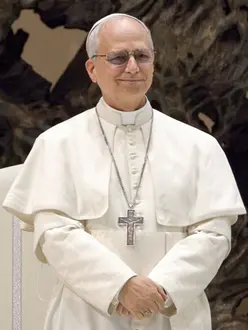
Pope of the Catholic Church (since 2025); formerly Robert Prevost, bishop of Chiclayo, Peru and prefect of the Dicastery for Bishops
Leo XIV, the first pope born in the United States, speaks in the tradition of Catholic social teaching: he stresses the dignity of every person, the preferential option for the poor, fair wages and unions, and the limits of unregulated markets, while opposing abortion and euthanasia, upholding marriage as the union of a man and a woman, and abolishing the death penalty. He argues for a welcoming but ordered approach to migration, multilateral institutions and international law, disarmament and an end to nuclear deterrence, and for ethical limits on artificial intelligence. His encyclical and addresses place him against nationalism, consumerism and the culture of power rather than with any party.
Closest ideologies
Based on the 113 statements where Leo XIV has a known position.
- Christian humanism (91% match)
- Composite nationalism (90% match)
- Jewish Autonomism (89% match)
- Social Liberalism (89% match)
- Christian Socialism (89% match)
Similar people
- Pope Francis (90% alike)
- Benedict XVI (89% alike)
- Émile Durkheim (89% alike)
- Harald V of Norway (89% alike)
- Robert F. Kennedy (89% alike)
Known positions
- Strongly: Force is for self-defence alone.
- Strongly: The state should be barred from executing people convicted of the gravest crimes, such as terrorism.
- Strongly: Working together internationally should count at least as much as my country's own priorities.
- Strongly: A country with nuclear weapons may give them up even while its rivals keep theirs.
- Strongly: Rich people have an obligation to help those worse off than they are.
- Strongly: Countries should maintain only the weapons needed for national safety.
- Strongly: Prisons should mainly help offenders rejoin society.
- Strongly: Abortion should be illegal in most cases.
- Strongly: My country may keep a military no stronger than its rivals'.
- Strongly: Technology will not solve most of humanity's problems.
- Strongly: Government should serve people's good while respecting each person as more than an instrument of the state or community.
- Strongly: One worker's pay should cover the living needs of that worker's family, including the worker.
- Strongly: Recreational drugs should be illegal for adults.
- Strongly: Human rights come from the nature that all human beings share.
- Strongly: Society may hold back technological change that would overturn established institutions.
- Strongly: Immigrants should not be expected to replace their original culture with the national culture.
- Strongly: Some things are right or wrong for everyone, in every culture and era.
- Strongly: Employers and workers should treat each other as partners whose cooperation comes before conflict, even where their interests differ.
- Strongly: The law may forbid medical help for terminally ill adults who want to end their lives.
- Strongly: Religious institutions should be independent of government direction in their internal affairs.
- Strongly: Workers are better off for having labor unions.
- Strongly: Ethnic diversity does not weaken a society's ability to hold together.
- Strongly: Where they conflict, religious faith should count for at least as much as evidence and reasoning.
- Strongly: Immigration rules should treat would-be immigrants the same whatever their race.
- Strongly: A healthy society depends on the traditional family, such as a married mother and father raising their children.
- Strongly: Private charity does not help people in poverty better than government programs do.
- Strongly: Meeting poor people's needs should be the first consideration in public policy.
- Strongly: Constantly seeking additional possessions is harmful overall, despite any benefits it brings.
- Strongly: My country can do without nuclear weapons that it alone controls.
- Strongly: Public institutions should have the power to constrain a national majority's decisions in a liberal democracy.
- Strongly: Other things drive humanity forward at least as much as rivalry and conflict between peoples.
- Strongly: Income-tax percentages may differ between income levels.
- Strongly: Private ownership is legitimate only insofar as it benefits society.
- Strongly: Politics should support people's spiritual well-being.
- Strongly: War does not strengthen a nation's character.
- Strongly: Being powerful does not mean a country should bring more land within its borders.
- Strongly: The government should let its political opponents organise, speak and compete for power.
- Strongly: Groups have rights of their own.
- Strongly: The law should treat everyone as an equal, whatever their birth, sex, race or status.
- Strongly: Minority groups are not, as groups, secretly plotting to harm the nation.
- Strongly: Religion does not offer illusory comfort for material suffering.
- Strongly: Laws should not be required to follow religious texts.
- Strongly: Looking after your own interests is not a moral good in itself.
- Strongly: News media should decide for themselves what they publish, whoever holds power.
- Strongly: We have a duty to leave the planet in good condition for those who come after us.
- Strongly: Human officials should retain final approval over every government decision involving AI.
- Strongly: Religious conversion should be free of legal restriction.
- Strongly: Members of other ethnic groups should be free to stay in the country.
- Strongly: Population growth does not mainly drive lasting poverty.
- Strongly: People of different races should not be discouraged from forming a family together, including through marriage and children.
- Strongly: Publicly insulting a religion's sacred beliefs should be left outside the criminal law.
- Strongly: No state may force a minority out of the country, however hostile it judges that minority to be.
- Strongly: Some areas of life should remain outside state direction.
- Strongly: Private owners' choice of whom they deal with should be subject to some restrictions.
- Strongly: No society has the right to rule another for its supposed improvement, however advanced it is.
- Strongly: Marriage should retain legal recognition.
- Strongly: Police forces should continue to exist.
- Strongly: Society needs government of some kind.
- Strongly: The ruler should be subject to the country's laws.
- Strongly: Government should have other tasks besides protecting people from physical violence.
- Strongly: Collecting taxes does not in itself amount to stealing people's money.
- Strongly: Public policy should not be used to reduce the passing on of inherited disabilities.
- Strongly: Belonging to a religious minority is no ground for shoppers to stay away from a shop.
- Strongly: Voting should not be limited to members of one ethnic group.
- Strongly: Killing another person can be right in self-defence or in defence of others.
- Strongly: Overseas territories need not be run mainly for the ruling country's economic benefit.
- Strongly: Taking part in politics is at least as good a way to live as living privately away from public affairs.
- Strongly: State schools need not steer pupils away from belief in God.
- Strongly: Public spaces such as schools and facilities should not be separated by race under the law.
- Strongly: Final authority over a state's laws need not belong to its most senior religious scholars.
- Strongly: The Holocaust happened as historians describe it.
- Strongly: People must be free to leave their religion without legal penalty.
- Strongly: Suspected drug dealers should never be put to death without a trial.
- Leans: Behind their different forms, the great religions point to one shared truth.
- Leans: International criminal courts should try political leaders responsible for atrocities such as genocide, crimes against humanity and war crimes.
- Leans: Believers can be excused from rules, such as dress or work-day rules, that conflict with their faith.
- Leans: Jews, as a people, are entitled to a country of their own in the Land of Israel.
- Leans: Adults' use of technology to improve their bodies and minds may be limited.
- Leans: Only the state's armed forces and police should have permission to carry weapons.
- Leans: People do not have full ownership of their own bodies.
- Leans: It is acceptable for the government to monitor people when that helps prevent terrorism.
- Leans: Businesses should be legally barred from agreements with competitors to suppress competition, such as fixing prices.
- Leans: Religious values and institutions should shape laws, schools and public life.
- Leans: Politics should prioritise a single common good identified by reasoning over compromises among organised interests.
- Leans: Society should follow a third course beyond capitalism and communism.
- Leans: High earners and the very rich should pay tax at a much higher rate than everyone else.
- Leans: Ending a marriage should not be possible without proving fault.
- Leans: The global economic system keeps poorer countries poor by directing their wealth toward richer countries.
- Leans: Laws, institutions and customs still favor men over women.
- Leans: The state should give families money to have more children, such as through payments and tax breaks.
- Leans: Political decisions should rest with the smallest local community able to handle them, with wider authorities handling matters that need a wider reach.
- Leans: Every treaty and agreement between governments should be made public.
- Leans: Democracy is best even when voters make poor choices.
- Leans: A law imposes no moral duty to obey it if the law is unjust.
- Leans: Society should take active steps to make up for the harm done by past racial injustices.
- Leans: Government should impose strict rules on how corporations operate.
- Leans: You can't reach a free, fair society by unfree or unfair means.
- Leans: Officials decide what gets made and who gets it at least as well as prices and competition do.
- Leans: People should have a direct role in making decisions where they work, live and study, rather than having those decisions made entirely for them.
- Leans: The state should make immigrants learn the language of the country they settle in.
- Leans: Countries should keep their armed forces.
- Leans: Being free requires having the practical resources to act on one's choices, such as an adequate livelihood.
- Leans: The general public should have at least as much say in policy as experts.
- Leans: Rulers must act under lasting, publicly known laws administered by recognised courts.
- Leans: Trade, finance and debt rules should be changed to give poorer countries a fairer share.
- Leans: Very large concentrations of wealth threaten a free society.
- Leans: Keeping a nation's inherited culture alive, including its language, customs and traditions, matters.
- Leans: Countries may keep controls on who enters and settles, even in the long run.
- Leans: Whatever their circumstances, everyone should be able to count on the state for enough to live decently, through benefits, pensions or public services.
- Leans: A people with a shared national identity is entitled to its own self-governing state.