Political Ideology Atlas · All people · Take the test
Europe · born 1881, historical
John XXIII
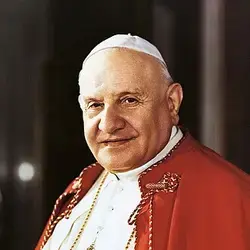
Pope of the Catholic Church (1958–1963)
Angelo Roncalli, pope 1958–1963, called the Second Vatican Council. His encyclicals defend private property with a social duty, workers' unions and a just family wage, subsidiarity and aid to poor countries, and reject communism and class war. Pacem in Terris sets out human rights, an end to the arms race and a world public authority; his addresses call for gradual reform from within.
Closest ideologies
Based on the 104 statements where John XXIII has a known position.
- Distributism (92% match)
- Catholic social teaching (92% match)
- Communitarianism (90% match)
- Christian democracy (89% match)
- Islamic modernism (89% match)
Similar people
- Pius XII (95% alike)
- Benedict XVI (93% alike)
- John Paul II (92% alike)
- Hassan Rouhani (90% alike)
- Leo XIV (90% alike)
Known positions
- Strongly: The right to govern traces back to God, even when people confer it on their leaders.
- Strongly: Changes to society should be introduced a little at a time.
- Strongly: Ending a marriage should not be possible without proving fault.
- Strongly: Abortion should be illegal in most cases.
- Strongly: Working together internationally should count at least as much as my country's own priorities.
- Strongly: Working for wages should remain a normal way for people to earn a living.
- Strongly: Government should serve people's good while respecting each person as more than an instrument of the state or community.
- Strongly: Property should belong to many people in small holdings.
- Strongly: My country may keep a military no stronger than its rivals'.
- Strongly: Some institutional ties between government and religion are acceptable.
- Strongly: Distance and nationality do not weaken the duty of the rich to help the poor abroad.
- Strongly: Countries should maintain only the weapons needed for national safety.
- Strongly: Politics should prioritise a single common good identified by reasoning over compromises among organised interests.
- Strongly: Rich people have an obligation to help those worse off than they are.
- Strongly: Technology will leave most of humanity's problems unsolved.
- Strongly: Employers and workers should treat each other as partners whose cooperation comes before conflict, even where their interests differ.
- Strongly: Human rights come from the nature that all human beings share.
- Strongly: Religious values and institutions should shape laws, schools and public life.
- Strongly: Political decisions should rest with the smallest local community able to handle them, with wider authorities handling matters that need a wider reach.
- Strongly: Public institutions should help minority languages be used in public life, for example through teaching or services in those languages.
- Strongly: Immigration rules should treat would-be immigrants the same whatever their race.
- Strongly: Society relies for its well-being on longstanding family arrangements, such as a married mother and father raising their children.
- Strongly: Religious institutions should be independent of government direction in their internal affairs.
- Strongly: Some things are right or wrong for everyone, in every culture and era.
- Strongly: A law imposes no moral duty to obey it if the law is unjust.
- Strongly: One worker's pay should cover the living needs of that worker's family, including the worker.
- Strongly: Humanity has not been declining since a past golden age.
- Strongly: Being powerful does not mean a country should bring more land within its borders.
- Strongly: Workers are better off for having labor unions.
- Strongly: Individual farms should not give way to joint cultivation by groups of farmers.
- Strongly: My country can do without nuclear weapons that it alone controls.
- Strongly: At least one other influence has contributed as much to human progress as rivalry between peoples has.
- Strongly: State ownership should stop short of covering all land.
- Strongly: Owning things privately is justified only if it benefits society as a whole.
- Strongly: The great religions need not share a single underlying truth.
- Strongly: Politics should support people's spiritual well-being.
- Strongly: Groups have rights of their own.
- Strongly: Members of other ethnic groups should be free to stay in the country.
- Strongly: The reassurance people draw from faith in the face of material hardship need not be founded on false hopes.
- Strongly: A national development strategy should not accept some regions growing wealthy ahead of the rest.
- Strongly: No state may force a minority out of the country, however hostile it judges that minority to be.
- Strongly: Industrial society has done at least as much good as harm to humanity.
- Strongly: Poor countries should retain economic ties with rich countries.
- Strongly: Public policy should not be used to reduce the passing on of inherited disabilities.
- Strongly: Keeping a nation's inherited culture alive, including its language, customs and traditions, matters.
- Strongly: Some areas of life should remain outside state direction.
- Strongly: No society has the right to rule another for its supposed improvement, however advanced it is.
- Strongly: Society needs government of some kind.
- Strongly: The ruler should be subject to the country's laws.
- Strongly: Collecting taxes does not in itself amount to stealing people's money.
- Strongly: Voting should not be limited to members of one ethnic group.
- Strongly: At least one other factor does as much to keep people in poverty as population growth does.
- Strongly: Public spaces such as schools and facilities should not be separated by race under the law.
- Strongly: Government should have other tasks besides protecting people from physical violence.
- Strongly: State schools need not steer pupils away from belief in God.
- Strongly: Overseas territories need not be run mainly for the ruling country's economic benefit.
- Strongly: A weaker state need not formally treat a stronger power as its superior.
- Strongly: Suspected drug dealers should never be put to death without a trial.
- Leans: The UN should have authority to compel member states to comply with its decisions.
- Leans: The national church should have episcopal government, with its bishops holding governing authority.
- Leans: Reforms should take existing institutions and their role in society seriously.
- Leans: Countries should hand part of their decision-making power to a union of nations, such as the European Union.
- Leans: Government should depend more on leaders setting a good example than on enforcing laws with penalties.
- Leans: Owners' rights to their property should almost never be overridden, even for public goals.
- Leans: The country may allow more immigration than strict limits would permit.
- Leans: Using a country's armed forces for wider policy goals is a misuse of military power.
- Leans: The work of making a product is not what gives it economic value.
- Leans: Farmers should get price floors, state buying or cheap credit to keep them secure.
- Leans: Private businesses and markets should run most of the economy, while the government supports people who cannot meet their basic needs.
- Leans: To keep their political freedoms, people need the freedom to own property, trade and choose their work.
- Leans: Government should be bound by written guarantees of basic rights protected against easy amendment by ordinary majorities.
- Leans: A country with nuclear weapons may give them up even while its rivals keep theirs.
- Leans: A business owner can earn a profit without taking unfair advantage of employees.
- Leans: Full-time work at the legal wage floor should pay enough to meet basic living costs.
- Leans: Trade unions should control their own affairs without state direction.
- Leans: Society should follow a third course beyond capitalism and communism.
- Leans: Defeating communism should not take priority over coexistence with it.
- Leans: Governments should encourage contact between cultural groups.
- Leans: People should want as few material things as possible.
- Leans: Government should impose strict rules on how corporations operate.
- Leans: Employees should have voting rights in the management of large companies.
- Leans: Women should be able to vote and stand for office on the same terms as men.
- Leans: Population growth may be left to run its course.
- Leans: Countries should start from a policy of staying out of other countries' internal affairs.
- Leans: Workers' pay should be settled in collective bargaining between their union and their employer.
- Leans: A poor country should develop mainly with its own resources.
- Leans: Looking after your own interests is not a moral good in itself.
- Leans: A mother country and its colonies may trade with the outside world.
- Leans: Rapid economic development does not justify temporary restrictions on political freedom.
- Leans: Income from useful work should be rewarded ahead of income from merely owning property.
- Leans: Spouses should make marital decisions as equals.
- Leans: Very large concentrations of wealth threaten a free society.
- Leans: The state should guarantee health care to everyone, whether it runs the services itself or pays for them.
- Leans: Rulers must act under lasting, publicly known laws administered by recognised courts.
- Leans: Being allowed to make a choice only counts as freedom if you have the resources to act on it.
- Leans: People should have a direct role in making decisions where they work, live and study, rather than having those decisions made entirely for them.
- Leans: Meeting poor people's needs should be the first consideration in public policy.
- Leans: Whatever their circumstances, everyone should be able to count on the state for enough to live decently, through benefits, pensions or public services.
- Leans: Constantly seeking additional possessions is harmful overall, despite any benefits it brings.
- Leans: The law should treat everyone as an equal, whatever their birth, sex, race or status.