Political Ideology Atlas · All people · Take the test
Europe · born 1599, historical
Oliver Cromwell
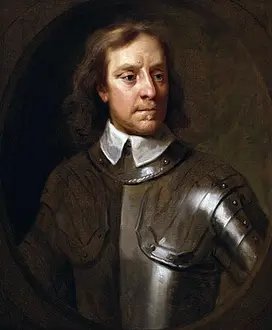
English general and Lord Protector of England, Scotland and Ireland (1653-1658)
A Parliamentary army commander who defeated the King in the Civil War and governed as Lord Protector under the Instrument of Government. He favoured liberty of conscience for Protestant sects but not for Catholics or bishops, opposed a wide franchise, ran the Major-General system of rule and the conquests of Ireland and Scotland, and refused the crown in 1657.
Closest ideologies
Based on the 71 statements where Oliver Cromwell has a known position.
- Russian imperialism (92% match)
- Neo-fascism (90% match)
- Eurasianism (90% match)
- Apartheid (90% match)
- İttihadism (89% match)
Similar people
- Alexander I of Yugoslavia (90% alike)
- Bashar al-Assad (89% alike)
- Catherine II of Russia (89% alike)
- Otto von Bismarck (89% alike)
- John Ruskin (89% alike)
Known positions
- Strongly: Only people who own property should have the right to vote.
- Strongly: The military should have a political role in protecting the constitution and public order, stepping in when they are threatened.
- Strongly: At its core, politics is a struggle between spiritual good and evil.
- Strongly: The best government combines a governing role for a few with a governing role for the wider population.
- Strongly: The government should have authority over religious institutions' internal affairs.
- Strongly: A national emergency sometimes justifies temporarily withdrawing normal legal safeguards against people the government regards as internal enemies, such as protections against detention without trial.
- Strongly: A country has the right to stop a region becoming independent by using its military.
- Strongly: Besides its directly elected parliament, a legislature should have a second chamber, such as a senate.
- Strongly: Religious values and institutions should shape laws, schools and public life.
- Strongly: Some institutional ties between government and religion are acceptable.
- Strongly: Foreign powers sometimes have a right to intervene in a country's internal affairs.
- Strongly: Armed forces may sometimes be used for purposes beyond defending the country against attack.
- Strongly: Government should take sides on how people live, backing the ways of life it judges good.
- Strongly: A national church need not be ruled by its bishops.
- Strongly: People are entitled to resist a ruler's unconstitutional exercise of power.
- Strongly: Defense should not rest with armed ordinary citizens in place of a standing force.
- Strongly: Where they conflict, religious faith should count for at least as much as evidence and reasoning.
- Strongly: A country may keep a region that wants to leave.
- Strongly: The state may restrict what adults do for reasons other than preventing harm to others.
- Strongly: Equality of outcomes should not be society's goal.
- Strongly: Politics should support people's spiritual well-being.
- Strongly: Political violence is sometimes justified.
- Strongly: Religion does not offer illusory comfort for material suffering.
- Strongly: At least some revolutions have been justified.
- Strongly: Society needs government of some kind.
- Strongly: Countries should keep their armed forces.
- Strongly: Government should have other tasks besides protecting people from physical violence.
- Strongly: State schools need not steer pupils away from belief in God.
- Strongly: Final authority over a state's laws need not belong to its most senior religious scholars.
- Leans: Every part of life should be subject to state direction.
- Leans: The state should punish people who publicly insult what a religion holds sacred.
- Leans: The state should encourage people of the majority group to move into areas where minority groups are in the majority.
- Leans: Someone who actually governs a state may hand that power on to their own child, whether as a king or as a republic's leader.
- Leans: Belonging to the nation goes with sharing its religion.
- Leans: The law may treat people differently according to such things as birth, sex, race and status.
- Leans: Governments may give special advantages to firms close to them.
- Leans: God has chosen one people to be superior to all other peoples.
- Leans: God is the ultimate source of the right to exercise political authority.
- Leans: The government should stop its political opponents from organising, speaking or competing for power.
- Leans: A powerful country should bring more land within its borders.
- Leans: Having a shared national identity does not by itself entitle a people to its own self-governing state.
- Leans: Rulers are not bound to act only under lasting, publicly known laws administered by recognised courts.
- Leans: Special ranks held by birth, such as noble titles and hereditary crowns, may continue to exist.
- Leans: The national church is recognised in law above other religions.
- Leans: The government may spend public money without first getting its budget approved by an elected legislature.
- Leans: The country would benefit from a strong leader with the power to act despite deadlock among its political institutions.
- Leans: Democracy is not the best form of government when voters choose badly.
- Leans: The state may give legal precedence to one stream of a religion over the others.
- Leans: Delegates selected by councils at one level should select officeholders at higher levels.
- Leans: My country's military strength should exceed that of its rivals.
- Leans: It is acceptable for the government to monitor people when that helps prevent terrorism.
- Leans: Government should be bound by written guarantees of basic rights protected against easy amendment by ordinary majorities.
- Leans: State schools may teach pupils a religious faith, for example through lessons in its beliefs and practice.
- Leans: Agreements between competing firms, price-fixing included, need not be outlawed.
- Leans: The worst crimes can be punished by death.
- Leans: Military intervention abroad is sometimes necessary to protect human rights.
- Leans: A country may join permanent military alliances.
- Leans: A constitution does not have to be drafted by an assembly elected for that purpose.
- Leans: Free trade does not benefit everyone in the long run.
- Leans: Owners' rights to their property need not be protected against being overridden for public goals.
- Leans: The head of state should not be elected directly by the voters.
- Leans: An electorate should choose the head of state, either directly or through elected representatives.
- Leans: Even a purely ceremonial head of state should not hold the position by birth.
- Leans: In war, the enemy's civilians are not legitimate targets.