Political Ideology Atlas · All people · Take the test
Europe · born 1769, historical
Napoleon
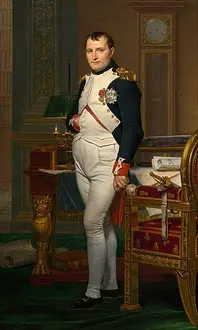
First Consul of France (1799–1804) and Emperor of the French (1804–1814, 1815)
Napoleon ruled France as an authoritarian modernizer: he consolidated the Revolution's civil equality and property settlement in the Civil Code and a centralized, merit-oriented state, while ending effective representative government, controlling the press, restoring Catholicism under state control, reinstating colonial slavery and creating a hereditary monarchy and nobility. He legitimated his rule by plebiscite and the sovereignty of the people, pursued French pre-eminence by conscription and conquest, and used protection and the Continental System against Britain.
Closest ideologies
Based on the 108 statements where Napoleon has a known position.
- Militarism (91% match)
- Pan-Germanism (89% match)
- İttihadism (88% match)
- Corporate statism (88% match)
- Bonapartism (88% match)
Similar people
- Jorge Rafael Videla (90% alike)
- Augustus (88% alike)
- Otto von Bismarck (88% alike)
- Stephen Miller (87% alike)
- Nicholas II of Russia (87% alike)
Known positions
- Strongly: Women's political rights may differ from men's.
- Strongly: The people in power should decide what the country's news media publish.
- Strongly: Someone who actually governs a state may hand that power on to their own child, whether as a king or as a republic's leader.
- Strongly: The government should stop its political opponents from organising, speaking or competing for power.
- Strongly: A powerful country should bring more land within its borders.
- Strongly: A person's sex should affect the public roles legally assigned to them.
- Strongly: One spouse may have more authority than the other within a marriage.
- Strongly: It is acceptable to praise a national leader openly as the one who stands for the whole nation.
- Strongly: Special ranks held by birth, such as noble titles and hereditary crowns, may continue to exist.
- Strongly: The government should have authority over religious institutions' internal affairs.
- Strongly: The head of state should not have to be chosen by election.
- Strongly: Owners' rights to their property should almost never be overridden, even for public goals.
- Strongly: The country would benefit from a strong leader with the power to act despite deadlock among its political institutions.
- Strongly: Women should have different military draft obligations from men.
- Strongly: Real authority to command the military should rest with the head of state.
- Strongly: Many political decisions should rest with national or wider authorities, even where a smaller community could handle them.
- Strongly: A president should be free to stand for re-election as many times as they like.
- Strongly: My country's military strength should exceed that of its rivals.
- Strongly: Only children of citizens should be citizens at birth: being born in the country should not be enough.
- Strongly: Taxes on imports should shield domestic producers from foreign competition.
- Strongly: Political power may be concentrated in one body.
- Strongly: When national priorities conflict with working together internationally, my country should choose its own priorities.
- Strongly: The worst crimes can be punished by death.
- Strongly: Some institutional ties between government and religion are acceptable.
- Strongly: Foreign powers sometimes have a right to intervene in a country's internal affairs.
- Strongly: The government should be able to require citizens to serve in the military.
- Strongly: Marriage, inheritance and family law should be the same for everyone, not set by each religious community.
- Strongly: A country may join permanent military alliances.
- Strongly: Free trade does not benefit everyone in the long run.
- Strongly: Another body may have the final say over what the legislature passes.
- Strongly: Elected politicians should be able to serve any number of terms in any office.
- Strongly: Governments are under no obligation to fund media that decide their own editorial content.
- Strongly: A person's right to hold land need not end when they stop using it.
- Strongly: Grown children owe care to parents who need it.
- Strongly: Political violence is sometimes justified.
- Strongly: Being the first to use force can be right, depending on what it is meant to achieve.
- Strongly: Lending money at interest should be legal.
- Strongly: Laws should not be required to follow religious texts.
- Strongly: Soldiers and conscripts need not refuse to fight when their state goes to war.
- Strongly: Central banks should keep a role in controlling the money supply.
- Strongly: Marriage should retain legal recognition.
- Strongly: Police forces should continue to exist.
- Strongly: Society needs government of some kind.
- Strongly: Countries should keep their armed forces.
- Strongly: Government should have other tasks besides protecting people from physical violence.
- Strongly: Collecting taxes does not in itself amount to stealing people's money.
- Strongly: State schools need not steer pupils away from belief in God.
- Strongly: Final authority over a state's laws need not belong to its most senior religious scholars.
- Leans: People farming an estate should lack the legal freedom to leave that estate.
- Leans: Law should require people of different races to use separate public spaces, such as schools and public facilities.
- Leans: Colonies should be run mainly to supply markets, materials and outlets for the ruling country.
- Leans: A great power should be entitled to intervene militarily without an allied government's consent to prevent its political system from being abandoned.
- Leans: Every part of life should be subject to state direction.
- Leans: The mother country and its colonies should meet their economic needs within their own bloc instead of trading with the outside world.
- Leans: Spreading our political system abroad should be a special calling of our nation.
- Leans: The leader should bypass parties and organised interest groups in dealing with the people.
- Leans: War develops virtues in a nation, such as courage and discipline.
- Leans: World power should not be divided among several independent major powers.
- Leans: Private property does not need to serve the common good to be justified.
- Leans: Art, poetry and stories that harm people's moral character should be censored.
- Leans: Specialists should have more weight in decisions than public opinion.
- Leans: Countries should hand part of their decision-making power to a union of nations, such as the European Union.
- Leans: Where they conflict, evidence and reasoning should count for more than faith, God, revelation or scripture.
- Leans: The national church is recognised in law above other religions.
- Leans: The national church should have episcopal government, with its bishops holding governing authority.
- Leans: A national emergency sometimes justifies temporarily withdrawing normal legal safeguards against people the government regards as internal enemies, such as protections against detention without trial.
- Leans: Countries within one civilization should unite politically.
- Leans: Dividing politics into left and right no longer makes sense.
- Leans: Countries are better off sharing one currency than each having its own.
- Leans: Major laws should be decided by citizens voting on them themselves.
- Leans: The nation's figurehead should be non-partisan and belong to everyone.
- Leans: Democracy is not the best form of government when voters choose badly.
- Leans: Judge policies by what they achieve, independently of whether they match an ideology.
- Leans: Delegates selected by councils at one level should select officeholders at higher levels.
- Leans: Either spouse can leave a marriage without showing wrongdoing by the other.
- Leans: It is acceptable for the government to monitor people when that helps prevent terrorism.
- Leans: Besides its directly elected parliament, a legislature should have a second chamber, such as a senate.
- Leans: Countries should maintain only the weapons needed for national safety.
- Leans: Property should belong to many people in small holdings.
- Leans: Religious values and institutions should shape laws, schools and public life.
- Leans: Governments should not borrow heavily, spending much more than they collect in taxes, to boost the economy.
- Leans: What you owe your community matters more than your personal rights.
- Leans: The government should steer investment into industries it sees as key to the country's future.
- Leans: A constitution does not have to be drafted by an assembly elected for that purpose.
- Leans: The holder of the highest state office need not be treated as holy.
- Leans: An elected legislature must approve the government's budget before the government spends public money.
- Leans: Government should rely at least as much on legal enforcement as on its rulers' moral example.
- Leans: Officials decide what gets made and who gets it at least as well as prices and competition do.
- Leans: A wife should be able to end the marriage even when her husband refuses.
- Leans: A healthy society depends on the traditional family, such as a married mother and father raising their children.
- Leans: The state may restrict what adults do for reasons other than preventing harm to others.
- Leans: Rulers have a right to rule only because the people they rule have agreed to it.
- Leans: The great religions need not share a single underlying truth.
- Leans: Politics should support people's spiritual well-being.
- Leans: Keeping a nation's inherited culture alive, including its language, customs and traditions, matters.
- Leans: At least some revolutions have been justified.
- Leans: Political authority does not ultimately come from God.
- Leans: Belonging to the nation does not go with sharing its religion.