Political Ideology Atlas · All people · Take the test
Europe · born 1638, historical
Louis XIV of France
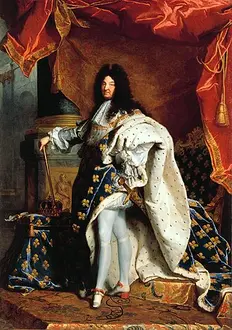
King of France (1643–1715)
Louis XIV ruled France as an absolute monarch who held that kings act in God's place and have free disposal of their subjects' goods for the state's needs. He subdued the Parlements and nobility, promoted state-run mercantilist industry through Colbert, fought wars of expansion, enforced Catholic uniformity (revoking the Edict of Nantes in 1685, issuing the Code Noir) and upheld Gallican limits on papal power. Near death he advised his heir to keep peace, ease taxes and fear God.
Closest ideologies
Based on the 55 statements where Louis XIV of France has a known position.
- Kokkashugi (90% match)
- Ruscism (89% match)
- Metaxism (89% match)
- Italian fascism (88% match)
- Absolute Monarchism (86% match)
Similar people
- Henry VIII of England (92% alike)
- Charlemagne (92% alike)
- Wilhelm II (88% alike)
- Benito Mussolini (87% alike)
- Reinhard Heydrich (86% alike)
Known positions
- Strongly: The ruler should not be bound by the country's laws, including those made by that ruler and by earlier ones.
- Strongly: A state may force a minority it sees as hostile to leave the country.
- Strongly: Overthrowing a government by revolution is never justified, whatever the cause.
- Strongly: Someone who actually governs a state may hand that power on to their own child, whether as a king or as a republic's leader.
- Strongly: Belonging to the nation goes with sharing its religion.
- Strongly: The law may treat people differently according to such things as birth, sex, race and status.
- Strongly: Governments may give special advantages to firms close to them.
- Strongly: God is the ultimate source of the right to exercise political authority.
- Strongly: The government should stop its political opponents from organising, speaking or competing for power.
- Strongly: A powerful country should bring more land within its borders.
- Strongly: Having a shared national identity does not by itself entitle a people to its own self-governing state.
- Strongly: Consent of the governed is not the only basis of legitimate political authority.
- Strongly: Some people are better suited by nature to govern.
- Strongly: Special ranks held by birth, such as noble titles and hereditary crowns, may continue to exist.
- Strongly: The national church is recognised in law above other religions.
- Strongly: A country should try to sell more abroad than it buys from abroad.
- Strongly: The head of state should not have to be chosen by election.
- Strongly: The government may spend public money without first getting its budget approved by an elected legislature.
- Strongly: A ruler's unconstitutional acts do not give people a right to resist.
- Strongly: The country would benefit from a strong leader with the power to act despite deadlock among its political institutions.
- Strongly: Real authority to command the military should rest with the head of state.
- Strongly: Governments should be able to keep some international agreements secret.
- Strongly: The state may give legal precedence to one stream of a religion over the others.
- Strongly: Many political decisions should rest with national or wider authorities, even where a smaller community could handle them.
- Strongly: My country's military strength should exceed that of its rivals.
- Strongly: Taxes on imports should shield domestic producers from foreign competition.
- Strongly: Political power may be concentrated in one body.
- Strongly: Religious values and institutions should shape laws, schools and public life.
- Strongly: Politics should prioritise a single common good identified by reasoning over compromises among organised interests.
- Strongly: When national priorities conflict with working together internationally, my country should choose its own priorities.
- Strongly: Some institutional ties between government and religion are acceptable.
- Strongly: Foreign powers sometimes have a right to intervene in a country's internal affairs.
- Strongly: Armed forces may sometimes be used for purposes beyond defending the country against attack.
- Strongly: The government should steer investment into industries it sees as key to the country's future.
- Strongly: Free trade does not benefit everyone in the long run.
- Strongly: Religious minorities should not be exempt from general laws that burden their practice.
- Strongly: Another body may have the final say over what the legislature passes.
- Strongly: Defense should not rest with armed ordinary citizens in place of a standing force.
- Strongly: Owners' rights to their property need not be protected against being overridden for public goals.
- Strongly: Officials decide what gets made and who gets it at least as well as prices and competition do.
- Strongly: A country may keep a region that wants to leave.
- Strongly: Being the law gives a rule a moral claim to be obeyed.
- Strongly: Lending money at interest should be legal.
- Strongly: Soldiers and conscripts need not refuse to fight when their state goes to war.
- Strongly: Society needs government of some kind.
- Strongly: Countries should keep their armed forces.
- Strongly: Government should have other tasks besides protecting people from physical violence.
- Strongly: Collecting taxes does not in itself amount to stealing people's money.
- Strongly: Courts need not be handed over to private businesses.
- Leans: The person holding the highest state office should be treated as holy.
- Leans: Only people born in the country should hold public office.
- Leans: The government should have authority over religious institutions' internal affairs.
- Leans: Government should rely at least as much on legal enforcement as on its rulers' moral example.
- Leans: Private ownership is legitimate only insofar as it benefits society.