Political Ideology Atlas · All people · Take the test
Europe · born 1883, historical
Benito Mussolini
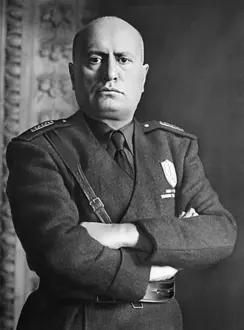
Founder of Italian Fascism; prime minister and dictator of Italy (1922-1943); head of the Italian Social Republic (1943-1945)
Mussolini began as a socialist editor, broke with the party in 1914 to back Italy's entry into the First World War, and founded Fascism, which he described as anti-liberal, anti-democratic, anti-Marxist and totalitarian, with the State absolute and classes reconciled through state-controlled corporations. He governed as a one-party dictator, pursued empire and war, drove a population-growth campaign, signed the Lateran Pacts with the Church and in 1938 introduced racial laws against Jews and Africans. In 1943 he proclaimed a republican, socialising programme at Verona.
Closest ideologies
Based on the 137 statements where Benito Mussolini has a known position.
- Italian fascism (93% match)
- Fascist mysticism (91% match)
- Palingenetic ultranationalism (91% match)
- Positive Christianity (90% match)
- Ruscism (90% match)
Similar people
- Reinhard Heydrich (89% alike)
- Joseph Goebbels (89% alike)
- Heinrich Himmler (89% alike)
- Hermann Göring (88% alike)
- Adolf Hitler (88% alike)
Known positions
- Strongly: Law should require people of different races to use separate public spaces, such as schools and public facilities.
- Strongly: Temporary rule by a more developed society is justified when it helps the ruled to progress.
- Strongly: Every part of life should be subject to state direction.
- Strongly: People of different races should be discouraged from forming a family together, whether through marriage or having children.
- Strongly: One ideologically correct party should hold state leadership without competing parties having a right to replace it.
- Strongly: The people in power should decide what the country's news media publish.
- Strongly: The law may treat people differently according to such things as birth, sex, race and status.
- Strongly: The government should stop its political opponents from organising, speaking or competing for power.
- Strongly: A powerful country should bring more land within its borders.
- Strongly: War develops virtues in a nation, such as courage and discipline.
- Strongly: Rivalry and conflict between nations or peoples do more than anything else to drive humanity forward.
- Strongly: The presence of people belonging to the same nation gives a state a legitimate territorial claim outside its borders.
- Strongly: Some people are better suited by nature to govern.
- Strongly: Officially recognized bodies representing employers and workers should negotiate wages together.
- Strongly: Young people should belong to uniformed, drilled organisations that prepare them to serve the nation.
- Strongly: People should gain political representation through social bodies such as families, local communities and occupational associations instead of political parties.
- Strongly: A former empire may keep a special relationship with its old territories.
- Strongly: The national church is recognised in law above other religions.
- Strongly: A country should be ready to use military force abroad on its own judgment, even if the UN Security Council has not authorized it.
- Strongly: There should be legal limits on strike action.
- Strongly: The country would benefit from a strong leader with the power to act despite deadlock among its political institutions.
- Strongly: Workers' solidarity with their own nation should take priority over solidarity with workers across borders.
- Strongly: Having a human nature in common is not what gives people their rights.
- Strongly: At least some unjust laws impose a moral duty of obedience.
- Strongly: Democracy is not the best form of government when voters choose badly.
- Strongly: My country may join a military alliance led by one of the great powers.
- Strongly: The state may give legal precedence to one stream of a religion over the others.
- Strongly: Collective goals can justify treating a person merely as a tool.
- Strongly: The political goal should be victory over communism ahead of accommodation with it.
- Strongly: People do not have full ownership of their own bodies.
- Strongly: Payment to a union should be permitted as a condition of employment in at least some circumstances.
- Strongly: Taxes on imports should shield domestic producers from foreign competition.
- Strongly: Political power may be concentrated in one body.
- Strongly: Armaments need not be limited to the minimum needed for national safety.
- Strongly: Trade unions may be subject to state direction of their affairs.
- Strongly: Government should not be bound by a written bill of rights protected against easy amendment by ordinary majorities.
- Strongly: Society should follow a third course beyond capitalism and communism.
- Strongly: When national priorities conflict with working together internationally, my country should choose its own priorities.
- Strongly: The worst crimes can be punished by death.
- Strongly: The nation has decayed and must be reborn.
- Strongly: Abortion should be illegal in most cases.
- Strongly: Some institutional ties between government and religion are acceptable.
- Strongly: Communist one-party states should not receive the same condemnation as fascist states.
- Strongly: Foreign powers sometimes have a right to intervene in a country's internal affairs.
- Strongly: Belonging to the nation ties a person's life to a sacred community that goes on after their death.
- Strongly: Heirs to large fortunes may keep most of what they inherit.
- Strongly: Armed forces may sometimes be used for purposes beyond defending the country against attack.
- Strongly: What you owe your community matters more than your personal rights.
- Strongly: A country may join permanent military alliances.
- Strongly: Workers may be represented through the parties already in place.
- Strongly: A democratic constitution need not be founded on an explicit rejection of fascism.
- Strongly: Political freedom can last without economic freedom.
- Strongly: Seats may be allocated in ways that do not follow parties' shares of the vote closely.
- Strongly: A nation need not wait for a cultural revival before building its state.
- Strongly: Another body may have the final say over what the legislature passes.
- Strongly: An ancestral bond to a land gives a people a claim that outweighs the claims of other peoples who now live there.
- Strongly: Elected representatives may serve out their terms without voters being able to remove them early.
- Strongly: Employers and workers should treat each other as partners whose cooperation comes before conflict, even where their interests differ.
- Strongly: Today's nation is the same people as its ancient and medieval forebears.
- Strongly: In the society we should aim for, a person's share of goods may depend on things besides their needs.
- Strongly: Profit made from owning businesses does not come from exploiting the workers who produce it.
- Strongly: Where they conflict, religious faith should count for at least as much as evidence and reasoning.
- Strongly: People who give their lives for the nation deserve to be remembered as martyrs, with reverence beyond ordinary thanks.
- Strongly: Political institutions developed in the West are not a suitable model for every civilization.
- Strongly: The people who own the economy and hold power are not the ones the state mainly serves.
- Strongly: A healthy society depends on the traditional family, such as a married mother and father raising their children.
- Strongly: A country may keep all its decisions in its own hands rather than pooling them with other nations.
- Strongly: Schools should cultivate patriotic feeling: loyalty to and pride in the nation, expressed for example through respect for its flag and anthem.
- Strongly: The nation's cause and the cause of its ordinary working people are one and the same.
- Strongly: A state should take responsibility for the welfare of its national communities across neighbouring borders.
- Strongly: Society need not promote ways of living that differ from custom.
- Strongly: The state may restrict what adults do for reasons other than preventing harm to others.
- Strongly: Being the law gives a rule a moral claim to be obeyed.
- Strongly: Equality of outcomes should not be society's goal.
- Strongly: Restoring a lost social order does not matter more than pursuing progress.
- Strongly: Population growth may be left to run its course.
- Strongly: Other forces move history at least as much as conflict between classes does.
- Strongly: Member states should keep the final decision on whether to follow UN decisions.
- Strongly: Politics should support people's spiritual well-being.
- Strongly: Political violence is sometimes justified.
- Strongly: Groups have rights of their own.
- Strongly: Religion does not offer illusory comfort for material suffering.
- Strongly: Looking after your own interests is not a moral good in itself.
- Strongly: Soldiers and conscripts need not refuse to fight when their state goes to war.
- Strongly: At least some revolutions have been justified.
- Strongly: Political power may rest on something other than workplace-elected councils.
- Strongly: Keeping a nation's inherited culture alive, including its language, customs and traditions, matters.
- Strongly: In a war between great powers, workers need not seek their own government's defeat.
- Strongly: In the long run people should still produce and share using money.
- Strongly: A workers' state does not need to suppress the old ruling class, even for a time.
- Strongly: Police forces should continue to exist.
- Strongly: Society needs government of some kind.
- Strongly: Countries should keep their armed forces.
- Strongly: The state should not be managed the way a well-run business is.
- Strongly: Government should have other tasks besides protecting people from physical violence.
- Strongly: Killing another person can be right in self-defence or in defence of others.
- Strongly: Taking part in politics is at least as good a way to live as living privately away from public affairs.
- Strongly: State schools need not steer pupils away from belief in God.
- Strongly: Courts need not be handed over to private businesses.
- Strongly: Final authority over a state's laws need not belong to its most senior religious scholars.
- Strongly: Farmers should have the legal freedom to leave the estates they work.
- Leans: Most of the average difference in ability between racial groups comes from genes.
- Leans: Spreading our political system abroad should be a special calling of our nation.
- Leans: Having a shared national identity does not by itself entitle a people to its own self-governing state.
- Leans: A person's sex should affect the public roles legally assigned to them.
- Leans: A nation should be mainly one ethnic people.
- Leans: Labor unions do not necessarily make workers better off.
- Leans: A national emergency sometimes justifies temporarily withdrawing normal legal safeguards against people the government regards as internal enemies, such as protections against detention without trial.
- Leans: Judge policies by what they achieve, independently of whether they match an ideology.
- Leans: The farmers who work large estates should take ownership from the landowners, with the transfer compulsory if owners refuse.
- Leans: Businesses need not belong to the people who work in them.
- Leans: Workers should not have democratic voting rights in the management of large companies.
- Leans: Religious values and institutions should shape laws, schools and public life.
- Leans: The state should give families money to have more children, such as through payments and tax breaks.
- Leans: A government should outlaw political parties that aim to do away with its constitutional order.
- Leans: The government should steer investment into industries it sees as key to the country's future.
- Leans: A constitution does not have to be drafted by an assembly elected for that purpose.
- Leans: One worker's pay should cover the living needs of that worker's family, including the worker.
- Leans: The left-right division in politics remains meaningful.
- Leans: Society may be changed in large, rapid steps.
- Leans: Government should impose strict rules on how corporations operate.
- Leans: Officials decide what gets made and who gets it at least as well as prices and competition do.
- Leans: Religious institutions should be independent of government direction in their internal affairs.
- Leans: Racial categories are not merely social constructs without a scientific basis.
- Leans: Nobody should hold a special rank by birth, such as a noble title, a hereditary crown or a caste position, or the special rights attached to one.
- Leans: Constantly seeking additional possessions is harmful overall, despite any benefits it brings.
- Leans: Even a purely ceremonial head of state should not hold the position by birth.
- Leans: Most people in political office look after themselves first and the public second.
- Leans: Private ownership is legitimate only insofar as it benefits society.
- Leans: Whatever their circumstances, everyone should be able to count on the state for enough to live decently, through benefits, pensions or public services.
- Leans: Income from useful work should be rewarded ahead of income from merely owning property.
- Leans: Laws should not be required to follow religious texts.
- Leans: State pensions funded by current workers' contributions should stay in place rather than be replaced by privately managed individual accounts.