Political Ideology Atlas · All people · Take the test
Europe · born 1904, historical
Reinhard Heydrich
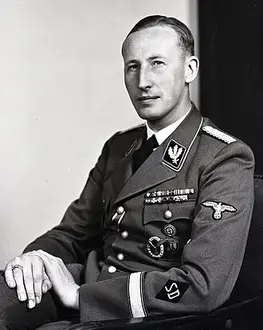
Chief of the Reich Security Main Office (1939-1942) and Deputy Reich Protector of Bohemia and Moravia (1941-1942)
Nazi security chief who built the Gestapo and SD and organised the Einsatzgruppen and the deportation and murder of European Jews. His own writings and speeches set out a racial-struggle worldview, hostility to Jews, Freemasons, churches and Bolshevism, and plans to Germanise and expel Czechs, with total police power in the Protectorate.
Closest ideologies
Based on the 63 statements where Reinhard Heydrich has a known position.
- Aryanism (92% match)
- Palingenetic ultranationalism (91% match)
- Italian fascism (91% match)
- Positive Christianity (90% match)
- Fascism in Europe (90% match)
Similar people
- Heinrich Himmler (93% alike)
- Joseph Goebbels (92% alike)
- Hermann Göring (91% alike)
- Wilhelm Frick (90% alike)
- Benito Mussolini (89% alike)
Known positions
- Strongly: Law should require people of different races to use separate public spaces, such as schools and public facilities.
- Strongly: Public policy, such as sterilization or incentives, should reduce the passing on of inherited disabilities.
- Strongly: Every part of life should be subject to state direction.
- Strongly: A state may force a minority it sees as hostile to leave the country.
- Strongly: People of different races should be discouraged from forming a family together, whether through marriage or having children.
- Strongly: One ideologically correct party should hold state leadership without competing parties having a right to replace it.
- Strongly: The people in power should decide what the country's news media publish.
- Strongly: The state should encourage people of the majority group to move into areas where minority groups are in the majority.
- Strongly: A minority group is working in secret to harm the nation.
- Strongly: Most of the average difference in ability between racial groups comes from genes.
- Strongly: The law may treat people differently according to such things as birth, sex, race and status.
- Strongly: The government should stop its political opponents from organising, speaking or competing for power.
- Strongly: A powerful country should bring more land within its borders.
- Strongly: Having a shared national identity does not by itself entitle a people to its own self-governing state.
- Strongly: The country's majority national group should have the leading role in controlling economic life.
- Strongly: Consent of the governed is not the only basis of legitimate political authority.
- Strongly: Rivalry and conflict between nations or peoples do more than anything else to drive humanity forward.
- Strongly: Some people are better suited by nature to govern.
- Strongly: A nation should be mainly one ethnic people.
- Strongly: Rulers are not bound to act only under lasting, publicly known laws administered by recognised courts.
- Strongly: Peoples who share an ethnic heritage, such as the Slavic, Arab or Turkic peoples, should come together in one state, even across present borders.
- Strongly: At its core, politics is a struggle between spiritual good and evil.
- Strongly: A society holds together less well when its members belong to different ethnic groups.
- Strongly: Labor unions do not necessarily make workers better off.
- Strongly: There should be legal limits on strike action.
- Strongly: Land that a state declares its own against its people's will is not illegally occupied by that state.
- Strongly: The country would benefit from a strong leader with the power to act despite deadlock among its political institutions.
- Strongly: A national emergency sometimes justifies temporarily withdrawing normal legal safeguards against people the government regards as internal enemies, such as protections against detention without trial.
- Strongly: Many political decisions should rest with national or wider authorities, even where a smaller community could handle them.
- Strongly: The political goal should be victory over communism ahead of accommodation with it.
- Strongly: It is acceptable for the government to monitor people when that helps prevent terrorism.
- Strongly: Political power may be concentrated in one body.
- Strongly: Trade unions may be subject to state direction of their affairs.
- Strongly: The worst crimes can be punished by death.
- Strongly: Past abuses by a state's security forces may be put behind it without anyone answering for them in court.
- Strongly: Belonging to the nation ties a person's life to a sacred community that goes on after their death.
- Strongly: Cultural life inside a state should not be placed under the control of each national minority.
- Strongly: Armed forces may sometimes be used for purposes beyond defending the country against attack.
- Strongly: What you owe your community matters more than your personal rights.
- Strongly: Parties and offices should cut across religious lines.
- Strongly: Some cultures are superior to others.
- Strongly: Today's nation is the same people as its ancient and medieval forebears.
- Strongly: Racial categories are not merely social constructs without a scientific basis.
- Strongly: A country may keep a region that wants to leave.
- Strongly: National policy should give priority to preventing outside powers from splitting the country territorially.
- Strongly: Governments are under no obligation to fund media that decide their own editorial content.
- Strongly: Other forces move history at least as much as conflict between classes does.
- Strongly: Political violence is sometimes justified.
- Strongly: A people's connection to its ancestral land is spiritual, beyond practical interests or ordinary affection.
- Strongly: Being the first to use force can be right, depending on what it is meant to achieve.
- Strongly: Looking after your own interests is not a moral good in itself.
- Strongly: Keeping a nation's inherited culture alive, including its language, customs and traditions, matters.
- Strongly: In a war between great powers, workers need not seek their own government's defeat.
- Strongly: A workers' state does not need to suppress the old ruling class, even for a time.
- Strongly: Police forces should continue to exist.
- Strongly: Final authority over a state's laws need not belong to its most senior religious scholars.
- Leans: The government should have authority over religious institutions' internal affairs.
- Leans: Innate nature shapes a person's character at least as much as their environment does.
- Leans: Religious values and institutions should not have a major part in shaping laws, schools and public life.
- Leans: It is legitimate to take pride in the racial group one belongs to.
- Leans: A state should take responsibility for the welfare of its national communities across neighbouring borders.
- Leans: Historical change does not come mainly from changes in how society produces and exchanges goods.