Political Ideology Atlas · All people · Take the test
Europe · born 121, historical
Marcus Aurelius
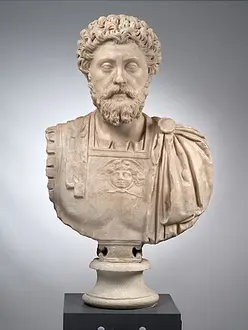
Roman emperor (161-180) and Stoic philosopher
Marcus Aurelius was a Stoic who held that all rational people share one reason and one common good, and who wrote that virtue matters more than wealth, fame or pleasure. As emperor he fought the Marcomannic and Parthian wars, ruled through the Senate and the courts, and passed power to his son Commodus. Most of what is known of his political acts comes from later ancient historians, and his own words survive mainly in the Meditations.
Closest ideologies
Based on the 38 statements where Marcus Aurelius has a known position.
- Ottomanism (93% match)
- Synarchism (92% match)
- Conservatism (91% match)
- Christian corporatism (91% match)
- Paternalistic Conservatism (89% match)
Similar people
- William Howard Taft (90% alike)
- Santiago Peña Palacios (88% alike)
- Henry Ford (88% alike)
- Ahmed al-Sharaa (87% alike)
- John Adams (86% alike)
Known positions
- Strongly: Someone who actually governs a state may hand that power on to their own child, whether as a king or as a republic's leader.
- Strongly: Real authority to command the military should rest with the head of state.
- Strongly: Religious values and institutions should shape laws, schools and public life.
- Strongly: Some institutional ties between government and religion are acceptable.
- Strongly: People should want as few material things as possible.
- Strongly: Human rights come from the nature that all human beings share.
- Strongly: Some things are right or wrong for everyone, in every culture and era.
- Strongly: The government should let its political opponents organise, speak and compete for power.
- Strongly: Naturalized citizens may hold public office as well as people born in the country.
- Strongly: Looking after your own interests is not a moral good in itself.
- Strongly: Society needs government of some kind.
- Leans: Starting the use of force against someone, or against their property, is wrong whatever it is meant to achieve.
- Leans: God is the ultimate source of the right to exercise political authority.
- Leans: A powerful country should bring more land within its borders.
- Leans: Special ranks held by birth, such as noble titles and hereditary crowns, may continue to exist.
- Leans: Freedom does not require the material means to exercise it.
- Leans: Remembering those who die for the nation need not go beyond ordinary civic thanks.
- Leans: Government should depend more on leaders setting a good example than on enforcing laws with penalties.
- Leans: The head of state should not have to be chosen by election.
- Leans: Those who inherit a large fortune should hand over a big share of it in tax.
- Leans: Working together internationally should count at least as much as my country's own priorities.
- Leans: Rich people have an obligation to help those worse off than they are.
- Leans: Politics should prioritise a single common good identified by reasoning over compromises among organised interests.
- Leans: The worst crimes can be punished by death.
- Leans: Armed forces may sometimes be used for purposes beyond defending the country against attack.
- Leans: Serious repeat offenders should not necessarily face mandatory minimum sentences.
- Leans: Taking part in politics is at least as good a way to live as living privately away from public affairs.
- Leans: Nature matters for its own sake, not only because it is useful to people.
- Leans: Overseas territories need not be run mainly for the ruling country's economic benefit.
- Leans: The ruler should be subject to the country's laws.
- Leans: Rulers must act under lasting, publicly known laws administered by recognised courts.
- Leans: Constantly seeking additional possessions is harmful overall, despite any benefits it brings.
- Leans: Keeping a nation's inherited culture alive, including its language, customs and traditions, matters.
- Leans: Countries may keep controls on who enters and settles, even in the long run.
- Leans: War does not strengthen a nation's character.
- Leans: The law should treat everyone as an equal, whatever their birth, sex, race or status.