Political Ideology Atlas · All people · Take the test
Europe · born 1834, historical
William Morris
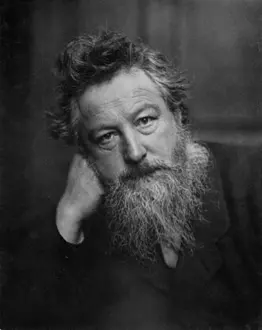
English designer, poet and socialist leader (1834-1896)
Morris became a revolutionary socialist in the 1880s and co-founded the Socialist League, which held that all land and means of production must be common property, that wages, exchange and class distinctions would end, and that socialism is international. He distrusted parliament and State Socialism, preferred decentralised, direct popular administration and the general strike, and in News from Nowhere pictured a stateless, pleasure-in-work society with no prisons, armies or nations.
Closest ideologies
Based on the 115 statements where William Morris has a known position.
- Makhnovshchina (91% match)
- Marxist humanism (90% match)
- Western Marxism (90% match)
- Left communism in China (90% match)
- Autonomist Marxism (89% match)
Similar people
- Nestor Makhno (91% alike)
- Antonio Gramsci (88% alike)
- Ted Kaczynski (88% alike)
- Mikhail Bakunin (87% alike)
- Helen Keller (87% alike)
Known positions
- Strongly: Police forces should be abolished and replaced with other ways of keeping people safe.
- Strongly: Marriage should cease to be a legally recognised status.
- Strongly: Eventually people should produce and share without money.
- Strongly: Society should aim for people to end up with broadly equal material conditions.
- Strongly: Socialism in a single country will not endure without successful socialist revolutions in other countries.
- Strongly: Choices that harm no one else should never be crimes.
- Strongly: Serving the nation does not mean serving its working people.
- Strongly: Schools should not cultivate patriotic feeling, meaning loyalty to and pride in the nation.
- Strongly: Laws, police and government mainly serve the interests of whoever owns the economy and holds power.
- Strongly: Wars between great powers are an unavoidable consequence of capitalism.
- Strongly: Owners' profit is value taken from workers' labor.
- Strongly: In the society we should aim for, a person's needs should determine their share of goods.
- Strongly: People should work mainly out of responsibility to society and a shared purpose, with personal material rewards playing a secondary role.
- Strongly: Cooperation between employers and workers should not come before conflict where their interests differ.
- Strongly: People seeking political change should act directly—for example, with strikes, boycotts or occupations—instead of pursuing change through elections and parliaments.
- Strongly: The system in which people work for wages for an employer should be ended.
- Strongly: Belonging to the nation does not tie a person's life to a sacred community that goes on after their death.
- Strongly: A woman who has sex outside marriage is not doing anything wrong.
- Strongly: Either spouse can leave a marriage without showing wrongdoing by the other.
- Strongly: The state should be barred from executing people convicted of the gravest crimes, such as terrorism.
- Strongly: Working together internationally should count at least as much as my country's own priorities.
- Strongly: Society does not need a third course beyond capitalism and communism.
- Strongly: Wage work cuts people off from the meaning and creativity of what they make.
- Strongly: Prisons should mainly help offenders rejoin society.
- Strongly: A general collapse of capitalism is unavoidable.
- Strongly: Production should be organised to provide what people need, instead of being organised around what yields a profit.
- Strongly: Industries such as energy, rail and utilities should be owned by the state or public bodies, not private companies.
- Strongly: Defeating communism should not take priority over coexistence with it.
- Strongly: Political decisions should rest with the smallest local community able to handle them, with wider authorities handling matters that need a wider reach.
- Strongly: The economy should not combine mainly private markets with government support for people who cannot meet their basic needs.
- Strongly: Without workers' own political power, state ownership is not socialism.
- Strongly: Socialism cannot be reached just by winning elections and governing through parliament.
- Strongly: The left-right division in politics remains meaningful.
- Strongly: Workers' solidarity with workers in other countries should count at least as much as solidarity with their own nation.
- Strongly: Whether a distribution of wealth is just does not depend only on how it came about.
- Strongly: Owners' rights to their property need not be protected against being overridden for public goals.
- Strongly: The law should impose no restrictions on strikes.
- Strongly: Officials decide what gets made and who gets it at least as well as prices and competition do.
- Strongly: People should have a direct role in making decisions where they work, live and study, rather than having those decisions made entirely for them.
- Strongly: A wife should be able to end the marriage even when her husband refuses.
- Strongly: The general public should have at least as much say in policy as experts.
- Strongly: Nobody should hold a special rank by birth, such as a noble title, a hereditary crown or a caste position, or the special rights attached to one.
- Strongly: Constantly seeking additional possessions is harmful overall, despite any benefits it brings.
- Strongly: No one is better suited by nature to govern than anyone else.
- Strongly: Other things drive humanity forward at least as much as rivalry and conflict between peoples.
- Strongly: Even a purely ceremonial head of state should not hold the position by birth.
- Strongly: Most people in political office look after themselves first and the public second.
- Strongly: Very large concentrations of wealth threaten a free society.
- Strongly: At most half of workers in wealthy countries benefit from the exploitation of poorer countries.
- Strongly: Political violence is sometimes justified.
- Strongly: Income from useful work should be rewarded ahead of income from merely owning property.
- Strongly: Being powerful does not mean a country should bring more land within its borders.
- Strongly: Protecting the constitution should be left to civilian institutions, not the armed forces.
- Strongly: Political authority does not ultimately come from God.
- Strongly: The law should treat everyone as an equal, whatever their birth, sex, race or status.
- Strongly: A government needs more than fair elections to be democratic.
- Strongly: Being the first to use force can be right, depending on what it is meant to achieve.
- Strongly: An armed minority's actions are incapable of bringing about the conditions for a broader revolutionary uprising.
- Strongly: Laws should not be required to follow religious texts.
- Strongly: Looking after your own interests is not a moral good in itself.
- Strongly: At least some revolutions have been justified.
- Strongly: No party's ideology should give it an exclusive right to lead the state.
- Strongly: Some areas of life should remain outside state direction.
- Strongly: No society has the right to rule another for its supposed improvement, however advanced it is.
- Strongly: Some decisions should bind people who have not consented to them.
- Strongly: Government should have other tasks besides protecting people from physical violence.
- Strongly: Overseas territories need not be run mainly for the ruling country's economic benefit.
- Strongly: The holder of the highest state office need not be treated as holy.
- Strongly: Museums, libraries and other inherited culture should not be destroyed, even when they stand in the way of new creation.
- Strongly: Farmers should have the legal freedom to leave the estates they work.
- Leans: A country can and should do without a standing military.
- Leans: Society would be better off without governments at all.
- Leans: Work should no longer be divided into separate specialized jobs held by different people.
- Leans: In the long run people should be free to live and work in any country.
- Leans: Religion gives people a false consolation for hardship in their material lives.
- Leans: History is mainly driven by conflict between economic classes.
- Leans: Political change should replace the existing administrative and coercive institutions with new forms of organization, rather than put new leaders in charge of the old apparatus.
- Leans: Historical change comes mainly from changes in how society produces and exchanges goods.
- Leans: People should live and work in communities that own land and goods together and govern themselves.
- Leans: A healthy society does not depend on the traditional family, such as a married mother and father raising their children.
- Leans: No moral truths hold across all cultures.
- Leans: Major laws should be decided by citizens voting on them themselves.
- Leans: Governments should set legal price ceilings on essential foods when supplies are scarce.
- Leans: Religious values and institutions should not have a major part in shaping laws, schools and public life.
- Leans: State schools should not teach religion.
- Leans: Employees should have voting rights in the management of large companies.
- Leans: Women's subordination is tied to how the economy is organised, so reform of laws and attitudes is not enough.
- Leans: Property need not be spread among many small owners.
- Leans: Businesses need not belong to the people who work in them.
- Leans: What things are worth comes from the work put into them.
- Leans: Full-time work at the legal wage floor should pay enough to meet basic living costs.
- Leans: Laws, institutions and customs still favor men over women.
- Leans: People should want as few material things as possible.
- Leans: What you owe your community matters more than your personal rights.
- Leans: After members debate and adopt a party decision, every member should have to help implement it, including those who opposed it.
- Leans: Society may be changed in large, rapid steps.
- Leans: A country can get through deadlock among its institutions without a leader who overrides them.
- Leans: You can't reach a free, fair society by unfree or unfair means.
- Leans: A person loses freedom from being at another person's mercy, even if that power is never exercised.
- Leans: Firms in a market economy need not be owned by the people who work in them.
- Leans: How someone turns out is shaped more by upbringing, society and experience than by the traits they are born with.
- Leans: Basic local services, such as water, hospitals and local transport, should be publicly owned and run.
- Leans: Workers are better off for having labor unions.
- Leans: Ethnic diversity does not weaken a society's ability to hold together.
- Leans: Being free requires having the practical resources to act on one's choices, such as an adequate livelihood.
- Leans: A nation does not need one main ethnic group: it can be made up of people of many ancestries.
- Leans: Spouses should make marital decisions as equals.
- Leans: An economy directed by a central plan is not capable of working better than one directed by market exchange.
- Leans: Businesses gain too much influence over government policy from their lobbying.