Political Ideology Atlas · All people · Take the test
North America · born 1880, historical
Helen Keller
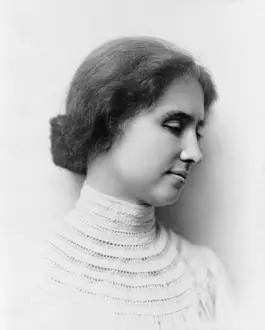
American author and activist; Socialist Party and IWW member (1880-1968)
A deafblind author and lecturer who became a committed socialist after studying the industrial causes of blindness, joining the Socialist Party in 1909 and later the IWW, which she thought less tied to electoral politics. She opposed war and militarism as products of capitalist exploitation, backed women's suffrage, unions and the NAACP, defended the Russian Revolution, and in 1915 endorsed birth control and withholding surgery from a severely impaired infant on eugenic grounds.
Closest ideologies
Based on the 77 statements where Helen Keller has a known position.
- Bundism (91% match)
- Neo-Marxism (91% match)
- Marxist feminism (90% match)
- Trotskyism (90% match)
- Eco-Socialism (89% match)
Similar people
- Huey P. Newton (94% alike)
- Hasan Piker (90% alike)
- Bill Ayers (89% alike)
- Eugene V. Debs (88% alike)
- W. E. B. Du Bois (87% alike)
Known positions
- Strongly: A state whose economy is publicly owned and planned should be defended against a return to capitalism even if a bureaucracy rules it.
- Strongly: Individual soldiers and conscripts have a duty to refuse to fight in state wars.
- Strongly: Schools should not cultivate patriotic feeling, meaning loyalty to and pride in the nation.
- Strongly: Laws, police and government mainly serve the interests of whoever owns the economy and holds power.
- Strongly: Wars between great powers are an unavoidable consequence of capitalism.
- Strongly: Owners' profit is value taken from workers' labor.
- Strongly: Cooperation between employers and workers should not come before conflict where their interests differ.
- Strongly: The system in which people work for wages for an employer should be ended.
- Strongly: Military service should always be voluntary.
- Strongly: Working together internationally should count at least as much as my country's own priorities.
- Strongly: Society does not need a third course beyond capitalism and communism.
- Strongly: Employees should have voting rights in the management of large companies.
- Strongly: Women's subordination is tied to how the economy is organised, so reform of laws and attitudes is not enough.
- Strongly: Businesses should belong to the people who work in them, for example as cooperatives.
- Strongly: A general collapse of capitalism is unavoidable.
- Strongly: Laws, institutions and customs still favor men over women.
- Strongly: Workers in the same industry should organise together regardless of their particular trade, replacing separate craft unions.
- Strongly: Industries such as energy, rail and utilities should be owned by the state or public bodies, not private companies.
- Strongly: My country may keep a military no stronger than its rivals'.
- Strongly: Defeating communism should not take priority over coexistence with it.
- Strongly: A law imposes no moral duty to obey it if the law is unjust.
- Strongly: Formal press freedom is hollow when wealth decides who can actually be heard.
- Strongly: Socialism cannot be reached just by winning elections and governing through parliament.
- Strongly: Society may be changed in large, rapid steps.
- Strongly: Workers' solidarity with workers in other countries should count at least as much as solidarity with their own nation.
- Strongly: Government should impose strict rules on how corporations operate.
- Strongly: Ordinary legal protections, such as the right not to be held without trial, should stay in force even in a national emergency.
- Strongly: Owners' rights to their property need not be protected against being overridden for public goals.
- Strongly: The law should impose no restrictions on strikes.
- Strongly: Officials decide what gets made and who gets it at least as well as prices and competition do.
- Strongly: Workers are better off for having labor unions.
- Strongly: Private charity does not help people in poverty better than government programs do.
- Strongly: Meeting poor people's needs should be the first consideration in public policy.
- Strongly: Even a purely ceremonial head of state should not hold the position by birth.
- Strongly: Very large concentrations of wealth threaten a free society.
- Strongly: Political violence is sometimes justified.
- Strongly: Income from useful work should be rewarded ahead of income from merely owning property.
- Strongly: A people with a shared national identity is entitled to its own self-governing state.
- Strongly: Being powerful does not mean a country should bring more land within its borders.
- Strongly: The government should let its political opponents organise, speak and compete for power.
- Strongly: Businesses gain too much influence over government policy from their lobbying.
- Strongly: At least some revolutions have been justified.
- Strongly: Daughters and widows should inherit and own land on the same terms as sons and husbands.
- Strongly: Population growth does not mainly drive lasting poverty.
- Strongly: Women should be able to vote and stand for office on the same terms as men.
- Strongly: Society needs government of some kind.
- Strongly: Government should have other tasks besides protecting people from physical violence.
- Strongly: Voting should not be limited to members of one ethnic group.
- Strongly: Overseas territories need not be run mainly for the ruling country's economic benefit.
- Strongly: Public spaces such as schools and facilities should not be separated by race under the law.
- Leans: Public policy, such as sterilization or incentives, should reduce the passing on of inherited disabilities.
- Leans: An economy whose production is directed by a central plan is capable of working better than an economy directed by market exchange.
- Leans: History is mainly driven by conflict between economic classes.
- Leans: Population growth should be deliberately held down.
- Leans: Historical change comes mainly from changes in how society produces and exchanges goods.
- Leans: Religious teaching and institutions are a main reason women have been held down.
- Leans: Every religious leadership role open to men should be open to women under the same eligibility rules.
- Leans: Workers should form a party of their own, separate from the parties already in place.
- Leans: Tackling oppression requires a combined approach to its overlapping forms, such as racism, sexism and class oppression.
- Leans: Governments should answer in law for past abuses by their security forces, including unlawful killings.
- Leans: Outside governments have no entitlement to interfere in another country's internal affairs for any purpose.
- Leans: Wage work cuts people off from the meaning and creativity of what they make.
- Leans: Entertainment produced for mass audiences tends to weaken people's willingness to challenge the established social order.
- Leans: Countries should maintain only the weapons needed for national safety.
- Leans: The ruling class stays in power mainly through people going along with its ideas.
- Leans: What things are worth comes from the work put into them.
- Leans: Production should be organised to provide what people need, instead of being organised around what yields a profit.
- Leans: Full-time work at the legal wage floor should pay enough to meet basic living costs.
- Leans: Without workers' own political power, state ownership is not socialism.
- Leans: Society should take active steps to make up for the harm done by past racial injustices.
- Leans: One worker's pay should cover the living needs of that worker's family, including the worker.
- Leans: Being free requires having the practical resources to act on one's choices, such as an adequate livelihood.
- Leans: The state should guarantee health care to everyone, whether it runs the services itself or pays for them.
- Leans: The law should treat everyone as an equal, whatever their birth, sex, race or status.