Political Ideology Atlas · All people · Take the test
Middle East & North Africa · born 1814, historical
Mikhail Bakunin
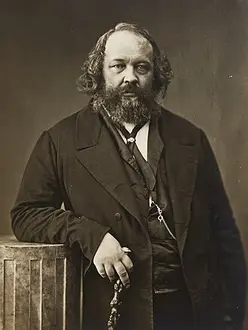
Russian revolutionary and collectivist anarchist theorist (1814–1876)
Bakunin’s mature politics sought to abolish the state and capitalist ownership in favor of freely federated communes and workers’ associations. He defended material equality, women’s emancipation and secular education while advocating mass revolution and clandestine organization. His polemics also made antisemitic conspiracy allegations.
Closest ideologies
Based on the 72 statements where Mikhail Bakunin has a known position.
- Makhnovshchina (89% match)
- Autonomist Marxism (87% match)
- Black anarchism (86% match)
- Antifa (86% match)
- Magonism (86% match)
Similar people
- William Morris (87% alike)
- Theodor W. Adorno (85% alike)
- Peter Kropotkin (84% alike)
- Emma Goldman (84% alike)
- Noam Chomsky (84% alike)
Known positions
- Strongly: Society would be better off without governments at all.
- Strongly: Marriage should cease to be a legally recognised status.
- Strongly: Work should no longer be divided into separate specialized jobs held by different people.
- Strongly: Religion gives people a false consolation for hardship in their material lives.
- Strongly: A minority group is working in secret to harm the nation.
- Strongly: The left should put workers' pay, jobs and living costs ahead of cultural identity causes.
- Strongly: Politics need not concern itself with people's spiritual needs.
- Strongly: Political change should replace the existing administrative and coercive institutions with new forms of organization, rather than put new leaders in charge of the old apparatus.
- Strongly: Towns and cities should link through councils whose delegates coordinate and administer what local assemblies decide, without making policy themselves.
- Strongly: Socialism in a single country will not endure without successful socialist revolutions in other countries.
- Strongly: Historical change comes mainly from changes in how society produces and exchanges goods.
- Strongly: A region should be entitled to leave its current country.
- Strongly: A healthy society does not depend on the traditional family, such as a married mother and father raising their children.
- Strongly: Laws, police and government mainly serve the interests of whoever owns the economy and holds power.
- Strongly: Communities should be free to choose their own economic arrangements, and a free society has no fixed blueprint for its economy.
- Strongly: Owners' profit is value taken from workers' labor.
- Strongly: Cooperation between employers and workers should not come before conflict where their interests differ.
- Strongly: People seeking political change should act directly—for example, with strikes, boycotts or occupations—instead of pursuing change through elections and parliaments.
- Strongly: Defense should rest with armed ordinary citizens, not a standing force.
- Strongly: Government should maintain a strict institutional separation from religion.
- Strongly: Religious values and institutions should not have a major part in shaping laws, schools and public life.
- Strongly: State schools should not teach religion.
- Strongly: Employees should have voting rights in the management of large companies.
- Strongly: Trade unions should control their own affairs without state direction.
- Strongly: Women's subordination is tied to how the economy is organised, so reform of laws and attitudes is not enough.
- Strongly: Businesses should belong to the people who work in them, for example as cooperatives.
- Strongly: A person's body belongs entirely to that person.
- Strongly: Laws, institutions and customs still favor men over women.
- Strongly: People outside state forces should also be allowed to bear arms.
- Strongly: Technology will not solve most of humanity's problems.
- Strongly: Political decisions should rest with the smallest local community able to handle them, with wider authorities handling matters that need a wider reach.
- Strongly: The state should treat all streams and interpretations of a religion equally under the law.
- Strongly: Whoever uses land or resources owes the rest of society a share of their value.
- Strongly: The national legislature should not be able to take back powers given to regions on its own.
- Strongly: Students should pay no tuition to attend public higher education institutions.
- Strongly: Society may be changed in large, rapid steps.
- Strongly: Workers' solidarity with workers in other countries should count at least as much as solidarity with their own nation.
- Strongly: A country can get through deadlock among its institutions without a leader who overrides them.
- Strongly: Hate speech should be legal.
- Strongly: A person loses freedom from being at another person's mercy, even if that power is never exercised.
- Strongly: Owners' rights to their property need not be protected against being overridden for public goals.
- Strongly: Workers are better off for having labor unions.
- Strongly: People should have a direct role in making decisions where they work, live and study, rather than having those decisions made entirely for them.
- Strongly: A wife should be able to end the marriage even when her husband refuses.
- Strongly: In law, a country's traditional national church should rank no higher than other religious bodies.
- Strongly: Being free requires having the practical resources to act on one's choices, such as an adequate livelihood.
- Strongly: The general public should have at least as much say in policy as experts.
- Strongly: Nobody should hold a special rank by birth, such as a noble title, a hereditary crown or a caste position, or the special rights attached to one.
- Strongly: Spouses should make marital decisions as equals.
- Strongly: No one is better suited by nature to govern than anyone else.
- Strongly: Rulers have a right to rule only because the people they rule have agreed to it.
- Strongly: Even a purely ceremonial head of state should not hold the position by birth.
- Strongly: Art should not be censored for its effect on people's moral character.
- Strongly: The law should not assign different roles in public life on the basis of sex.
- Strongly: Very large concentrations of wealth threaten a free society.
- Strongly: An economy directed by a central plan is not capable of working better than one directed by market exchange.
- Strongly: Political violence is sometimes justified.
- Strongly: Income from useful work should be rewarded ahead of income from merely owning property.
- Strongly: Political authority does not ultimately come from God.
- Strongly: A government needs more than fair elections to be democratic.
- Strongly: Laws should not be required to follow religious texts.
- Strongly: At least some revolutions have been justified.
- Strongly: News media should decide for themselves what they publish, whoever holds power.
- Strongly: No party's ideology should give it an exclusive right to lead the state.
- Strongly: Some areas of life should remain outside state direction.
- Strongly: Women should be able to vote and stand for office on the same terms as men.
- Strongly: A workers' state does not need to suppress the old ruling class, even for a time.
- Strongly: Final authority over a state's laws need not belong to its most senior religious scholars.
- Leans: Living in a city does at least as much for a person's moral wellbeing as living in the countryside.
- Leans: What things are worth comes from the work put into them.
- Leans: Industries such as energy, rail and utilities should be owned by the state or public bodies, not private companies.
- Leans: You can't reach a free, fair society by unfree or unfair means.