Political Ideology Atlas · All people · Take the test
South & Southeast Asia · born 1883, historical
Vinayak Damodar Savarkar
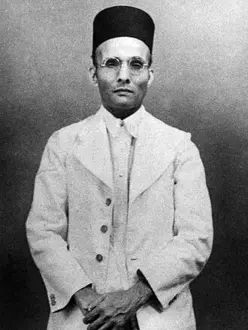
Indian revolutionary, writer and Hindu nationalist ideologue; coined Hindutva; president of the Hindu Mahasabha (1937-1943)
Savarkar (1883-1966) began as an armed revolutionary against British rule, was transported to the Andamans, and after his release in 1924 became the main ideologue of Hindu nationalism, defining a Hindu as one who holds India as both fatherland and holyland and treating the Hindus as a nation. As Hindu Mahasabha president he demanded one man one vote and equal citizenship with no communal electorates, an undivided India, Hindu militarisation, a machine-age nationalist economy that co-ordinated class interests, and war on caste untouchability, cow worship and superstition in the name of science, while describing Muslims as a hostile community and urging retaliation against enemy civilians in his history.
Closest ideologies
Based on the 100 statements where Vinayak Damodar Savarkar has a known position.
- American nationalism (92% match)
- Pan-Iranism (90% match)
- Turanism (89% match)
- Sovereigntism (89% match)
- German nationalism in Austria (89% match)
Similar people
- Ulrich Siegmund (89% alike)
- Ulysses S. Grant (89% alike)
- Niccolò Machiavelli (88% alike)
- Andrew Jackson (88% alike)
- Max Weber (88% alike)
Known positions
- Strongly: In war, the enemy's civilians are legitimate targets.
- Strongly: Foreign loanwords should be removed from the national language and replaced with native words.
- Strongly: Where they conflict, evidence and reasoning should count for more than faith, God, revelation or scripture.
- Strongly: Workers' solidarity with their own nation should take priority over solidarity with workers across borders.
- Strongly: Jews, as a people, are entitled to a country of their own in the Land of Israel.
- Strongly: My country's military strength should exceed that of its rivals.
- Strongly: Taxes on imports should shield domestic producers from foreign competition.
- Strongly: Prisons should mainly help offenders rejoin society.
- Strongly: When national priorities conflict with working together internationally, my country should choose its own priorities.
- Strongly: People outside state forces should also be allowed to bear arms.
- Strongly: A government may leave the political systems of other countries to their own people.
- Strongly: Some cultures are superior to others.
- Strongly: Employers and workers should treat each other as partners whose cooperation comes before conflict, even where their interests differ.
- Strongly: Owning a gun should not face strict legal limits.
- Strongly: Deeply divided societies should not guarantee every major community a share of executive power.
- Strongly: Today's nation is the same people as its ancient and medieval forebears.
- Strongly: People who give their lives for the nation deserve to be remembered as martyrs, with reverence beyond ordinary thanks.
- Strongly: A country may keep a region that wants to leave.
- Strongly: A people split by an imposed border should be brought together in a single state.
- Strongly: National policy should give priority to preventing outside powers from splitting the country territorially.
- Strongly: Historical change does not come mainly from changes in how society produces and exchanges goods.
- Strongly: Other forces move history at least as much as conflict between classes does.
- Strongly: The holy scripture of one's faith is not God's own error-free word.
- Strongly: Political violence is sometimes justified.
- Strongly: The government should let its political opponents organise, speak and compete for power.
- Strongly: A people's connection to its ancestral land is spiritual, beyond practical interests or ordinary affection.
- Strongly: A country may leave other nations to choose their own political systems.
- Strongly: Being the first to use force can be right, depending on what it is meant to achieve.
- Strongly: Laws should not be required to follow religious texts.
- Strongly: Soldiers and conscripts need not refuse to fight when their state goes to war.
- Strongly: At least some revolutions have been justified.
- Strongly: Keeping a nation's inherited culture alive, including its language, customs and traditions, matters.
- Strongly: In a war between great powers, workers need not seek their own government's defeat.
- Strongly: Industrial society has done at least as much good as harm to humanity.
- Strongly: Members of other ethnic groups should be free to stay in the country.
- Strongly: People of different races should not be discouraged from forming a family together, including through marriage and children.
- Strongly: Countries should keep their armed forces.
- Strongly: Voters of different religious communities may all vote in the same elections.
- Strongly: Voting should not be limited to members of one ethnic group.
- Strongly: Killing another person can be right in self-defence or in defence of others.
- Strongly: People without property should also have the right to vote.
- Strongly: Public spaces such as schools and facilities should not be separated by race under the law.
- Leans: In the long run people should be free to live and work in any country.
- Leans: A minority group is working in secret to harm the nation.
- Leans: All land should be owned by the state.
- Leans: Members of every racial group should organise politically around interests specific to their group.
- Leans: A person's sex should affect the public roles legally assigned to them.
- Leans: It is acceptable for a monarch who inherits the throne to be the country's symbolic head while others govern.
- Leans: The presence of people belonging to the same nation gives a state a legitimate territorial claim outside its borders.
- Leans: Young people should belong to uniformed, drilled organisations that prepare them to serve the nation.
- Leans: A nation should be mainly one ethnic people.
- Leans: The state should keep the colonial-era boundaries it inherits at independence.
- Leans: A society holds together less well when its members belong to different ethnic groups.
- Leans: There should be legal limits on strike action.
- Leans: Owners' rights to their property should almost never be overridden, even for public goals.
- Leans: The state should make one language the only common language of government, schooling and public life, limiting the use of others.
- Leans: A national emergency sometimes justifies temporarily withdrawing normal legal safeguards against people the government regards as internal enemies, such as protections against detention without trial.
- Leans: Society should push new technology forward faster, even where it overturns established institutions.
- Leans: Judge policies by what they achieve, independently of whether they match an ideology.
- Leans: Force is for self-defence alone.
- Leans: A national minority should run its own schools, language and cultural institutions inside the state it lives in.
- Leans: Many political decisions should rest with national or wider authorities, even where a smaller community could handle them.
- Leans: Science and technology will fix most of what goes wrong for people.
- Leans: Outside governments have no entitlement to interfere in another country's internal affairs for any purpose.
- Leans: Government should maintain a strict institutional separation from religion.
- Leans: A country has the right to stop a region becoming independent by using its military.
- Leans: Admissions, hiring and contracts should not favor anyone on the basis of race.
- Leans: Inherited religious teachings should be understood anew in light of present conditions.
- Leans: Sharing a language is not sufficient for people to constitute one nation.
- Leans: Society should follow a third course beyond capitalism and communism.
- Leans: The nation has decayed and must be reborn.
- Leans: Industries such as energy, rail and utilities should be owned by the state or public bodies, not private companies.
- Leans: Humanity would gain nothing by going back to living off hunting and gathering.
- Leans: The government should be able to require citizens to serve in the military.
- Leans: Belonging to the nation ties a person's life to a sacred community that goes on after their death.
- Leans: The state should treat all streams and interpretations of a religion equally under the law.
- Leans: My country should stay neutral and join neither of the opposing great-power alliances.
- Leans: Land claimed as the historic homeland should not be traded away, even for peace.
- Leans: Ideas of what men and women are like do not come mostly from culture.
- Leans: A poor country should develop mainly with its own resources.
- Leans: Society may be changed in large, rapid steps.
- Leans: Public institutions should help minority languages be used in public life, for example through teaching or services in those languages.
- Leans: Women and men should face identical draft obligations, including no obligations for either group when the draft is abolished.
- Leans: A nation need not wait for a cultural revival before building its state.
- Leans: How someone turns out is shaped more by upbringing, society and experience than by the traits they are born with.
- Leans: Direct action does not have to take the place of elections and parliament as the way to achieve political change.
- Leans: Society should use modern technology together with revived values inherited from its ancestors.
- Leans: Political institutions developed in the West are not a suitable model for every civilization.
- Leans: Schools should cultivate patriotic feeling: loyalty to and pride in the nation, expressed for example through respect for its flag and anthem.
- Leans: Nobody should hold a special rank by birth, such as a noble title, a hereditary crown or a caste position, or the special rights attached to one.
- Leans: It is legitimate to take pride in the racial group one belongs to.
- Leans: Some areas of life should remain outside state direction.
- Leans: Restoring a lost social order does not matter more than pursuing progress.
- Leans: Rulers have a right to rule only because the people they rule have agreed to it.
- Leans: Being powerful does not mean a country should bring more land within its borders.
- Leans: School history should mostly tell the story of the student's own nation.
- Leans: The law should treat everyone as an equal, whatever their birth, sex, race or status.