Political Ideology Atlas · All ideologies · Take the test
American nationalism
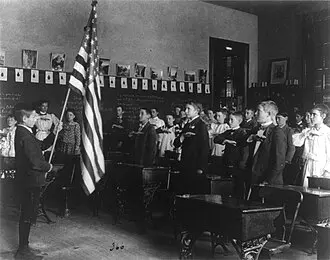
American nationalism holds that Americans are one nation, represented by the US government, whose independence, union and identity are to be defended. It runs from the founders' union and neutrality through Lincoln's creedal nation and Theodore Roosevelt's demand for undivided allegiance to restrictionist and America First nationalism, which differ on immigration, religion and ethnicity.
What it stands for
- A powerful country should bring more land within its borders.
- A country has the right to stop a region becoming independent by using its military.
- When national priorities conflict with working together internationally, my country should choose its own priorities.
- Cultural life inside a state should not be placed under the control of each national minority.
- Democracy is best even when voters make poor choices.
- The state should make immigrants learn the language of the country they settle in.
Key figures
- George Washington: First President whose Farewell Address urges union as one people under the name of American and no permanent foreign alliances.
- Abraham Lincoln: Defended the perpetual Union and framed the nation around the Declaration's equality proposition.
- Theodore Roosevelt: Advocate of the New Nationalism and of undivided, 'hyphen-free' Americanism and Americanisation.
Closest ideologies
- Venizelism (92% match)
- Revisionist Zionism (91% match)
- Creole nationalism (90% match)
- Sovereign democracy (89% match)
- German nationalism in Austria (89% match)
People closest to it
- Vinayak Damodar Savarkar (92% alike)
- Andrew Jackson (91% alike)
- Niccolò Machiavelli (90% alike)
- Giorgia Meloni (89% alike)
- William McKinley (89% alike)
Key positions
- Strongly: A powerful country should bring more land within its borders.
- Strongly: A country has the right to stop a region becoming independent by using its military.
- Strongly: When national priorities conflict with working together internationally, my country should choose its own priorities.
- Strongly: Cultural life inside a state should not be placed under the control of each national minority.
- Strongly: Democracy is best even when voters make poor choices.
- Strongly: The state should make immigrants learn the language of the country they settle in.
- Strongly: A country may keep a region that wants to leave.
- Strongly: A country may keep all its decisions in its own hands rather than pooling them with other nations.
- Strongly: Schools should cultivate patriotic feeling: loyalty to and pride in the nation, expressed for example through respect for its flag and anthem.
- Strongly: Member states should keep the final decision on whether to follow UN decisions.
- Strongly: Political violence is sometimes justified.
- Strongly: School history should mostly tell the story of the student's own nation.
- Strongly: The law should treat everyone as an equal, whatever their birth, sex, race or status.
- Strongly: At least some revolutions have been justified.
- Strongly: Countries may keep controls on who enters and settles, even in the long run.
- Strongly: Keeping a nation's inherited culture alive, including its language, customs and traditions, matters.
- Strongly: In a war between great powers, workers need not seek their own government's defeat.
- Strongly: Countries should keep their armed forces.
- Leans: The state should make one language the only common language of government, schooling and public life, limiting the use of others.
- Leans: Newcomers should adopt the host nation's culture in place of their original culture.
- Leans: My country's military strength should exceed that of its rivals.
- Leans: Belonging to the nation ties a person's life to a sacred community that goes on after their death.
- Leans: Some things are right or wrong for everyone, in every culture and era.
- Leans: The nation's cause and the cause of its ordinary working people are one and the same.
- Leans: A people with a shared national identity is entitled to its own self-governing state.
- Leans: A people's connection to its ancestral land is spiritual, beyond practical interests or ordinary affection.