Political Ideology Atlas · All people · Take the test
Europe · born 1469, historical
Niccolò Machiavelli
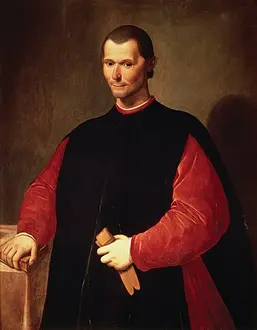
Florentine diplomat and political theorist (1469–1527)
Machiavelli served the Florentine Republic as secretary and diplomat and wrote The Prince, a manual of power for rulers, and the Discourses on Livy, which favours a mixed republic with an armed citizenry. He separates political success from conventional morality, defends a citizen militia over mercenaries, and treats religion as a civic tool while criticising the Church's role in Italian division. The Prince and the Discourses differ in sympathy and are read here with the Discourses as closer to his own preference.
Closest ideologies
Based on the 58 statements where Niccolò Machiavelli has a known position.
- German nationalism (90% match)
- American nationalism (90% match)
- Greater Somalia (89% match)
- Pan-Slavism (89% match)
- Turanism (89% match)
Similar people
- Napoleon III (90% alike)
- William McKinley (89% alike)
- Vinayak Damodar Savarkar (88% alike)
- Wang Jingwei (88% alike)
- Vladimir Putin (87% alike)
Known positions
- Strongly: The best government combines a governing role for a few with a governing role for the wider population.
- Strongly: Defense should rest with armed ordinary citizens, not a standing force.
- Strongly: A free, fair society can be reached through methods that fall short of being free and fair.
- Strongly: Judge policies by what they achieve, independently of whether they match an ideology.
- Strongly: My country may join a military alliance led by one of the great powers.
- Strongly: My country's military strength should exceed that of its rivals.
- Strongly: Armaments need not be limited to the minimum needed for national safety.
- Strongly: When national priorities conflict with working together internationally, my country should choose its own priorities.
- Strongly: Foreign powers sometimes have a right to intervene in a country's internal affairs.
- Strongly: The government should be able to require citizens to serve in the military.
- Strongly: Political violence is sometimes justified.
- Strongly: Being the first to use force can be right, depending on what it is meant to achieve.
- Strongly: Society needs government of some kind.
- Strongly: Countries should keep their armed forces.
- Strongly: State schools need not steer pupils away from belief in God.
- Leans: The state should punish people who publicly insult what a religion holds sacred.
- Leans: A powerful country should bring more land within its borders.
- Leans: War develops virtues in a nation, such as courage and discipline.
- Leans: History is mainly driven by conflict between economic classes.
- Leans: Recovering how society used to be matters more than moving forward.
- Leans: Young people should belong to uniformed, drilled organisations that prepare them to serve the nation.
- Leans: Peoples who share an ethnic heritage, such as the Slavic, Arab or Turkic peoples, should come together in one state, even across present borders.
- Leans: The government should have authority over religious institutions' internal affairs.
- Leans: Owners' rights to their property should almost never be overridden, even for public goals.
- Leans: The country would benefit from a strong leader with the power to act despite deadlock among its political institutions.
- Leans: A national emergency sometimes justifies temporarily withdrawing normal legal safeguards against people the government regards as internal enemies, such as protections against detention without trial.
- Leans: Changes to society should be introduced a little at a time.
- Leans: The country may allow more immigration than strict limits would permit.
- Leans: Politics should give compromises among competing groups at least as much weight as a single common good identified by reasoning.
- Leans: Besides its directly elected parliament, a legislature should have a second chamber, such as a senate.
- Leans: Inherited religious teachings should be understood anew in light of present conditions.
- Leans: Property should belong to many people in small holdings.
- Leans: Political power should be split among separate branches and levels that can each limit the others.
- Leans: The ruling class stays in power mainly through people going along with its ideas.
- Leans: Religious values and institutions should shape laws, schools and public life.
- Leans: The worst crimes can be punished by death.
- Leans: The nation has decayed and must be reborn.
- Leans: People should want as few material things as possible.
- Leans: Large landed estates should not be compulsorily transferred to the people who farm them.
- Leans: Armed forces may sometimes be used for purposes beyond defending the country against attack.
- Leans: What you owe your community matters more than your personal rights.
- Leans: How someone turns out is shaped more by upbringing, society and experience than by the traits they are born with.
- Leans: Political authority need not rest on oaths of loyalty sworn to a lord.
- Leans: An electorate should choose the head of state, either directly or through elected representatives.
- Leans: Government should rely at least as much on legal enforcement as on its rulers' moral example.
- Leans: The ruler should be subject to the country's laws.
- Leans: Nobody should hold a special rank by birth, such as a noble title, a hereditary crown or a caste position, or the special rights attached to one.
- Leans: Rulers must act under lasting, publicly known laws administered by recognised courts.
- Leans: Constantly seeking additional possessions is harmful overall, despite any benefits it brings.
- Leans: Most people in political office look after themselves first and the public second.
- Leans: Very large concentrations of wealth threaten a free society.
- Leans: At least some revolutions have been justified.
- Leans: Someone who actually governs a state should not hand that power on to their own child.