Political Ideology Atlas · All people · Take the test
Europe · born 1864, historical
Max Weber
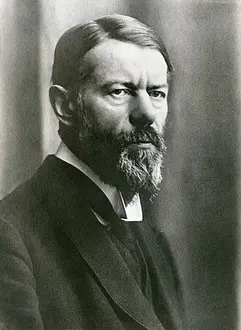
German sociologist, political economist and publicist (1864-1920)
German liberal-nationalist political economist and sociologist who put the power interests of the nation state above economic class interests and argued for a strong parliament and a directly elected, plebiscitary president as the way to select political leaders against rule by officials. He saw modern life as bureaucratising and disenchanted, held that conflicting ultimate values cannot be settled by science or reason, and doubted that socialism could do more than extend bureaucracy.
Closest ideologies
Based on the 44 statements where Max Weber has a known position.
- Venizelism (90% match)
- American nationalism (89% match)
- National Liberalism (89% match)
- Sovereigntism (87% match)
- Manifest destiny (87% match)
Similar people
- Vinayak Damodar Savarkar (88% alike)
- Ulrich Siegmund (87% alike)
- Andrew Jackson (86% alike)
- Benjamin Netanyahu (86% alike)
- Dick Cheney (86% alike)
Known positions
- Strongly: The state should encourage people of the majority group to move into areas where minority groups are in the majority.
- Strongly: Voters themselves should elect the head of state, without an intermediary body selecting the officeholder.
- Strongly: A free, fair society can be reached through methods that fall short of being free and fair.
- Strongly: No moral truths hold across all cultures.
- Strongly: The representative legislature should have the final say on legislation.
- Strongly: Politics should give compromises among competing groups at least as much weight as a single common good identified by reasoning.
- Strongly: When national priorities conflict with working together internationally, my country should choose its own priorities.
- Strongly: The country should impose strict limits on immigration.
- Strongly: Major laws should not be decided by direct votes of citizens.
- Strongly: An elected legislature must approve the government's budget before the government spends public money.
- Strongly: Workers are better off for having labor unions.
- Strongly: Political power may rest on something other than workplace-elected councils.
- Strongly: Society needs government of some kind.
- Strongly: Countries should keep their armed forces.
- Strongly: People without property should also have the right to vote.
- Leans: It is acceptable for a monarch who inherits the throne to be the country's symbolic head while others govern.
- Leans: A nation should be mainly one ethnic people.
- Leans: People do not need a direct role in making decisions where they work, live and study.
- Leans: Prices and competition generally decide better than officials what gets made and who gets it.
- Leans: The country would benefit from a strong leader with the power to act despite deadlock among its political institutions.
- Leans: The nation's figurehead should be non-partisan and belong to everyone.
- Leans: Judge policies by what they achieve, independently of whether they match an ideology.
- Leans: Parties that seek to abolish a country's constitutional order should be free to organize.
- Leans: Many political decisions should rest with national or wider authorities, even where a smaller community could handle them.
- Leans: Government should maintain a strict institutional separation from religion.
- Leans: Trade unions should control their own affairs without state direction.
- Leans: Some knowledge is neutral.
- Leans: Workers' pay should be settled in collective bargaining between their union and their employer.
- Leans: Seats may be allocated in ways that do not follow parties' shares of the vote closely.
- Leans: The law should impose no restrictions on strikes.
- Leans: The people who own the economy and hold power are not the ones the state mainly serves.
- Leans: A workers' state does not need to suppress the old ruling class, even for a time.
- Leans: Political representation should not come through social bodies such as families, local communities and occupational associations instead of political parties.
- Leans: In the long run people should still produce and share using money.
- Leans: Historical change does not come mainly from changes in how society produces and exchanges goods.
- Leans: Other forces move history at least as much as conflict between classes does.
- Leans: Keeping a nation's inherited culture alive, including its language, customs and traditions, matters.
- Leans: An economy directed by a central plan is not capable of working better than one directed by market exchange.
- Leans: World power should be distributed among several independent major powers, without one dominant power.
- Leans: Whatever their circumstances, everyone should be able to count on the state for enough to live decently, through benefits, pensions or public services.
- Leans: The leader should not bypass political intermediaries in dealing with the people.