Political Ideology Atlas · All people · Take the test
North America · born 1767, historical
Andrew Jackson
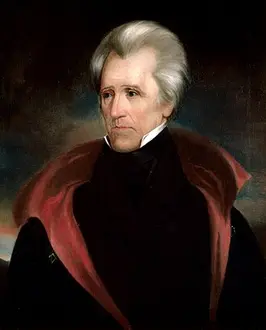
US president (1829–1837)
Jackson governed as a champion of white male farmers and laborers against what he called the moneyed few, rejecting a national bank, protective tariffs, federal internal improvements and constructive readings of federal power. He insisted on the permanence of the Union, rejecting nullification and secession by force, and drove Indian removal while defending slaveholders' rights against abolitionist agitation.
Closest ideologies
Based on the 65 statements where Andrew Jackson has a known position.
- American nationalism (91% match)
- Creole nationalism (90% match)
- Thatcherism (89% match)
- German nationalism in Austria (88% match)
- Post-fascism (88% match)
Similar people
- Giorgia Meloni (91% alike)
- Dick Cheney (89% alike)
- Dan Sullivan (89% alike)
- Margaret Thatcher (89% alike)
- Gerald Ford (88% alike)
Known positions
- Strongly: Voters themselves should elect the head of state, without an intermediary body selecting the officeholder.
- Strongly: Real authority to command the military should rest with the head of state.
- Strongly: A government should sometimes be entitled to rewrite or end such a treaty without the resident nation's consent.
- Strongly: Decisions about indigenous peoples' traditional lands may rest with the wider state, not with those peoples.
- Strongly: A country has the right to stop a region becoming independent by using its military.
- Strongly: Political power should be split among separate branches and levels that can each limit the others.
- Strongly: Officeholders at higher levels may be chosen by means other than delegates picked by lower councils.
- Strongly: Political decisions should rest with the smallest local community able to handle them, with wider authorities handling matters that need a wider reach.
- Strongly: The national legislature should not be able to take back powers given to regions on its own.
- Strongly: Direct action does not have to take the place of elections and parliament as the way to achieve political change.
- Strongly: Authorities need not limit outsiders settling in regions that were originally majority indigenous.
- Strongly: Recruitment to the civil service should not depend on competitive examinations.
- Strongly: An electorate should choose the head of state, either directly or through elected representatives.
- Strongly: A country may keep a region that wants to leave.
- Strongly: No one is better suited by nature to govern than anyone else.
- Strongly: Being the law gives a rule a moral claim to be obeyed.
- Strongly: Equality of outcomes should not be society's goal.
- Strongly: Most people in political office look after themselves first and the public second.
- Strongly: Very large concentrations of wealth threaten a free society.
- Strongly: Political violence is sometimes justified.
- Strongly: Protecting the constitution should be left to civilian institutions, not the armed forces.
- Strongly: Elected governments need not leave monetary policy to central banks acting on their own.
- Strongly: Businesses gain too much influence over government policy from their lobbying.
- Strongly: Governments should give no subsidies, licences or protections that favour firms close to them.
- Strongly: The armed forces may be controlled by someone other than the governing party's leadership.
- Strongly: Some decisions should bind people who have not consented to them.
- Strongly: Society needs government of some kind.
- Strongly: Countries should keep their armed forces.
- Strongly: The ruler should be subject to the country's laws.
- Leans: A government should exist, with protection against physical violence as its only task.
- Leans: Temporary rule by a more developed society is justified when it helps the ruled to progress.
- Leans: The government should stop its political opponents from organising, speaking or competing for power.
- Leans: A powerful country should bring more land within its borders.
- Leans: Owners' rights to their property should almost never be overridden, even for public goals.
- Leans: Elected politicians should serve only a small number of terms.
- Leans: Defense should rest with armed ordinary citizens, not a standing force.
- Leans: Speech that attacks groups for who they are can be punished by law.
- Leans: A national emergency sometimes justifies temporarily withdrawing normal legal safeguards against people the government regards as internal enemies, such as protections against detention without trial.
- Leans: Fewer tariffs and trade barriers make all countries better off over time.
- Leans: Changes to society should be introduced a little at a time.
- Leans: The government may leave it to investors to decide which industries receive investment.
- Leans: At least some unjust laws impose a moral duty of obedience.
- Leans: Businesses should be legally barred from agreements with competitors to suppress competition, such as fixing prices.
- Leans: Politics should give compromises among competing groups at least as much weight as a single common good identified by reasoning.
- Leans: Property should belong to many people in small holdings.
- Leans: Tariffs should not be used to protect domestic industry from foreign competition.
- Leans: A president should be limited in how many times he or she may stand for re-election.
- Leans: Within a country, the richer regions grew rich by draining the poorer ones, much as colonial powers drained their colonies.
- Leans: Democracy is best even when voters make poor choices.
- Leans: A head of state may take a side in party politics.
- Leans: The state should stop foreign buyers from taking over key national businesses.
- Leans: Government should impose strict rules on how corporations operate.
- Leans: Purchases of basic necessities should carry no consumption tax.
- Leans: People are entitled to resist a ruler's unconstitutional exercise of power.
- Leans: An elected legislature must approve the government's budget before the government spends public money.
- Leans: Collecting taxes does not in itself amount to stealing people's money.
- Leans: The general public should have at least as much say in policy as experts.
- Leans: Nobody should hold a special rank by birth, such as a noble title, a hereditary crown or a caste position, or the special rights attached to one.
- Leans: Rulers have a right to rule only because the people they rule have agreed to it.
- Leans: At least some revolutions have been justified.
- Leans: Income from useful work should be rewarded ahead of income from merely owning property.
- Leans: Political authority does not ultimately come from God.