Political Ideology Atlas · All people · Take the test
Europe · born 1856, historical
Philippe Pétain
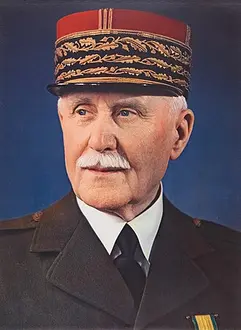
Chief of the French State at Vichy (1940–1944)
Philippe Pétain concentrated executive and legislative power in his own office after France’s defeat in 1940. His National Revolution promoted traditional family roles and state-supervised cooperation between employers and workers. He pursued collaboration with Nazi Germany and personally tightened the first Vichy statute excluding Jews from public life.
Closest ideologies
Based on the 58 statements where Philippe Pétain has a known position.
- Absolutism (European history) (91% match)
- Falangism (91% match)
- Emperor-system fascism (90% match)
- Corporate statism (90% match)
- National syndicalism (90% match)
Similar people
- Paul von Hindenburg (93% alike)
- Alexander Dugin (91% alike)
- Oliver Cromwell (91% alike)
- Alexander I of Yugoslavia (90% alike)
- William Joyce (89% alike)
Known positions
- Strongly: The people in power should decide what the country's news media publish.
- Strongly: Even under foreign military occupation, resistance should be unarmed.
- Strongly: A person's sex should affect the public roles legally assigned to them.
- Strongly: The law may treat people differently according to such things as birth, sex, race and status.
- Strongly: The government should stop its political opponents from organising, speaking or competing for power.
- Strongly: Rulers are not bound to act only under lasting, publicly known laws administered by recognised courts.
- Strongly: Officially recognized bodies representing employers and workers should negotiate wages together.
- Strongly: There should be legal limits on strike action.
- Strongly: Young people should belong to uniformed, drilled organisations that prepare them to serve the nation.
- Strongly: It is acceptable to praise a national leader openly as the one who stands for the whole nation.
- Strongly: The government may spend public money without first getting its budget approved by an elected legislature.
- Strongly: Governments should set legal price ceilings on essential foods when supplies are scarce.
- Strongly: Real authority to command the military should rest with the head of state.
- Strongly: A national emergency sometimes justifies temporarily withdrawing normal legal safeguards against people the government regards as internal enemies, such as protections against detention without trial.
- Strongly: The country would benefit from a strong leader with the power to act despite deadlock among its political institutions.
- Strongly: Trade unions may be subject to state direction of their affairs.
- Strongly: Abortion should be illegal in most cases.
- Strongly: Political power may be concentrated in one body.
- Strongly: Democracy is not the best form of government when voters choose badly.
- Strongly: Working for wages should remain a normal way for people to earn a living.
- Strongly: Full-time work at the legal wage floor should pay enough to meet basic living costs.
- Strongly: Some institutional ties between government and religion are acceptable.
- Strongly: Officials decide what gets made and who gets it at least as well as prices and competition do.
- Strongly: Employers and workers should treat each other as partners whose cooperation comes before conflict, even where their interests differ.
- Strongly: Government should impose strict rules on how corporations operate.
- Strongly: The nation has decayed and must be reborn.
- Strongly: Another body may have the final say over what the legislature passes.
- Strongly: Society relies for its well-being on longstanding family arrangements, such as a married mother and father raising their children.
- Strongly: The head of state should not be elected directly by the voters.
- Strongly: The state may restrict what adults do for reasons other than preventing harm to others.
- Strongly: Equality of outcomes should not be society's goal.
- Strongly: Police forces should continue to exist.
- Strongly: Keeping a nation's inherited culture alive, including its language, customs and traditions, matters.
- Strongly: Society needs government of some kind.
- Strongly: Countries should keep their armed forces.
- Leans: Women's political rights may differ from men's.
- Leans: Legal limits on how far prices, including pay, may rise are a good way to fight inflation.
- Leans: The head of state should not have to be chosen by election.
- Leans: Businesses need not belong to the people who work in them.
- Leans: Political change should replace the existing administrative and coercive institutions with new forms of organization, rather than put new leaders in charge of the old apparatus.
- Leans: The state should give families money to have more children, such as through payments and tax breaks.
- Leans: The law should make earning a living or doing other work compulsory for anyone capable of working.
- Leans: Besides its directly elected parliament, a legislature should have a second chamber, such as a senate.
- Leans: Property should belong to many people in small holdings.
- Leans: A constitution does not have to be drafted by an assembly elected for that purpose.
- Leans: A head of state should have the power to dissolve parliament.
- Leans: What you owe your community matters more than your personal rights.
- Leans: Living in the countryside does more for a person's moral wellbeing than living in a city.
- Leans: Religious values and institutions should shape laws, schools and public life.
- Leans: Government should take sides on how people live, backing the ways of life it judges good.
- Leans: Workers' pay should be settled in collective bargaining between their union and their employer.
- Leans: The people who make up the nation today are the same people, generation after generation, all the way back to its beginnings in antiquity.
- Leans: Changing how society works can be justified even when it breaks with the institutions already in place.
- Leans: Schools should cultivate patriotic feeling: loyalty to and pride in the nation, expressed for example through respect for its flag and anthem.
- Leans: Groups have rights of their own.
- Leans: Owning things privately is justified only if it benefits society as a whole.
- Leans: State ownership should stop short of covering all land.