Political Ideology Atlas · All people · Take the test
Europe · born 1847, historical
Paul von Hindenburg
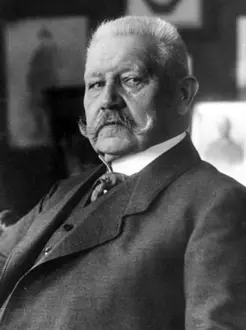
German field marshal and president of the German Reich (1925–1934)
Hindenburg was a monarchist and former military commander who served as president of the Weimar Republic. From 1930 he increasingly governed through presidential cabinets and emergency decrees. He appointed Adolf Hitler chancellor in January 1933 and issued the decree suspending constitutional protections after the Reichstag fire.
Closest ideologies
Based on the 33 statements where Paul von Hindenburg has a known position.
- Emperor-system fascism (94% match)
- Metaxism (93% match)
- Absolutism (European history) (92% match)
- İttihadism (92% match)
- Corporate statism (92% match)
Similar people
- Wilhelm II (93% alike)
- Philippe Pétain (93% alike)
- Oliver Cromwell (93% alike)
- Alexander Dugin (92% alike)
- Alexander I of Yugoslavia (92% alike)
Known positions
- Strongly: The government should stop its political opponents from organising, speaking or competing for power.
- Strongly: A powerful country should bring more land within its borders.
- Strongly: The government may spend public money without first getting its budget approved by an elected legislature.
- Strongly: Real authority to command the military should rest with the head of state.
- Strongly: A national emergency sometimes justifies temporarily withdrawing normal legal safeguards against people the government regards as internal enemies, such as protections against detention without trial.
- Strongly: The country would benefit from a strong leader with the power to act despite deadlock among its political institutions.
- Strongly: When national priorities conflict with working together internationally, my country should choose its own priorities.
- Strongly: The worst crimes can be punished by death.
- Strongly: The government should be able to require citizens to serve in the military.
- Strongly: A head of state should have the power to dissolve parliament.
- Strongly: What you owe your community matters more than your personal rights.
- Strongly: Another body may have the final say over what the legislature passes.
- Strongly: People who give their lives for the nation deserve to be remembered as martyrs, with reverence beyond ordinary thanks.
- Strongly: In a war between great powers, workers need not seek their own government's defeat.
- Strongly: Countries should keep their armed forces.
- Leans: The people in power should decide what the country's news media publish.
- Leans: Bringing back the way society used to be should take priority over trying to make new advances.
- Leans: Having a shared national identity does not by itself entitle a people to its own self-governing state.
- Leans: Many political decisions should rest with national or wider authorities, even where a smaller community could handle them.
- Leans: Workers' solidarity with their own nation should take priority over solidarity with workers across borders.
- Leans: The nation's figurehead should be non-partisan and belong to everyone.
- Leans: Large landed estates should not be compulsorily transferred to the people who farm them.
- Leans: The political goal should be victory over communism ahead of accommodation with it.
- Leans: The law should make earning a living or doing other work compulsory for anyone capable of working.
- Leans: Political power may be concentrated in one body.
- Leans: Democracy is not the best form of government when voters choose badly.
- Leans: The government should steer investment into industries it sees as key to the country's future.
- Leans: Employers and workers should treat each other as partners whose cooperation comes before conflict, even where their interests differ.
- Leans: A country should use its armed forces to advance policy goals beyond national self-defence.
- Leans: Owners' rights to their property need not be protected against being overridden for public goals.
- Leans: Keeping a nation's inherited culture alive, including its language, customs and traditions, matters.
- Leans: The armed forces may be controlled by someone other than the governing party's leadership.