Political Ideology Atlas · All people · Take the test
Russia & Central Asia · born 1962
Alexander Dugin
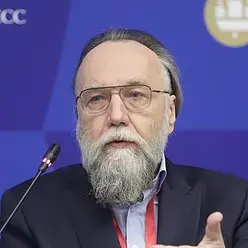
Russian political philosopher; founder of neo-Eurasianism and the fourth political theory
Dugin rejects liberalism, communism and fascism as modern ideologies and proposes a 'fourth political theory' built on tradition, collective identity and civilizational sovereignty. He calls for a multipolar order against the 'Atlanticist' West, a Russian-led Eurasian bloc, and supports Putin and the war in Ukraine. Scholars place him in the radical-conservative, Heideggerian and New Right tradition.
Key figure of
Closest ideologies
Based on the 37 statements where Alexander Dugin has a known position.
- Neo-fascism (93% match)
- Metaxism (92% match)
- Mobutism (91% match)
- Corporate statism (90% match)
- Absolutism (European history) (90% match)
Similar people
- Paul von Hindenburg (92% alike)
- Philippe Pétain (91% alike)
- Jorge Rafael Videla (90% alike)
- Oliver Cromwell (90% alike)
- Augustus (89% alike)
Known positions
- Strongly: Having a shared national identity does not by itself entitle a people to its own self-governing state.
- Strongly: My country should possess its own nuclear arsenal with independent authority over its use.
- Strongly: A powerful country should bring more land within its borders.
- Strongly: Humanity has been declining since a past golden age.
- Strongly: Dividing politics into left and right no longer makes sense.
- Strongly: At its core, politics is a struggle between spiritual good and evil.
- Strongly: Whether a policy fits an ideology should count independently of its results.
- Strongly: Inherited religious teachings may stay as handed down, without being rethought for present conditions.
- Strongly: A country with nuclear weapons should keep them for as long as its rivals retain theirs.
- Strongly: Countries within one civilization should unite politically.
- Strongly: Ideas of what men and women are like do not come mostly from culture.
- Strongly: Society should follow a third course beyond capitalism and communism.
- Strongly: Religious values and institutions should shape laws, schools and public life.
- Strongly: A government may leave the political systems of other countries to their own people.
- Strongly: The law should not extend marriage to same-sex couples.
- Strongly: Society relies for its well-being on longstanding family arrangements, such as a married mother and father raising their children.
- Strongly: Transgender people's legal gender should not be based on their gender identity.
- Strongly: At least one other influence has shaped history as much as conflict between economic classes has.
- Strongly: Countries that feel dominated by Western powers should band together to resist them.
- Strongly: Political institutions developed in the West are not a suitable model for every civilization.
- Strongly: Groups have rights of their own.
- Strongly: The reassurance people draw from faith in the face of material hardship need not be founded on false hopes.
- Strongly: World power should be distributed among several independent major powers, without one dominant power.
- Strongly: In a war between great powers, workers need not seek their own government's defeat.
- Strongly: Classifying people by sex tracks differences that exist whatever society says.
- Strongly: Keeping a nation's inherited culture alive, including its language, customs and traditions, matters.
- Strongly: Public spaces such as schools and facilities should not be separated by race under the law.
- Strongly: State schools need not steer pupils away from belief in God.
- Leans: Once the national majority has decided, public institutions, including courts and independent bodies, should not limit its decision.
- Leans: No moral truths hold across all cultures.
- Leans: Peoples who share an ethnic heritage, such as the Slavic, Arab or Turkic peoples, should come together in one state, even across present borders.
- Leans: When national priorities conflict with working together internationally, my country should choose its own priorities.
- Leans: Democracy is not the best form of government when voters choose badly.
- Leans: Officials decide what gets made and who gets it at least as well as prices and competition do.
- Leans: Owners' rights to their property need not be protected against being overridden for public goals.
- Leans: The nation has decayed and must be reborn.
- Leans: Politics should support people's spiritual well-being.