Political Ideology Atlas · All people · Take the test
Europe · born 1906, historical
William Joyce
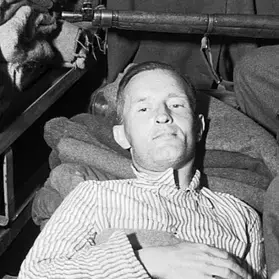
British fascist organizer and Nazi wartime broadcaster
Joyce founded the National Socialist League and advocated authoritarian leadership, occupational representation and state direction of the British economy. His politics centered on racial nationalism and antisemitism. During the Second World War he broadcast Nazi propaganda from Germany to Britain.
Key figure of
Closest ideologies
Based on the 86 statements where William Joyce has a known position.
- Volksgemeinschaft (92% match)
- Palingenetic ultranationalism (91% match)
- Nasserism (91% match)
- Völkisch movement (90% match)
- Mobutism (89% match)
Similar people
- Nick Fuentes (90% alike)
- Wilhelm Frick (90% alike)
- Philippe Pétain (89% alike)
- Oliver Cromwell (89% alike)
- Idi Amin (88% alike)
Known positions
- Strongly: Legal limits on how far prices, including pay, may rise are a good way to fight inflation.
- Strongly: Every part of life should be subject to state direction.
- Strongly: A state may force a minority it sees as hostile to leave the country.
- Strongly: The mother country and its colonies should meet their economic needs within their own bloc instead of trading with the outside world.
- Strongly: An economy whose production is directed by a central plan is capable of working better than an economy directed by market exchange.
- Strongly: The law may treat people differently according to such things as birth, sex, race and status.
- Strongly: The government should stop its political opponents from organising, speaking or competing for power.
- Strongly: Having a shared national identity does not by itself entitle a people to its own self-governing state.
- Strongly: A minority group is working in secret to harm the nation.
- Strongly: Officially recognized bodies representing employers and workers should negotiate wages together.
- Strongly: It is acceptable to praise a national leader openly as the one who stands for the whole nation.
- Strongly: A country should limit who may immigrate according to their race.
- Strongly: People should gain political representation through social bodies such as families, local communities and occupational associations instead of political parties.
- Strongly: Most of the people who make up a nation should belong to the same ethnic group.
- Strongly: Innate nature shapes a person's character at least as much as their environment does.
- Strongly: Workers' solidarity with their own nation should take priority over solidarity with workers across borders.
- Strongly: Governments should limit how money and investment can be moved across borders.
- Strongly: Businesses need not belong to the people who work in them.
- Strongly: The country would benefit from a strong leader with the power to act despite deadlock among its political institutions.
- Strongly: The work of making a product is not what gives it economic value.
- Strongly: When national priorities conflict with working together internationally, my country should choose its own priorities.
- Strongly: Besides its directly elected parliament, a legislature should have a second chamber, such as a senate.
- Strongly: Democracy is not the best form of government when voters choose badly.
- Strongly: Society should follow a third course beyond capitalism and communism.
- Strongly: The government should steer investment into industries it sees as key to the country's future.
- Strongly: A state of their own in the Land of Israel is not something Jews are owed as a people.
- Strongly: Direct action does not have to take the place of elections and parliament as the way to achieve political change.
- Strongly: Creating new money should be reserved to public institutions, excluding private banks' creation of money through lending.
- Strongly: Tariffs should not be used to protect domestic industry from foreign competition.
- Strongly: A country can miss out on lasting gains when barriers to international commerce come down.
- Strongly: What you owe your community matters more than your personal rights.
- Strongly: Seats may be allocated in ways that do not follow parties' shares of the vote closely.
- Strongly: Officials decide what gets made and who gets it at least as well as prices and competition do.
- Strongly: Society may be changed in large, rapid steps.
- Strongly: Employers and workers should treat each other as partners whose cooperation comes before conflict, even where their interests differ.
- Strongly: Government should impose strict rules on how corporations operate.
- Strongly: A country may keep a region that wants to leave.
- Strongly: Automation should be directed towards making the time people need to spend working as short as feasible.
- Strongly: Owners' rights to their property need not be protected against being overridden for public goals.
- Strongly: Firms in a market economy need not be owned by the people who work in them.
- Strongly: The nation has decayed and must be reborn.
- Strongly: Production should be organised to provide what people need, instead of being organised around what yields a profit.
- Strongly: Another body may have the final say over what the legislature passes.
- Strongly: Conflict between social classes ends once a society becomes socialist.
- Strongly: At least one other factor explains as much of history as changes in how economies are organized do.
- Strongly: At least one other influence has shaped history as much as conflict between economic classes has.
- Strongly: Formal press freedom is hollow when wealth decides who can actually be heard.
- Strongly: Being allowed to make a choice only counts as freedom if you have the resources to act on it.
- Strongly: Political institutions developed in the West are not a suitable model for every civilization.
- Strongly: Countries may keep controls on who enters and settles, even in the long run.
- Strongly: Owning things privately is justified only if it benefits society as a whole.
- Strongly: Most people in political office look after themselves first and the public second.
- Strongly: In the long run people should still produce and share using money.
- Strongly: A workers' state does not need to suppress the old ruling class, even for a time.
- Strongly: Elected governments need not leave monetary policy to central banks acting on their own.
- Strongly: Central banks should keep a role in controlling the money supply.
- Strongly: Society needs government of some kind.
- Strongly: Countries should keep their armed forces.
- Strongly: Government should have other tasks besides protecting people from physical violence.
- Strongly: Final authority over a state's laws need not belong to its most senior religious scholars.
- Leans: When rival great powers go to war, workers should work to make their own state lose.
- Leans: One ideologically correct party should hold state leadership without competing parties having a right to replace it.
- Leans: A person's sex should affect the public roles legally assigned to them.
- Leans: Specialists should have more weight in decisions than public opinion.
- Leans: The presence of people belonging to the same nation gives a state a legitimate territorial claim outside its borders.
- Leans: A society holds together less well when its members belong to different ethnic groups.
- Leans: Political change should replace the existing administrative and coercive institutions with new forms of organization, rather than put new leaders in charge of the old apparatus.
- Leans: New oil and gas wells and coal mines should be permitted.
- Leans: The law should make earning a living or doing other work compulsory for anyone capable of working.
- Leans: Property should belong to many people in small holdings.
- Leans: Some institutional ties between government and religion are acceptable.
- Leans: Religious values and institutions should shape laws, schools and public life.
- Leans: Countries should start from a policy of staying out of other countries' internal affairs.
- Leans: Keeping a nation's inherited culture alive, including its language, customs and traditions, matters.
- Leans: Society relies for its well-being on longstanding family arrangements, such as a married mother and father raising their children.
- Leans: Changing how society works can be justified even when it breaks with the institutions already in place.
- Leans: The global economic system keeps poorer countries poor by directing their wealth toward richer countries.
- Leans: The head of state should not be elected directly by the voters.
- Leans: Income from useful work should be rewarded ahead of income from merely owning property.
- Leans: Armed resistance to a foreign military occupation is justified.
- Leans: Without workers' own political power, state ownership is not socialism.
- Leans: Being powerful does not mean a country should bring more land within its borders.
- Leans: Workers are better off for having labor unions.
- Leans: Rulers have a right to rule only because the people they rule have agreed to it.
- Leans: A state should take responsibility for the welfare of its national communities across neighbouring borders.
- Leans: Belonging to the nation does not go with sharing its religion.