Political Ideology Atlas · All ideologies · Take the test
Greater Somalia
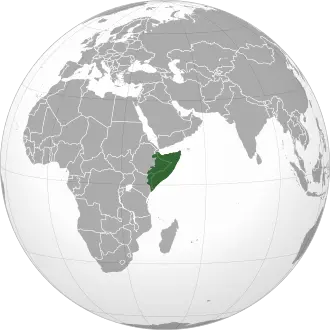
Greater Somalia (pan-Somalism) holds that the Somali people, divided by European and Ethiopian partition among Somalia, Djibouti, Ethiopia's Ogaden and Kenya's Northern Frontier District, should be reunited in one state. In its independence-era form it was a parliamentary, Muslim-majority nationalism that pursued unification officially by legal and peaceful means while backing armed kin and building a large army, and it takes no distinctive stance on the economy.
What it stands for
- The presence of people belonging to the same nation gives a state a legitimate territorial claim outside its borders.
- A nation should be mainly one ethnic people.
- Peoples who share an ethnic heritage, such as the Slavic, Arab or Turkic peoples, should come together in one state, even across present borders.
- A country should press its neighbour to give back land taken from it in an old war.
- Only children of citizens should be citizens at birth: being born in the country should not be enough.
- Speaking a common language is sufficient for people to constitute one nation.
Closest ideologies
- Pan-Slavism (91% match)
- Confucianism (88% match)
- Neue Rechte (87% match)
- Garveyism (87% match)
- American nationalism (87% match)
People closest to it
- Niccolò Machiavelli (89% alike)
- Ahmed al-Sharaa (88% alike)
- William McKinley (87% alike)
- Giorgia Meloni (87% alike)
- Marcus Garvey (86% alike)
Key positions
- Strongly: The presence of people belonging to the same nation gives a state a legitimate territorial claim outside its borders.
- Strongly: A nation should be mainly one ethnic people.
- Strongly: Peoples who share an ethnic heritage, such as the Slavic, Arab or Turkic peoples, should come together in one state, even across present borders.
- Strongly: A country should press its neighbour to give back land taken from it in an old war.
- Strongly: Only children of citizens should be citizens at birth: being born in the country should not be enough.
- Strongly: Speaking a common language is sufficient for people to constitute one nation.
- Strongly: Armaments need not be limited to the minimum needed for national safety.
- Strongly: State schools may teach pupils a religious faith, for example through lessons in its beliefs and practice.
- Strongly: Some institutional ties between government and religion are acceptable.
- Strongly: Belonging to the nation ties a person's life to a sacred community that goes on after their death.
- Strongly: Land claimed as the historic homeland should not be traded away, even for peace.
- Strongly: A people should have one region of its own rather than being split across several.
- Strongly: Sex work between consenting adults should be illegal.
- Strongly: A national church need not be ruled by its bishops.
- Strongly: An ancestral bond to a land gives a people a claim that outweighs the claims of other peoples who now live there.
- Strongly: Land that a state declares its own against its people's will is still illegally occupied by that state.
- Strongly: Gathering all the people in the homeland should have at least as much priority as supporting diaspora culture.
- Strongly: Today, nobody is bound by a colonial-era treaty that divided a people without asking them.
- Strongly: A newly independent state should sometimes redraw its inherited colonial borders.
- Strongly: A healthy society depends on the traditional family, such as a married mother and father raising their children.
- Strongly: The law should not extend marriage to same-sex couples.
- Strongly: A people split by an imposed border should be brought together in a single state.
- Strongly: A state should take responsibility for the welfare of its national communities across neighbouring borders.
- Strongly: Other forces move history at least as much as conflict between classes does.
- Strongly: A people with a shared national identity is entitled to its own self-governing state.
- Strongly: Someone who actually governs a state should not hand that power on to their own child.
- Strongly: Workers do not need a disciplined revolutionary party to lead them.
- Strongly: Political power may rest on something other than workplace-elected councils.
- Strongly: The armed forces may be controlled by someone other than the governing party's leadership.
- Strongly: Work may stay divided into separate specialized jobs held by different people.
- Strongly: In the long run people should still produce and share using money.
- Strongly: Some areas of life should remain outside state direction.
- Strongly: Private owners' choice of whom they deal with should be subject to some restrictions.
- Strongly: No society has the right to rule another for its supposed improvement, however advanced it is.
- Strongly: Marriage should retain legal recognition.
- Strongly: A workers' state does not need to suppress the old ruling class, even for a time.
- Strongly: Public offices may be filled by methods other than drawing lots.
- Strongly: Society needs government of some kind.
- Strongly: Countries should keep their armed forces.
- Strongly: The ruler should be subject to the country's laws.
- Strongly: Collecting taxes does not in itself amount to stealing people's money.
- Strongly: Public policy should not be used to reduce the passing on of inherited disabilities.
- Strongly: Renting out housing should be permitted in at least some circumstances.
- Strongly: Overseas territories need not be run mainly for the ruling country's economic benefit.
- Strongly: The holder of the highest state office need not be treated as holy.
- Strongly: State schools need not steer pupils away from belief in God.
- Strongly: Courts need not be handed over to private businesses.
- Strongly: Museums, libraries and other inherited culture should not be destroyed, even when they stand in the way of new creation.
- Strongly: Humanity would gain nothing by going back to living off hunting and gathering.
- Strongly: Farmers should have the legal freedom to leave the estates they work.
- Leans: The law limits or polices changing religion, for example to prevent pressure or inducement.
- Leans: Laws should follow religious texts.
- Leans: An armed minority's actions are capable of bringing about conditions that enable a broader revolutionary uprising.
- Leans: Belonging to the nation goes with sharing its religion.
- Leans: A powerful country should bring more land within its borders.
- Leans: My country should give weapons to foreign insurgents fighting governments it regards as enemies.
- Leans: A person's sex should affect the public roles legally assigned to them.
- Leans: A region should be entitled to leave its current country.
- Leans: The representative legislature should have the final say on legislation.
- Leans: Marriage, inheritance and family law may differ between religious communities.
- Leans: My country's military strength should exceed that of its rivals.
- Leans: Government should be bound by written guarantees of basic rights protected against easy amendment by ordinary majorities.
- Leans: Allies are bound to defend one another against armed attack.
- Leans: Political power should be split among separate branches and levels that can each limit the others.
- Leans: Work under capitalism does not alienate people from their own creative activity.
- Leans: Religious values and institutions should shape laws, schools and public life.
- Leans: Foreign powers sometimes have a right to intervene in a country's internal affairs.
- Leans: Suspected drug dealers should never be put to death without a trial.
- Leans: Armed forces may sometimes be used for purposes beyond defending the country against attack.
- Leans: Democracy is best even when voters make poor choices.
- Leans: Final authority over a state's laws need not belong to its most senior religious scholars.
- Leans: Society may be changed in large, rapid steps.
- Leans: Countries within one civilization may remain politically separate.
- Leans: Workers' solidarity with workers in other countries should count at least as much as solidarity with their own nation.
- Leans: A country can get through deadlock among its institutions without a leader who overrides them.
- Leans: Immigrants should qualify for citizenship with less than ten years of residence.
- Leans: Political authority need not rest on oaths of loyalty sworn to a lord.
- Leans: The head of state should not be elected directly by the voters.
- Leans: Today's nation is the same people as its ancient and medieval forebears.
- Leans: An electorate should choose the head of state, either directly or through elected representatives.
- Leans: Government should rely at least as much on legal enforcement as on its rulers' moral example.
- Leans: People belonging to a nation but living abroad should be entitled to settle in that nation's ancestral homeland.
- Leans: Government should have other tasks besides protecting people from physical violence.
- Leans: Capitalism does not inevitably cause wars between great powers.
- Leans: Where they conflict, religious faith should count for at least as much as evidence and reasoning.
- Leans: The people who own the economy and hold power are not the ones the state mainly serves.
- Leans: The general public should have at least as much say in policy as experts.
- Leans: Schools should cultivate patriotic feeling: loyalty to and pride in the nation, expressed for example through respect for its flag and anthem.
- Leans: Rulers must act under lasting, publicly known laws administered by recognised courts.
- Leans: The vote keeps a government in check at least as well as being able to leave the country does.
- Leans: National policy should give priority to preventing outside powers from splitting the country territorially.
- Leans: Historical change does not come mainly from changes in how society produces and exchanges goods.
- Leans: There is no deliberate plan behind immigration aimed at replacing the native population.
- Leans: No one is better suited by nature to govern than anyone else.
- Leans: The state should guarantee health care to everyone, whether it runs the services itself or pays for them.
- Leans: Rulers have a right to rule only because the people they rule have agreed to it.
- Leans: Even a purely ceremonial head of state should not hold the position by birth.
- Leans: Most people in political office look after themselves first and the public second.
- Leans: Private ownership is legitimate only insofar as it benefits society.
- Leans: Politics should support people's spiritual well-being.
- Leans: Countries may keep controls on who enters and settles, even in the long run.
- Leans: No party's ideology should give it an exclusive right to lead the state.
- Leans: News media should decide for themselves what they publish, whoever holds power.
- Leans: At least some revolutions have been justified.
- Leans: War does not strengthen a nation's character.
- Leans: Political violence is sometimes justified.
- Leans: The government should let its political opponents organise, speak and compete for power.
- Leans: Minority groups are not, as groups, secretly plotting to harm the nation.
- Leans: The leader should not bypass political intermediaries in dealing with the people.
- Leans: A country may leave other nations to choose their own political systems.
- Leans: A mother country and its colonies may trade with the outside world.
- Leans: Being the first to use force can be right, depending on what it is meant to achieve.
- Leans: Groups have rights of their own.
- Leans: School history should mostly tell the story of the student's own nation.
- Leans: The law should treat everyone as an equal, whatever their birth, sex, race or status.
- Leans: Individual farms should not give way to joint cultivation by groups of farmers.