Political Ideology Atlas · All people · Take the test
Europe · born 1808, historical
Napoleon III
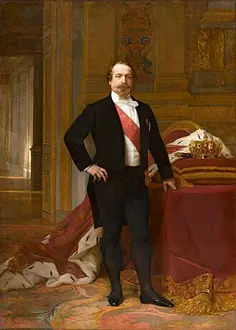
President of the French Republic (1848-1852) and Emperor of the French (1852-1870)
Napoleon III combined plebiscitary authoritarian rule, a strong executive and hereditary monarchy with state-led economic modernisation, free trade, public works and limited social reform. He presented himself as the heir of the Revolution and of Napoleon I, backed nationalities in Italy, protected the Pope's temporal power and expanded French influence overseas. In the 1860s he granted the legislature more powers and workers the right to strike.
Closest ideologies
Based on the 86 statements where Napoleon III has a known position.
- German nationalism (91% match)
- Person Dignity Theory (89% match)
- Pan-Finnicism (88% match)
- Japanese nationalism (88% match)
- American nationalism (88% match)
Similar people
- Niccolò Machiavelli (90% alike)
- William McKinley (88% alike)
- Ahmed al-Sharaa (87% alike)
- Theodore Roosevelt (86% alike)
- Giorgia Meloni (86% alike)
Known positions
- Strongly: Temporary rule by a more developed society is justified when it helps the ruled to progress.
- Strongly: Someone who actually governs a state may hand that power on to their own child, whether as a king or as a republic's leader.
- Strongly: Owners' rights to their property should almost never be overridden, even for public goals.
- Strongly: The country would benefit from a strong leader with the power to act despite deadlock among its political institutions.
- Strongly: A national emergency sometimes justifies temporarily withdrawing normal legal safeguards against people the government regards as internal enemies, such as protections against detention without trial.
- Strongly: Fewer tariffs and trade barriers make all countries better off over time.
- Strongly: Real authority to command the military should rest with the head of state.
- Strongly: Military intervention abroad is sometimes necessary to protect human rights.
- Strongly: Governments should not fix maximum prices for essential foods, even in times of scarcity.
- Strongly: Some cultures are superior to others.
- Strongly: Employers and workers should treat each other as partners whose cooperation comes before conflict, even where their interests differ.
- Strongly: Restoring a lost social order does not matter more than pursuing progress.
- Strongly: Political violence is sometimes justified.
- Strongly: A mother country and its colonies may trade with the outside world.
- Strongly: Industrial society has done at least as much good as harm to humanity.
- Strongly: Population growth does not mainly drive lasting poverty.
- Strongly: Some areas of life should remain outside state direction.
- Strongly: Society needs government of some kind.
- Strongly: Government should have other tasks besides protecting people from physical violence.
- Strongly: Collecting taxes does not in itself amount to stealing people's money.
- Strongly: The holder of the highest state office need not be treated as holy.
- Strongly: Final authority over a state's laws need not belong to its most senior religious scholars.
- Leans: An armed minority's actions are capable of bringing about conditions that enable a broader revolutionary uprising.
- Leans: Farming should be organized as joint cultivation by groups of farmers instead of separate individual farm operations.
- Leans: Spreading our political system abroad should be a special calling of our nation.
- Leans: Temporary limits on political freedom are justified to achieve rapid economic development.
- Leans: A powerful country should bring more land within its borders.
- Leans: Private property does not need to serve the common good to be justified.
- Leans: Some people are better suited by nature to govern.
- Leans: It is acceptable to praise a national leader openly as the one who stands for the whole nation.
- Leans: Special ranks held by birth, such as noble titles and hereditary crowns, may continue to exist.
- Leans: Countries should hand part of their decision-making power to a union of nations, such as the European Union.
- Leans: The best government combines a governing role for a few with a governing role for the wider population.
- Leans: The government should have authority over religious institutions' internal affairs.
- Leans: Prices and competition generally decide better than officials what gets made and who gets it.
- Leans: Voters themselves should elect the head of state, without an intermediary body selecting the officeholder.
- Leans: Changes to society should be introduced a little at a time.
- Leans: Countries are better off sharing one currency than each having its own.
- Leans: Major laws should be decided by citizens voting on them themselves.
- Leans: The nation's figurehead should be non-partisan and belong to everyone.
- Leans: Judge policies by what they achieve, independently of whether they match an ideology.
- Leans: Many political decisions should rest with national or wider authorities, even where a smaller community could handle them.
- Leans: My country's military strength should exceed that of its rivals.
- Leans: Allies are bound to defend one another against armed attack.
- Leans: Tariffs should not be used to protect domestic industry from foreign competition.
- Leans: Living in the countryside does more for a person's moral wellbeing than living in a city.
- Leans: State schools may teach pupils a religious faith, for example through lessons in its beliefs and practice.
- Leans: Religious values and institutions should shape laws, schools and public life.
- Leans: Some institutional ties between government and religion are acceptable.
- Leans: The government should be able to require citizens to serve in the military.
- Leans: Governments should not borrow heavily, spending much more than they collect in taxes, to boost the economy.
- Leans: A government should outlaw political parties that aim to do away with its constitutional order.
- Leans: Marriage, inheritance and family law should be the same for everyone, not set by each religious community.
- Leans: The government should steer investment into industries it sees as key to the country's future.
- Leans: A country may join permanent military alliances.
- Leans: A constitution does not have to be drafted by an assembly elected for that purpose.
- Leans: How someone turns out is shaped more by upbringing, society and experience than by the traits they are born with.
- Leans: Direct action does not have to take the place of elections and parliament as the way to achieve political change.
- Leans: The law should impose no restrictions on strikes.
- Leans: A country need not treat an excess of exports over imports as something to aim for.
- Leans: Workers are better off for having labor unions.
- Leans: Where they conflict, religious faith should count for at least as much as evidence and reasoning.
- Leans: The people who own the economy and hold power are not the ones the state mainly serves.
- Leans: A healthy society depends on the traditional family, such as a married mother and father raising their children.
- Leans: A people split by an imposed border should be brought together in a single state.
- Leans: Meeting poor people's needs should be the first consideration in public policy.
- Leans: People of different races should not be discouraged from forming a family together, including through marriage and children.
- Leans: Equality of outcomes should not be society's goal.
- Leans: Other forces move history at least as much as conflict between classes does.
- Leans: No party's ideology should give it an exclusive right to lead the state.
- Leans: Whatever their circumstances, everyone should be able to count on the state for enough to live decently, through benefits, pensions or public services.
- Leans: A people with a shared national identity is entitled to its own self-governing state.
- Leans: Laws should not be required to follow religious texts.
- Leans: The law should treat everyone as an equal, whatever their birth, sex, race or status.