Political Ideology Atlas · All people · Take the test
Europe · born 1566, historical
James VI and I
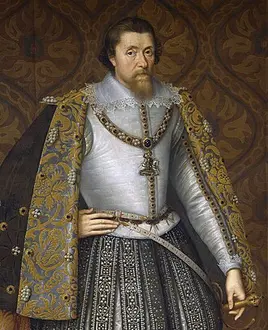
King of Scotland (1567-1625) and of England and Ireland (1603-1625)
James defended hereditary monarchy as God's appointment and held that subjects may never resist even a bad king, though a king in a settled realm should rule by its laws and answers to God alone. He backed bishops and royal control of the church, opposed Puritan and papal claims, sought a union of England and Scotland, and kept peace abroad. His moral views were strict: death for witchcraft, sodomy among unpardonable crimes, and wives subordinate to husbands.
Closest ideologies
Based on the 96 statements where James VI and I has a known position.
- Absolute Monarchism (91% match)
- Absolutism (90% match)
- Authoritarian Conservatism (88% match)
- Corporate statism (87% match)
- National Catholicism (86% match)
Similar people
- Nicholas II of Russia (90% alike)
- Augustus (89% alike)
- Toussaint Louverture (87% alike)
- Jorge Rafael Videla (86% alike)
- Catherine II of Russia (85% alike)
Known positions
- Strongly: Women's political rights may differ from men's.
- Strongly: Same-sex relations between consenting adults should be punishable by law.
- Strongly: Someone who actually governs a state may hand that power on to their own child, whether as a king or as a republic's leader.
- Strongly: God is the ultimate source of the right to exercise political authority.
- Strongly: The holy scripture of one's faith is God's own word and contains no errors.
- Strongly: Consent of the governed is not the only basis of legitimate political authority.
- Strongly: Some people are better suited by nature to govern.
- Strongly: One spouse may have more authority than the other within a marriage.
- Strongly: Special ranks held by birth, such as noble titles and hereditary crowns, may continue to exist.
- Strongly: The national church is recognised in law above other religions.
- Strongly: The government should have authority over religious institutions' internal affairs.
- Strongly: The head of state should not have to be chosen by election.
- Strongly: A ruler's unconstitutional acts do not give people a right to resist.
- Strongly: The national church should have episcopal government, with its bishops holding governing authority.
- Strongly: Elected officials should serve out their full terms.
- Strongly: Changes to society should be introduced a little at a time.
- Strongly: Real authority to command the military should rest with the head of state.
- Strongly: Democracy is not the best form of government when voters choose badly.
- Strongly: The state may give legal precedence to one stream of a religion over the others.
- Strongly: People do not have full ownership of their own bodies.
- Strongly: Political power may be concentrated in one body.
- Strongly: The worst crimes can be punished by death.
- Strongly: A woman who has sex outside marriage is doing something wrong.
- Strongly: Some institutional ties between government and religion are acceptable.
- Strongly: Another body may have the final say over what the legislature passes.
- Strongly: Authorities need not limit outsiders settling in regions that were originally majority indigenous.
- Strongly: Some cultures are superior to others.
- Strongly: The head of state should not be elected directly by the voters.
- Strongly: Where they conflict, religious faith should count for at least as much as evidence and reasoning.
- Strongly: The state may restrict what adults do for reasons other than preventing harm to others.
- Strongly: Being the law gives a rule a moral claim to be obeyed.
- Strongly: The great religions need not share a single underlying truth.
- Strongly: My country should not send weapons to foreign insurgents, whatever it thinks of the governments they fight.
- Strongly: Politics should support people's spiritual well-being.
- Strongly: Grown children owe care to parents who need it.
- Strongly: Religion does not offer illusory comfort for material suffering.
- Strongly: Soldiers and conscripts need not refuse to fight when their state goes to war.
- Strongly: Marriage should retain legal recognition.
- Strongly: Society needs government of some kind.
- Strongly: Countries should keep their armed forces.
- Strongly: Government should have other tasks besides protecting people from physical violence.
- Strongly: Collecting taxes does not in itself amount to stealing people's money.
- Strongly: Killing another person can be right in self-defence or in defence of others.
- Strongly: State schools need not steer pupils away from belief in God.
- Strongly: Courts need not be handed over to private businesses.
- Strongly: Final authority over a state's laws need not belong to its most senior religious scholars.
- Strongly: Suspected drug dealers should never be put to death without a trial.
- Leans: Abandoning the faith is a crime that the state may punish.
- Leans: The person holding the highest state office should be treated as holy.
- Leans: Temporary rule by a more developed society is justified when it helps the ruled to progress.
- Leans: The law limits or polices changing religion, for example to prevent pressure or inducement.
- Leans: The people in power should decide what the country's news media publish.
- Leans: The state should encourage people of the majority group to move into areas where minority groups are in the majority.
- Leans: Laws should follow religious texts.
- Leans: Belonging to the nation goes with sharing its religion.
- Leans: Only people born in the country should hold public office.
- Leans: A person's sex should affect the public roles legally assigned to them.
- Leans: Specialists should have more weight in decisions than public opinion.
- Leans: Government should depend more on leaders setting a good example than on enforcing laws with penalties.
- Leans: Strict legal limits should apply to owning a gun.
- Leans: Owners' rights to their property should almost never be overridden, even for public goals.
- Leans: Innate nature shapes a person's character at least as much as their environment does.
- Leans: The country would benefit from a strong leader with the power to act despite deadlock among its political institutions.
- Leans: A national emergency sometimes justifies temporarily withdrawing normal legal safeguards against people the government regards as internal enemies, such as protections against detention without trial.
- Leans: Fewer tariffs and trade barriers make all countries better off over time.
- Leans: The nation's figurehead should be non-partisan and belong to everyone.
- Leans: The country may allow more immigration than strict limits would permit.
- Leans: Whether citizens may see government information can be left to the government to decide.
- Leans: Governments should be able to keep some international agreements secret.
- Leans: Governments should set legal price ceilings on essential foods when supplies are scarce.
- Leans: Only the state's armed forces and police should have permission to carry weapons.
- Leans: Besides its directly elected parliament, a legislature should have a second chamber, such as a senate.
- Leans: Politics should prioritise a single common good identified by reasoning over compromises among organised interests.
- Leans: A government should outlaw political parties that aim to do away with its constitutional order.
- Leans: A law imposes no moral duty to obey it if the law is unjust.
- Leans: What you owe your community matters more than your personal rights.
- Leans: Recreational drugs should be illegal for adults.
- Leans: At least some religious leadership offices should have different eligibility rules for women than for men.
- Leans: Religious minorities should not be exempt from general laws that burden their practice.
- Leans: Some things are right or wrong for everyone, in every culture and era.
- Leans: The best constitution does not combine rule by the few with rule by the many.
- Leans: The ruler should be subject to the country's laws.
- Leans: A healthy society depends on the traditional family, such as a married mother and father raising their children.
- Leans: Rulers must act under lasting, publicly known laws administered by recognised courts.
- Leans: Private ownership is legitimate only insofar as it benefits society.
- Leans: Being powerful does not mean a country should bring more land within its borders.