Political Ideology Atlas · All people · Take the test
Russia & Central Asia · born 1868, historical
Nicholas II of Russia
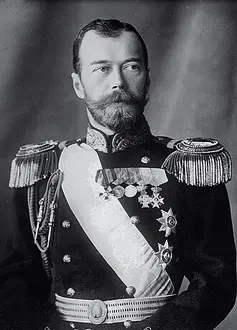
Last Emperor of Russia (1894–1917)
Nicholas II held that the tsar's authority was God-given and absolute, and he refused to share power with elected bodies in his 1895 speech and afterwards. Under pressure from the 1905 revolution he accepted the October Manifesto and a Duma, but he kept his powers and dissolved Dumas that opposed him. He promoted the Hague disarmament conferences, backed Russian expansion in the Far East, and led Russia into the First World War before abdicating in March 1917.
Closest ideologies
Based on the 29 statements where Nicholas II of Russia has a known position.
- Integral nationalism (89% match)
- Absolute Monarchism (88% match)
- Maurrassisme (88% match)
- Authoritarian Conservatism (88% match)
- Integralismo Lusitano (88% match)
Similar people
- Augustus (92% alike)
- James VI and I (90% alike)
- Wilhelm II (88% alike)
- Napoleon (87% alike)
- Stephen Miller (86% alike)
Known positions
- Strongly: The person holding the highest state office should be treated as holy.
- Strongly: A minority group is working in secret to harm the nation.
- Strongly: Someone who actually governs a state may hand that power on to their own child, whether as a king or as a republic's leader.
- Strongly: God is the ultimate source of the right to exercise political authority.
- Strongly: Consent of the governed is not the only basis of legitimate political authority.
- Strongly: The national church is recognised in law above other religions.
- Strongly: People do not need a direct role in making decisions where they work, live and study.
- Strongly: The head of state should not have to be chosen by election.
- Strongly: Owners' rights to their property should almost never be overridden, even for public goals.
- Strongly: The country would benefit from a strong leader with the power to act despite deadlock among its political institutions.
- Strongly: Real authority to command the military should rest with the head of state.
- Strongly: Democracy is not the best form of government when voters choose badly.
- Strongly: Many political decisions should rest with national or wider authorities, even where a smaller community could handle them.
- Strongly: Political power may be concentrated in one body.
- Strongly: Countries should maintain only the weapons needed for national safety.
- Strongly: Allies are bound to defend one another against armed attack.
- Strongly: Some institutional ties between government and religion are acceptable.
- Strongly: Large landed estates should not be compulsorily transferred to the people who farm them.
- Strongly: Another body may have the final say over what the legislature passes.
- Strongly: The head of state should not be elected directly by the voters.
- Strongly: The existing governing institutions should be retained, even if their personnel, policies or procedures change.
- Leans: The ruler should not be bound by the country's laws, including those made by that ruler and by earlier ones.
- Leans: The government should stop its political opponents from organising, speaking or competing for power.
- Leans: A powerful country should bring more land within its borders.
- Leans: Having a shared national identity does not by itself entitle a people to its own self-governing state.
- Leans: There should be legal limits on strike action.
- Leans: Religious values and institutions should shape laws, schools and public life.
- Leans: Past abuses by a state's security forces may be put behind it without anyone answering for them in court.