Political Ideology Atlas · All people · Take the test
Europe · born 1743, historical
Toussaint Louverture
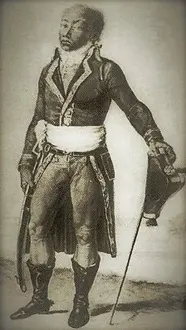
General-in-chief and governor-general for life of Saint-Domingue (1797-1802)
A formerly enslaved Catholic planter-steward who led the Haitian Revolution's black armies, ended slavery in Saint-Domingue and ruled it as a French colony almost independently. His 1801 constitution made him governor for life with near-absolute powers, made Catholicism the only public religion, tied cultivators to plantations under compulsory labor, censored the press and banned popular societies, while declaring all men free and equal before the law.
Closest ideologies
Based on the 60 statements where Toussaint Louverture has a known position.
- Russian imperialism (91% match)
- Sinocentrism (90% match)
- Bonapartism (90% match)
- Turkish–Islamic synthesis (89% match)
- Erdoğanism (89% match)
Similar people
- Mohammed bin Salman Al Saud (91% alike)
- Catherine II of Russia (90% alike)
- Jorge Rafael Videla (90% alike)
- Stephen Miller (88% alike)
- Muhammad (87% alike)
Known positions
- Strongly: People farming an estate should lack the legal freedom to leave that estate.
- Strongly: The people in power should decide what the country's news media publish.
- Strongly: The government should stop its political opponents from organising, speaking or competing for power.
- Strongly: The national church is recognised in law above other religions.
- Strongly: A wife should not be able to end the marriage when her husband refuses.
- Strongly: The government should have authority over religious institutions' internal affairs.
- Strongly: The head of state should not have to be chosen by election.
- Strongly: The country would benefit from a strong leader with the power to act despite deadlock among its political institutions.
- Strongly: A national emergency sometimes justifies temporarily withdrawing normal legal safeguards against people the government regards as internal enemies, such as protections against detention without trial.
- Strongly: Real authority to command the military should rest with the head of state.
- Strongly: A president should be free to stand for re-election as many times as they like.
- Strongly: Living in the countryside does more for a person's moral wellbeing than living in a city.
- Strongly: Religious values and institutions should shape laws, schools and public life.
- Strongly: Ending a marriage should not be possible without proving fault.
- Strongly: Some institutional ties between government and religion are acceptable.
- Strongly: Large landed estates should not be compulsorily transferred to the people who farm them.
- Strongly: Sex work between consenting adults should be illegal.
- Strongly: Another body may have the final say over what the legislature passes.
- Strongly: Employers and workers should treat each other as partners whose cooperation comes before conflict, even where their interests differ.
- Strongly: The head of state should not be elected directly by the voters.
- Strongly: A healthy society depends on the traditional family, such as a married mother and father raising their children.
- Strongly: Nobody should hold a special rank by birth, such as a noble title, a hereditary crown or a caste position, or the special rights attached to one.
- Strongly: The state may restrict what adults do for reasons other than preventing harm to others.
- Strongly: Political violence is sometimes justified.
- Strongly: People should be free to own land privately.
- Strongly: Being the first to use force can be right, depending on what it is meant to achieve.
- Strongly: Religion does not offer illusory comfort for material suffering.
- Strongly: At least some revolutions have been justified.
- Strongly: Marriage should retain legal recognition.
- Strongly: Police forces should continue to exist.
- Strongly: Society needs government of some kind.
- Strongly: Countries should keep their armed forces.
- Strongly: Government should have other tasks besides protecting people from physical violence.
- Strongly: Collecting taxes does not in itself amount to stealing people's money.
- Strongly: Voting should not be limited to members of one ethnic group.
- Strongly: Killing another person can be right in self-defence or in defence of others.
- Strongly: State schools need not steer pupils away from belief in God.
- Strongly: Public spaces such as schools and facilities should not be separated by race under the law.
- Strongly: Courts need not be handed over to private businesses.
- Leans: The leader should bypass parties and organised interest groups in dealing with the people.
- Leans: Private property does not need to serve the common good to be justified.
- Leans: It is acceptable to praise a national leader openly as the one who stands for the whole nation.
- Leans: There should be legal limits on strike action.
- Leans: Owners' rights to their property should almost never be overridden, even for public goals.
- Leans: The country may allow more immigration than strict limits would permit.
- Leans: Democracy is not the best form of government when voters choose badly.
- Leans: Many political decisions should rest with national or wider authorities, even where a smaller community could handle them.
- Leans: Taxes on imports should shield domestic producers from foreign competition.
- Leans: Workers should not have democratic voting rights in the management of large companies.
- Leans: Being a foreigner should not by itself bar someone from owning land in the country.
- Leans: The worst crimes can be punished by death.
- Leans: A government should outlaw political parties that aim to do away with its constitutional order.
- Leans: What you owe your community matters more than your personal rights.
- Leans: Major laws should not be decided by direct votes of citizens.
- Leans: Working for wages should remain a normal way for people to earn a living.
- Leans: Government should rely at least as much on legal enforcement as on its rulers' moral example.
- Leans: A mother country and its colonies may trade with the outside world.
- Leans: The law should treat everyone as an equal, whatever their birth, sex, race or status.