Political Ideology Atlas · All ideologies · Take the test
National Catholicism
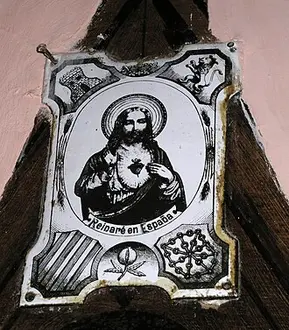
National Catholicism fused Spanish national identity with the Catholic Church as the basis of the state. It made Catholic doctrine the inspiration of law, gave the Church control over education, marriage and morals, and rejected liberal democracy, class struggle and secularism in favour of an authoritarian, hierarchical, corporatist order under a providential leader.
What it stands for
- The law may limit or closely check marriages between people of different religions.
- Same-sex relations between consenting adults should be punishable by law.
- Belonging to the nation goes with sharing its religion.
- God is the ultimate source of the right to exercise political authority.
- The military should have a political role in protecting the constitution and public order, stepping in when they are threatened.
- The government should stop its political opponents from organising, speaking or competing for power.
Key figures
- Francisco Franco: Head of state of Spain 1939-1975, under whom National Catholicism was the state ideology
Closest ideologies
- Clerical Fascism (92% match)
- Rexism (90% match)
- Authoritarian Conservatism (90% match)
- Metaxism (90% match)
- Corporate statism (87% match)
People closest to it
- Francisco Franco (88% alike)
- James VI and I (86% alike)
- Charlemagne (86% alike)
- Louis XIV of France (85% alike)
- Augustus (85% alike)
Key positions
- Strongly: The law may limit or closely check marriages between people of different religions.
- Strongly: Same-sex relations between consenting adults should be punishable by law.
- Strongly: Belonging to the nation goes with sharing its religion.
- Strongly: God is the ultimate source of the right to exercise political authority.
- Strongly: The military should have a political role in protecting the constitution and public order, stepping in when they are threatened.
- Strongly: The government should stop its political opponents from organising, speaking or competing for power.
- Strongly: A person's sex should affect the public roles legally assigned to them.
- Strongly: Art, poetry and stories that harm people's moral character should be censored.
- Strongly: Recovering how society used to be matters more than moving forward.
- Strongly: One spouse may have more authority than the other within a marriage.
- Strongly: It is acceptable to praise a national leader openly as the one who stands for the whole nation.
- Strongly: Special ranks held by birth, such as noble titles and hereditary crowns, may continue to exist.
- Strongly: People should gain political representation through social bodies such as families, local communities and occupational associations instead of political parties.
- Strongly: At its core, politics is a struggle between spiritual good and evil.
- Strongly: The national church is recognised in law above other religions.
- Strongly: A wife should not be able to end the marriage when her husband refuses.
- Strongly: People do not need a direct role in making decisions where they work, live and study.
- Strongly: The head of state should not have to be chosen by election.
- Strongly: There should be legal limits on strike action.
- Strongly: The state should make one language the only common language of government, schooling and public life, limiting the use of others.
- Strongly: The country would benefit from a strong leader with the power to act despite deadlock among its political institutions.
- Strongly: The national church should have episcopal government, with its bishops holding governing authority.
- Strongly: Elected officials should serve out their full terms.
- Strongly: A national emergency sometimes justifies temporarily withdrawing normal legal safeguards against people the government regards as internal enemies, such as protections against detention without trial.
- Strongly: Public institutions do not need to help minority languages be used in public life.
- Strongly: Workers' pay need not be set through negotiations between their union and their employer.
- Strongly: Real authority to command the military should rest with the head of state.
- Strongly: A society can be socialist without the working class itself holding political power.
- Strongly: Democracy is not the best form of government when voters choose badly.
- Strongly: The state may give legal precedence to one stream of a religion over the others.
- Strongly: Within a country, the richer regions did not grow rich by draining the poorer ones.
- Strongly: The political goal should be victory over communism ahead of accommodation with it.
- Strongly: Areas where an ethnic minority is the majority may be governed in the same way as the rest of the state.
- Strongly: Only the state's armed forces and police should have permission to carry weapons.
- Strongly: Laws, institutions and customs today do not systematically favor men over women.
- Strongly: A country has the right to stop a region becoming independent by using its military.
- Strongly: Governments should sometimes withhold the records explaining their decisions.
- Strongly: Political power may be concentrated in one body.
- Strongly: Inherited religious teachings may stay as handed down, without being rethought for present conditions.
- Strongly: Women's equality can be fully achieved without transforming the economic system.
- Strongly: Trade unions may be subject to state direction of their affairs.
- Strongly: Workers should not have democratic voting rights in the management of large companies.
- Strongly: State schools may teach pupils a religious faith, for example through lessons in its beliefs and practice.
- Strongly: Religious values and institutions should shape laws, schools and public life.
- Strongly: Politics should prioritise a single common good identified by reasoning over compromises among organised interests.
- Strongly: The worst crimes can be punished by death.
- Strongly: The nation has decayed and must be reborn.
- Strongly: Ending a marriage should not be possible without proving fault.
- Strongly: Abortion should be illegal in most cases.
- Strongly: A woman who has sex outside marriage is doing something wrong.
- Strongly: Some institutional ties between government and religion are acceptable.
- Strongly: School curricula should exclude sex education.
- Strongly: The state should give families money to have more children, such as through payments and tax breaks.
- Strongly: Past abuses by a state's security forces may be put behind it without anyone answering for them in court.
- Strongly: Large landed estates should not be compulsorily transferred to the people who farm them.
- Strongly: Belonging to the nation ties a person's life to a sacred community that goes on after their death.
- Strongly: Cultural life inside a state should not be placed under the control of each national minority.
- Strongly: A government should outlaw political parties that aim to do away with its constitutional order.
- Strongly: The law should limit the making or sale of pornography.
- Strongly: What you owe your community matters more than your personal rights.
- Strongly: Major laws should not be decided by direct votes of citizens.
- Strongly: Tackling oppression does not require a combined approach to its overlapping forms, such as racism, sexism and class oppression.
- Strongly: Ideas of what men and women are like do not come mostly from culture.
- Strongly: A constitution does not have to be drafted by an assembly elected for that purpose.
- Strongly: Workers may be represented through the parties already in place.
- Strongly: Some knowledge is neutral.
- Strongly: One worker's pay should cover the living needs of that worker's family, including the worker.
- Strongly: At least some religious leadership offices should have different eligibility rules for women than for men.
- Strongly: Human rights come from the nature that all human beings share.
- Strongly: A democratic constitution need not be founded on an explicit rejection of fascism.
- Strongly: Sex work between consenting adults should be illegal.
- Strongly: Seats may be allocated in ways that do not follow parties' shares of the vote closely.
- Strongly: Religious minorities should not be exempt from general laws that burden their practice.
- Strongly: Countries that had colonies should not have to compensate the countries they colonized.
- Strongly: Another body may have the final say over what the legislature passes.
- Strongly: Some things are right or wrong for everyone, in every culture and era.
- Strongly: Elected representatives may serve out their terms without voters being able to remove them early.
- Strongly: Defense should not rest with armed ordinary citizens in place of a standing force.
- Strongly: Some cultures are superior to others.
- Strongly: Employers and workers should treat each other as partners whose cooperation comes before conflict, even where their interests differ.
- Strongly: The head of state should not be elected directly by the voters.
- Strongly: The law may forbid medical help for terminally ill adults who want to end their lives.
- Strongly: Today's nation is the same people as its ancient and medieval forebears.
- Strongly: Religious institutions should be independent of government direction in their internal affairs.
- Strongly: Profit made from owning businesses does not come from exploiting the workers who produce it.
- Strongly: Capitalism does not inevitably cause wars between great powers.
- Strongly: It is not true that communities should be free to choose their own economic arrangements with no fixed blueprint for a free society's economy.
- Strongly: Where they conflict, religious faith should count for at least as much as evidence and reasoning.
- Strongly: People who give their lives for the nation deserve to be remembered as martyrs, with reverence beyond ordinary thanks.
- Strongly: Political institutions developed in the West are not a suitable model for every civilization.
- Strongly: Conclusions from groups of citizens chosen at random should not contribute to decisions on major public issues.
- Strongly: The people who own the economy and hold power are not the ones the state mainly serves.
- Strongly: A healthy society depends on the traditional family, such as a married mother and father raising their children.
- Strongly: Rules need not set equal numbers of women and men on public bodies.
- Strongly: A country may keep a region that wants to leave.
- Strongly: Schools should cultivate patriotic feeling: loyalty to and pride in the nation, expressed for example through respect for its flag and anthem.
- Strongly: The law should not extend marriage to same-sex couples.
- Strongly: The nation's cause and the cause of its ordinary working people are one and the same.
- Strongly: Society need not promote ways of living that differ from custom.
- Strongly: Historical change does not come mainly from changes in how society produces and exchanges goods.
- Strongly: Governments are under no obligation to fund media that decide their own editorial content.
- Strongly: The state may restrict what adults do for reasons other than preventing harm to others.
- Strongly: Families may keep the main responsibility for housework and childcare.
- Strongly: A person's right to hold land need not end when they stop using it.
- Strongly: Whether a religious text promotes women's full humanity should not be a standard for judging that text.
- Strongly: Equality of outcomes should not be society's goal.
- Strongly: Local communities should not tie their joint councils to merely carrying out what local assemblies decide.
- Strongly: The existing governing institutions should be retained, even if their personnel, policies or procedures change.
- Strongly: Population growth may be left to run its course.
- Strongly: Other forces move history at least as much as conflict between classes does.
- Strongly: Private ownership is legitimate only insofar as it benefits society.
- Strongly: The great religions need not share a single underlying truth.
- Strongly: Politics should support people's spiritual well-being.
- Strongly: Class struggle does not continue under socialism.
- Strongly: Political violence is sometimes justified.
- Strongly: Descendants of settlers need not be led politically by the country's original peoples.
- Strongly: Groups have rights of their own.
- Strongly: School history should mostly tell the story of the student's own nation.
- Strongly: Individual farms should not give way to joint cultivation by groups of farmers.
- Strongly: A government needs more than fair elections to be democratic.
- Strongly: Being the first to use force can be right, depending on what it is meant to achieve.
- Strongly: Classifying people by sex tracks differences that exist whatever society says.
- Strongly: Workers do not need a disciplined revolutionary party to lead them.
- Strongly: Religion does not offer illusory comfort for material suffering.
- Strongly: Local community ownership of the means of production should not replace private or state ownership.
- Strongly: Looking after your own interests is not a moral good in itself.
- Strongly: Soldiers and conscripts need not refuse to fight when their state goes to war.
- Strongly: Political power may rest on something other than workplace-elected councils.
- Strongly: Keeping a nation's inherited culture alive, including its language, customs and traditions, matters.
- Strongly: Small, informal, trust-based groups should not take the place of lasting parties, unions and federations in political action.
- Strongly: In a war between great powers, workers need not seek their own government's defeat.
- Strongly: Work may stay divided into separate specialized jobs held by different people.
- Strongly: In the long run people should still produce and share using money.
- Strongly: People of different races should not be discouraged from forming a family together, including through marriage and children.
- Strongly: Marriage should retain legal recognition.
- Strongly: A market economy is incompatible with socialism under communist-party leadership.
- Strongly: Some decisions should bind people who have not consented to them.
- Strongly: A workers' state does not need to suppress the old ruling class, even for a time.
- Strongly: Public offices may be filled by methods other than drawing lots.
- Strongly: Police forces should continue to exist.
- Strongly: Society needs government of some kind.
- Strongly: Countries should keep their armed forces.
- Strongly: The state should not be managed the way a well-run business is.
- Strongly: Government should have other tasks besides protecting people from physical violence.
- Strongly: Collecting taxes does not in itself amount to stealing people's money.
- Strongly: Public policy should not be used to reduce the passing on of inherited disabilities.
- Strongly: Renting out housing should be permitted in at least some circumstances.
- Strongly: Taking part in politics is at least as good a way to live as living privately away from public affairs.
- Strongly: State schools need not steer pupils away from belief in God.
- Strongly: Public spaces such as schools and facilities should not be separated by race under the law.
- Strongly: Courts need not be handed over to private businesses.
- Strongly: Museums, libraries and other inherited culture should not be destroyed, even when they stand in the way of new creation.
- Strongly: Humanity would gain nothing by going back to living off hunting and gathering.
- Strongly: Farmers should have the legal freedom to leave the estates they work.
- Leans: A ruler's failure to apply religious law is a sufficient ground for overthrowing that ruler with armed force.
- Leans: Women's political rights may differ from men's.
- Leans: Temporary rule by a more developed society is justified when it helps the ruled to progress.
- Leans: The law limits or polices changing religion, for example to prevent pressure or inducement.
- Leans: The people in power should decide what the country's news media publish.
- Leans: Laws should follow religious texts.
- Leans: Someone who actually governs a state may hand that power on to their own child, whether as a king or as a republic's leader.
- Leans: The mother country and its colonies should meet their economic needs within their own bloc instead of trading with the outside world.
- Leans: Temporary limits on political freedom are justified to achieve rapid economic development.
- Leans: The country's majority national group should have the leading role in controlling economic life.
- Leans: Consent of the governed is not the only basis of legitimate political authority.
- Leans: Officially recognized bodies representing employers and workers should negotiate wages together.
- Leans: Young people should belong to uniformed, drilled organisations that prepare them to serve the nation.
- Leans: Voluntary charitable help does a better job of helping people in poverty than government aid does.
- Leans: Specialists should have more weight in decisions than public opinion.
- Leans: A former empire may keep a special relationship with its old territories.
- Leans: Labor unions do not necessarily make workers better off.
- Leans: Owners' rights to their property should almost never be overridden, even for public goals.
- Leans: The government may spend public money without first getting its budget approved by an elected legislature.
- Leans: A ruler's unconstitutional acts do not give people a right to resist.
- Leans: Religious communities may be a basis for political life, as when parties represent one faith and top offices are shared out between faiths.
- Leans: Workers' solidarity with their own nation should take priority over solidarity with workers across borders.
- Leans: Countries within one civilization should unite politically.
- Leans: Regions should not be merged to give a people one region of its own.
- Leans: The nation's figurehead should be non-partisan and belong to everyone.
- Leans: A country should press its neighbour to give back land taken from it in an old war.
- Leans: Press freedom still means something when wealthy owners control the media.
- Leans: Whether citizens may see government information can be left to the government to decide.
- Leans: Governments should set legal price ceilings on essential foods when supplies are scarce.
- Leans: Marriage, inheritance and family law may differ between religious communities.
- Leans: Many political decisions should rest with national or wider authorities, even where a smaller community could handle them.
- Leans: A president should be free to stand for re-election as many times as they like.
- Leans: Countries that feel dominated by Western powers may handle their relations with them separately.
- Leans: People do not have full ownership of their own bodies.
- Leans: Transfers of wealth to richer countries do not explain poor countries' continuing poverty.
- Leans: It is acceptable for the government to monitor people when that helps prevent terrorism.
- Leans: Payment to a union should be permitted as a condition of employment in at least some circumstances.
- Leans: Governments should limit how money and investment can be moved across borders.
- Leans: What things are worth does not come from the work put into them.
- Leans: Taxes on imports should shield domestic producers from foreign competition.
- Leans: Rich people have an obligation to help those worse off than they are.
- Leans: Businesses need not belong to the people who work in them.
- Leans: Government should not be bound by a written bill of rights protected against easy amendment by ordinary majorities.
- Leans: Elected officials may receive a salary above what an average worker earns.
- Leans: Living in the countryside does more for a person's moral wellbeing than living in a city.
- Leans: The directly elected parliament should be a legislature's only chamber.
- Leans: Society should follow a third course beyond capitalism and communism.
- Leans: When national priorities conflict with working together internationally, my country should choose its own priorities.
- Leans: Workers in the same industry should organise together regardless of their particular trade, replacing separate craft unions.
- Leans: The government should be able to require citizens to serve in the military.
- Leans: Whether a policy fits an ideology should count independently of its results.
- Leans: A law imposes no moral duty to obey it if the law is unjust.
- Leans: The government should steer investment into industries it sees as key to the country's future.
- Leans: A country may join permanent military alliances.
- Leans: A state of their own in the Land of Israel is not something Jews are owed as a people.
- Leans: Society may hold back technological change that would overturn established institutions.
- Leans: Political freedom can last without economic freedom.
- Leans: People without property should also have the right to vote.
- Leans: The state should stop foreign buyers from taking over key national businesses.
- Leans: The holder of the highest state office need not be treated as holy.
- Leans: Free trade does not benefit everyone in the long run.
- Leans: Religious language may speak of God in male terms alone, as many traditions do.
- Leans: Firms in a market economy need not be owned by the people who work in them.
- Leans: Killing another person can be right in self-defence or in defence of others.
- Leans: Voting should not be limited to members of one ethnic group.
- Leans: Direct action does not have to take the place of elections and parliament as the way to achieve political change.
- Leans: In the society we should aim for, a person's share of goods may depend on things besides their needs.
- Leans: Officials decide what gets made and who gets it at least as well as prices and competition do.
- Leans: The ruler should be subject to the country's laws.
- Leans: A country may keep all its decisions in its own hands rather than pooling them with other nations.
- Leans: Each country should hold ultimate authority over its natural resources, without foreign interests controlling them.
- Leans: Meeting poor people's needs should be the first consideration in public policy.
- Leans: Constantly seeking additional possessions is harmful overall, despite any benefits it brings.
- Leans: Voting in local elections should be reserved for citizens.
- Leans: Population growth does not mainly drive lasting poverty.
- Leans: Public institutions should have the power to constrain a national majority's decisions in a liberal democracy.
- Leans: Being the law gives a rule a moral claim to be obeyed.
- Leans: Industrial society has done at least as much good as harm to humanity.
- Leans: Other things drive humanity forward at least as much as rivalry and conflict between peoples.
- Leans: The armed forces may be controlled by someone other than the governing party's leadership.
- Leans: Member states should keep the final decision on whether to follow UN decisions.
- Leans: Racial groups should not each organise to defend distinct political interests of their own.
- Leans: An economy directed by a central plan is not capable of working better than one directed by market exchange.
- Leans: At most half of workers in wealthy countries benefit from the exploitation of poorer countries.
- Leans: Income from useful work should be rewarded ahead of income from merely owning property.
- Leans: The state should not steer people of the majority group toward settling in regions where minorities predominate.
- Leans: A people's connection to its ancestral land is spiritual, beyond practical interests or ordinary affection.
- Leans: Lending money at interest should be legal.
- Leans: An armed minority's actions are incapable of bringing about the conditions for a broader revolutionary uprising.
- Leans: Most of the average difference in ability between racial groups does not come from genes.
- Leans: Poor countries should retain economic ties with rich countries.
- Leans: The law should treat everyone as an equal, whatever their birth, sex, race or status.