Political Ideology Atlas · All people · Take the test
Europe · born 1729, historical
Catherine II of Russia
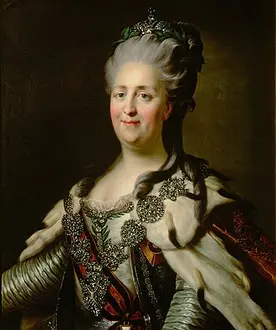
Empress of Russia (1762-1796)
Catherine II was an enlightened absolutist who defended autocracy as suited to Russia's size while drawing on Montesquieu and Beccaria for limits on torture, a preference for toleration and equality under law. In practice she entrenched noble privilege and serfdom, subordinated the Church to the state, crushed the Pugachev rising and expanded the empire through Crimea and the Polish partitions. After 1789 she turned against revolutionary ideas and tightened censorship.
Closest ideologies
Based on the 58 statements where Catherine II of Russia has a known position.
- Russian imperialism (92% match)
- Sinocentrism (90% match)
- İttihadism (89% match)
- Absolutism (88% match)
- Militarism (88% match)
Similar people
- Mohammed bin Salman Al Saud (94% alike)
- Toussaint Louverture (90% alike)
- Oliver Cromwell (89% alike)
- Jorge Rafael Videla (87% alike)
- Vladislav Surkov (87% alike)
Known positions
- Strongly: The people in power should decide what the country's news media publish.
- Strongly: Someone who actually governs a state may hand that power on to their own child, whether as a king or as a republic's leader.
- Strongly: God is the ultimate source of the right to exercise political authority.
- Strongly: The government should stop its political opponents from organising, speaking or competing for power.
- Strongly: A powerful country should bring more land within its borders.
- Strongly: Having a shared national identity does not by itself entitle a people to its own self-governing state.
- Strongly: My country should give weapons to foreign insurgents fighting governments it regards as enemies.
- Strongly: Special ranks held by birth, such as noble titles and hereditary crowns, may continue to exist.
- Strongly: The government should have authority over religious institutions' internal affairs.
- Strongly: Land that a state declares its own against its people's will is not illegally occupied by that state.
- Strongly: Real authority to command the military should rest with the head of state.
- Strongly: The country may allow more immigration than strict limits would permit.
- Strongly: Governments should be able to keep some international agreements secret.
- Strongly: Some institutional ties between government and religion are acceptable.
- Strongly: Foreign powers sometimes have a right to intervene in a country's internal affairs.
- Strongly: Large landed estates should not be compulsorily transferred to the people who farm them.
- Strongly: A country may join permanent military alliances.
- Strongly: Private charity does not help people in poverty better than government programs do.
- Strongly: A person's right to hold land need not end when they stop using it.
- Strongly: Population growth may be left to run its course.
- Strongly: Political violence is sometimes justified.
- Strongly: Countries should keep their armed forces.
- Strongly: Government should have other tasks besides protecting people from physical violence.
- Strongly: Collecting taxes does not in itself amount to stealing people's money.
- Strongly: Final authority over a state's laws need not belong to its most senior religious scholars.
- Leans: People farming an estate should lack the legal freedom to leave that estate.
- Leans: Only people who own property should have the right to vote.
- Leans: The law limits or polices changing religion, for example to prevent pressure or inducement.
- Leans: The law may treat people differently according to such things as birth, sex, race and status.
- Leans: Art, poetry and stories that harm people's moral character should be censored.
- Leans: Recovering how society used to be matters more than moving forward.
- Leans: People should gain political representation through social bodies such as families, local communities and occupational associations instead of political parties.
- Leans: The national church is recognised in law above other religions.
- Leans: A country should try to sell more abroad than it buys from abroad.
- Leans: The country would benefit from a strong leader with the power to act despite deadlock among its political institutions.
- Leans: Changes to society should be introduced a little at a time.
- Leans: Society should not aim to minimise necessary working hours using automation.
- Leans: Democracy is not the best form of government when voters choose badly.
- Leans: Property need not be spread among many small owners.
- Leans: Allies are bound to defend one another against armed attack.
- Leans: Religious values and institutions should shape laws, schools and public life.
- Leans: Politics should prioritise a single common good identified by reasoning over compromises among organised interests.
- Leans: The worst crimes can be punished by death.
- Leans: People able to work should get welfare benefits only in return for some work, such as a job or a work scheme.
- Leans: The state should give families money to have more children, such as through payments and tax breaks.
- Leans: The government should be able to require citizens to serve in the military.
- Leans: Armed forces may sometimes be used for purposes beyond defending the country against attack.
- Leans: The government should steer investment into industries it sees as key to the country's future.
- Leans: Public institutions should help minority languages be used in public life, for example through teaching or services in those languages.
- Leans: Rulers must act under lasting, publicly known laws administered by recognised courts.
- Leans: Population growth does not mainly drive lasting poverty.
- Leans: Whatever their circumstances, everyone should be able to count on the state for enough to live decently, through benefits, pensions or public services.
- Leans: Governments should give no subsidies, licences or protections that favour firms close to them.