Political Ideology Atlas · All people · Take the test
Middle East & North Africa · born 1928, historical
Hosni Mubarak
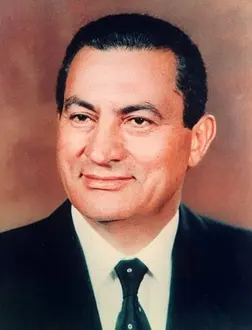
President of Egypt (1981–2011)
Mubarak governed Egypt under a continuously renewed state of emergency and sought constitutional changes expanding presidential discretion over security cases and restricting electoral competition. His presidency moved toward private investment and asset sales, while retaining public subsidies. He maintained peace with Israel and sent Egyptian forces to join the coalition that drove Iraq out of Kuwait.
Closest ideologies
Based on the 43 statements where Hosni Mubarak has a known position.
- Arab socialism (90% match)
- African socialism (89% match)
- Arab nationalism (88% match)
- Ideology of the Chinese Communist Party (88% match)
- Pan-Arabism (88% match)
Similar people
- Sheikh Hasina (91% alike)
- Lyndon B. Johnson (90% alike)
- Juan Perón (90% alike)
- Xi Jinping (89% alike)
- Mahathir Mohamad (89% alike)
Known positions
- Strongly: The government should stop its political opponents from organising, speaking or competing for power.
- Strongly: Voters themselves should elect the head of state, without an intermediary body selecting the officeholder.
- Strongly: Government bodies should be specifically responsible for advancing gender equality.
- Strongly: It is acceptable for the government to monitor people when that helps prevent terrorism.
- Strongly: Population growth should be deliberately held down.
- Strongly: A national emergency sometimes justifies temporarily withdrawing normal legal safeguards against people the government regards as internal enemies, such as protections against detention without trial.
- Strongly: A president should be free to stand for re-election as many times as they like.
- Strongly: Public authorities should help get new facilities built to generate electricity from nuclear energy.
- Strongly: Political power may be concentrated in one body.
- Strongly: The worst crimes can be punished by death.
- Strongly: A head of state should have the power to dissolve parliament.
- Strongly: Distance and nationality do not weaken the duty of the rich to help the poor abroad.
- Strongly: Countries should maintain only the weapons needed for national safety.
- Strongly: Parties and offices should cut across religious lines.
- Strongly: Land that a state declares its own against its people's will is still illegally occupied by that state.
- Strongly: My country can do without nuclear weapons that it alone controls.
- Strongly: There should be a central bank.
- Strongly: Trade, finance and debt rules should be changed to give poorer countries a fairer share.
- Strongly: Central banks should keep a role in controlling the money supply.
- Strongly: Public spaces such as schools and facilities should not be separated by race under the law.
- Leans: The UN should have authority to compel member states to comply with its decisions.
- Leans: There should be legal limits on strike action.
- Leans: The government should have authority over religious institutions' internal affairs.
- Leans: Countries should hand part of their decision-making power to a union of nations, such as the European Union.
- Leans: Real authority to command the military should rest with the head of state.
- Leans: Industries such as energy, rail and utilities do not need to be publicly owned.
- Leans: Only children of citizens should be citizens at birth: being born in the country should not be enough.
- Leans: Private businesses and markets should run most of the economy, while the government supports people who cannot meet their basic needs.
- Leans: The state should limit or screen money that foreign donors give to charities, campaign groups, the press and universities.
- Leans: Besides its directly elected parliament, a legislature should have a second chamber, such as a senate.
- Leans: Countries within one civilization should unite politically.
- Leans: Working together internationally should count at least as much as my country's own priorities.
- Leans: Democracy is not the best form of government when voters choose badly.
- Leans: Either spouse can leave a marriage without showing wrongdoing by the other.
- Leans: A head of state may take a side in party politics.
- Leans: Some institutional ties between government and religion are acceptable.
- Leans: Government should impose strict rules on how corporations operate.
- Leans: An electorate should choose the head of state, either directly or through elected representatives.
- Leans: Keeping a nation's inherited culture alive, including its language, customs and traditions, matters.
- Leans: An elected legislature must approve the government's budget before the government spends public money.
- Leans: Elected governments need not leave monetary policy to central banks acting on their own.
- Leans: Income-tax percentages may differ between income levels.
- Leans: A wife should be able to end the marriage even when her husband refuses.