Political Ideology Atlas · All people · Take the test
South & Southeast Asia · born 1925
Mahathir Mohamad
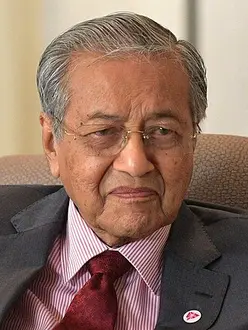
Prime Minister of Malaysia (1981-2003, 2018-2020)
A Malay nationalist and developmental statist who ran Malaysia for 22 years with state-led industrialisation, privatisation, Bumiputera preferences and tight security and press laws, then returned in 2018 on an anti-corruption platform. Abroad he attacked Western dominance of the UN, trade rules and finance, defended developing countries' right to develop first and championed the Palestinian cause.
Closest ideologies
Based on the 55 statements where Mahathir Mohamad has a known position.
- Person Dignity Theory (89% match)
- Islamic Socialism (89% match)
- Integral humanism (87% match)
- Tridemism (87% match)
- Statism (87% match)
Similar people
- Abraham Lincoln (91% alike)
- Wang Jingwei (89% alike)
- Sun Yat-sen (89% alike)
- Richard Nixon (89% alike)
- Mamata Banerjee (88% alike)
Known positions
- Strongly: Land claimed as a historic homeland may be given up in exchange for peace.
- Strongly: Force is for self-defence alone.
- Strongly: Unions covering a whole industry should not take the place of separate craft unions.
- Strongly: Governments should limit how money and investment can be moved across borders.
- Strongly: Taxes on imports should shield domestic producers from foreign competition.
- Strongly: Countries should maintain only the weapons needed for national safety.
- Strongly: Some race-based affirmative action should continue.
- Strongly: The government should be able to require citizens to serve in the military.
- Strongly: My country should stay neutral and join neither of the opposing great-power alliances.
- Strongly: Trade deals may leave out legally binding requirements protecting workers.
- Strongly: The government should steer investment into industries it sees as key to the country's future.
- Strongly: A government may leave the political systems of other countries to their own people.
- Strongly: Recreational drugs should be illegal for adults.
- Strongly: A state of their own in the Land of Israel is not something Jews are owed as a people.
- Strongly: Employers and workers should treat each other as partners whose cooperation comes before conflict, even where their interests differ.
- Strongly: A country should reject spending cuts demanded in return for loans and set its own course.
- Strongly: A healthy society depends on the traditional family, such as a married mother and father raising their children.
- Strongly: The law should not extend marriage to same-sex couples.
- Strongly: Trade, finance and debt rules should be changed to give poorer countries a fairer share.
- Strongly: In war, the enemy's civilians are not legitimate targets.
- Strongly: World power should be distributed among several independent major powers, without one dominant power.
- Strongly: Economic growth should not be limited for the sake of the environment.
- Strongly: Poor countries should retain economic ties with rich countries.
- Leans: Same-sex relations between consenting adults should be punishable by law.
- Leans: The people in power should decide what the country's news media publish.
- Leans: The government should stop its political opponents from organising, speaking or competing for power.
- Leans: The UN should have authority to compel member states to comply with its decisions.
- Leans: International criminal courts should try political leaders responsible for atrocities such as genocide, crimes against humanity and war crimes.
- Leans: A society holds together less well when its members belong to different ethnic groups.
- Leans: A national emergency sometimes justifies temporarily withdrawing normal legal safeguards against people the government regards as internal enemies, such as protections against detention without trial.
- Leans: Governments may spend well beyond their tax revenue to support a weak economy.
- Leans: Industries such as energy, rail and utilities do not need to be publicly owned.
- Leans: Businesses should be legally barred from agreements with competitors to suppress competition, such as fixing prices.
- Leans: Political power may be concentrated in one body.
- Leans: Inherited religious teachings should be understood anew in light of present conditions.
- Leans: Trade unions may be subject to state direction of their affairs.
- Leans: The global economic system keeps poorer countries poor by directing their wealth toward richer countries.
- Leans: Some institutional ties between government and religion are acceptable.
- Leans: Foreign powers sometimes have a right to intervene in a country's internal affairs.
- Leans: Military intervention abroad is sometimes necessary to protect human rights.
- Leans: Democracy is best even when voters make poor choices.
- Leans: Society should take active steps to make up for the harm done by past racial injustices.
- Leans: Free trade does not benefit everyone in the long run.
- Leans: Public institutions should help minority languages be used in public life, for example through teaching or services in those languages.
- Leans: Purchases of basic necessities should carry no consumption tax.
- Leans: The state should not make one language the only common language of government, schooling and public life at the cost of limiting others.
- Leans: Political institutions developed in the West are not a suitable model for every civilization.
- Leans: Constantly seeking additional possessions is harmful overall, despite any benefits it brings.
- Leans: We have a duty to leave the planet in good condition for those who come after us.
- Leans: War does not strengthen a nation's character.
- Leans: A people with a shared national identity is entitled to its own self-governing state.
- Leans: Businesses gain too much influence over government policy from their lobbying.