Political Ideology Atlas · All people · Take the test
East Asia · born 1953
Xi Jinping
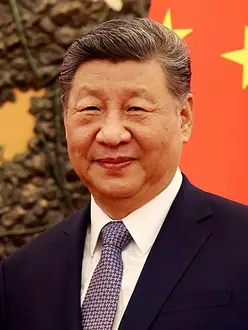
General secretary of the Chinese Communist Party (2012–present); president of China (2013–present)
Xi advocates Communist Party leadership, socialist modernisation and national reunification. He supports a mixed economy under party leadership, technological development, cultural continuity and a larger developing-country voice in international governance.
Closest ideologies
Based on the 88 statements where Xi Jinping has a known position.
- Tridemism (89% match)
- Xi Jinping Thought (89% match)
- Chinese unification (88% match)
- Statism (87% match)
- Ideology of the Chinese Communist Party (87% match)
Similar people
- Deng Xiaoping (92% alike)
- Sheikh Hasina (89% alike)
- Mohammad Reza I of Iran (88% alike)
- Sun Yat-sen (87% alike)
- Abraham Lincoln (87% alike)
Known positions
- Strongly: A socialist system led by a communist party is able to include a market economy.
- Strongly: The governing party's own leadership should control the armed forces.
- Strongly: One ideologically correct party should hold state leadership without competing parties having a right to replace it.
- Strongly: The people in power should decide what the country's news media publish.
- Strongly: The government should stop its political opponents from organising, speaking or competing for power.
- Strongly: My country should possess its own nuclear arsenal with independent authority over its use.
- Strongly: Cultures do not rank above one another in overall worth.
- Strongly: A president should be free to stand for re-election as many times as they like.
- Strongly: Outside governments have no entitlement to interfere in another country's internal affairs for any purpose.
- Strongly: A country has the right to stop a region becoming independent by using its military.
- Strongly: Trade unions may be subject to state direction of their affairs.
- Strongly: A country with nuclear weapons should keep them for as long as its rivals retain theirs.
- Strongly: Defeating communism should not take priority over coexistence with it.
- Strongly: Joining a larger state should leave a region free to keep its existing economic arrangements.
- Strongly: The government should steer investment into industries it sees as key to the country's future.
- Strongly: After members debate and adopt a party decision, every member should have to help implement it, including those who opposed it.
- Strongly: Climate change calls for drastic action by governments.
- Strongly: Elected politicians should be able to serve any number of terms in any office.
- Strongly: Each country's communist party should decide its strategy for socialism without taking orders from another country's party.
- Strongly: Political institutions developed in the West are not a suitable model for every civilization.
- Strongly: A healthy society depends on the traditional family, such as a married mother and father raising their children.
- Strongly: A country may keep a region that wants to leave.
- Strongly: Schools should cultivate patriotic feeling: loyalty to and pride in the nation, expressed for example through respect for its flag and anthem.
- Strongly: World power should be distributed among several independent major powers, without one dominant power.
- Strongly: Poor countries should retain economic ties with rich countries.
- Strongly: A government needs more than fair elections to be democratic.
- Strongly: We have a duty to leave the planet in good condition for those who come after us.
- Strongly: Keeping a nation's inherited culture alive, including its language, customs and traditions, matters.
- Strongly: No society has the right to rule another for its supposed improvement, however advanced it is.
- Leans: A workers' state must suppress the old ruling class for a time.
- Leans: The UN should have authority to compel member states to comply with its decisions.
- Leans: People should lose their right to a plot of land when they no longer use it.
- Leans: Historical change comes mainly from changes in how society produces and exchanges goods.
- Leans: It is acceptable to praise a national leader openly as the one who stands for the whole nation.
- Leans: Economic accounts should record ecosystems as assets whose depletion counts as a loss.
- Leans: The government should have authority over religious institutions' internal affairs.
- Leans: Prices and competition generally decide better than officials what gets made and who gets it.
- Leans: Owners' rights to their property should almost never be overridden, even for public goals.
- Leans: The state should make one language the only common language of government, schooling and public life, limiting the use of others.
- Leans: The country would benefit from a strong leader with the power to act despite deadlock among its political institutions.
- Leans: Public institutions do not need to help minority languages be used in public life.
- Leans: Fewer tariffs and trade barriers make all countries better off over time.
- Leans: Government bodies should be specifically responsible for advancing gender equality.
- Leans: Changes to society should be introduced a little at a time.
- Leans: Society should push new technology forward faster, even where it overturns established institutions.
- Leans: Private businesses and markets should run most of the economy, while the government supports people who cannot meet their basic needs.
- Leans: Democracy is not the best form of government when voters choose badly.
- Leans: Judge policies by what they achieve, independently of whether they match an ideology.
- Leans: Online participation should sometimes require disclosure of a person's legal identity.
- Leans: It is acceptable for the government to monitor people when that helps prevent terrorism.
- Leans: Businesses should be legally barred from agreements with competitors to suppress competition, such as fixing prices.
- Leans: Distance and nationality do not weaken the duty of the rich to help the poor abroad.
- Leans: Government should support building nuclear power plants.
- Leans: Political power may be concentrated in one body.
- Leans: Businesses need not belong to the people who work in them.
- Leans: Tariffs should not be used to protect domestic industry from foreign competition.
- Leans: High earners and the very rich should pay tax at a much higher rate than everyone else.
- Leans: The nation has decayed and must be reborn.
- Leans: Areas where an ethnic minority makes up most of the population should be able to run many of their own affairs within the state.
- Leans: Industries such as energy, rail and utilities should be owned by the state or public bodies, not private companies.
- Leans: The state should give families money to have more children, such as through payments and tax breaks.
- Leans: Government should impose strict rules on how corporations operate.
- Leans: Firms in a market economy need not be owned by the people who work in them.
- Leans: Employers and workers should treat each other as partners whose cooperation comes before conflict, even where their interests differ.
- Leans: Society should use modern technology together with revived values inherited from its ancestors.
- Leans: Workers are better off for having labor unions.
- Leans: National policy should give priority to preventing outside powers from splitting the country territorially.
- Leans: Meeting poor people's needs should be the first consideration in public policy.
- Leans: Constantly seeking additional possessions is harmful overall, despite any benefits it brings.
- Leans: The state should guarantee health care to everyone, whether it runs the services itself or pays for them.
- Leans: Trade, finance and debt rules should be changed to give poorer countries a fairer share.
- Leans: Most people in political office look after themselves first and the public second.
- Leans: Politics should support people's spiritual well-being.
- Leans: Grown children owe care to parents who need it.
- Leans: An economy directed by a central plan is not capable of working better than one directed by market exchange.
- Leans: Economic growth should not be limited for the sake of the environment.
- Leans: At least some revolutions have been justified.
- Leans: School history should mostly tell the story of the student's own nation.
- Leans: The law should treat everyone as an equal, whatever their birth, sex, race or status.
- Leans: Individual farms should not give way to joint cultivation by groups of farmers.
- Leans: Governments should give no subsidies, licences or protections that favour firms close to them.