Political Ideology Atlas · All ideologies · Take the test
African Socialism
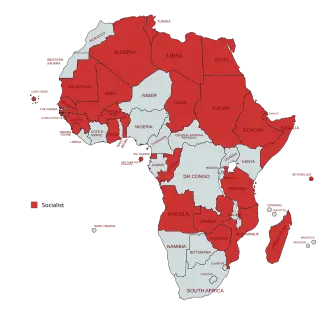
African socialism holds that traditional African communities were already communal and classless, so socialism is an indigenous inheritance to be restored rather than an import from Europe. It favours a large public sector guiding development, state or cooperative ownership of land and major industry, self-reliance over foreign aid and capital, Africanisation, non-alignment and Pan-African unity. It rejects class struggle as a European idea and stresses work, communal obligation and leaders who live as they preach, while practice ranged from Tanzania's village collectivisation to Senegal's mixed economy.
What it stands for
- People should lose their right to a plot of land when they no longer use it.
- People should live and work in communities that own land and goods together and govern themselves.
- Society should follow a third course beyond capitalism and communism.
- Industries such as energy, rail and utilities should be owned by the state or public bodies, not private companies.
- People able to work should get welfare benefits only in return for some work, such as a job or a work scheme.
- My country should stay neutral and join neither of the opposing great-power alliances.
Key figures
- Julius Nyerere: Tanzania's first president and author of Ujamaa and the Arusha Declaration.
- Léopold Sédar Senghor: Senegal's first president, who linked a moderate socialism to Négritude.
- Kwame Nkrumah: Ghana's first leader, who expanded state control and promoted Pan-African socialism.
Closest ideologies
- Ujamaa (94% match)
- African nationalism (93% match)
- Third World socialism (92% match)
- Marhaenism (90% match)
- Third-worldism (90% match)
People closest to it
- Maximilien Robespierre (90% alike)
- Indira Gandhi (88% alike)
- Nicolás Maduro (87% alike)
- Bassirou Diomaye Faye (87% alike)
- George Orwell (87% alike)
Key positions
- Strongly: People should lose their right to a plot of land when they no longer use it.
- Strongly: People should live and work in communities that own land and goods together and govern themselves.
- Strongly: Society should follow a third course beyond capitalism and communism.
- Strongly: Industries such as energy, rail and utilities should be owned by the state or public bodies, not private companies.
- Strongly: People able to work should get welfare benefits only in return for some work, such as a job or a work scheme.
- Strongly: My country should stay neutral and join neither of the opposing great-power alliances.
- Strongly: Whoever uses land or resources owes the rest of society a share of their value.
- Strongly: A poor country should develop mainly with its own resources.
- Strongly: Political freedom can last without economic freedom.
- Strongly: The state should stop foreign buyers from taking over key national businesses.
- Strongly: Government should impose strict rules on how corporations operate.
- Strongly: Each country's communist party should decide its strategy for socialism without taking orders from another country's party.
- Strongly: Owners' rights to their property need not be protected against being overridden for public goals.
- Strongly: Basic local services, such as water, hospitals and local transport, should be publicly owned and run.
- Strongly: Officials decide what gets made and who gets it at least as well as prices and competition do.
- Strongly: Ethnic diversity does not weaken a society's ability to hold together.
- Strongly: Political institutions developed in the West are not a suitable model for every civilization.
- Strongly: Political independence means little unless the economic and property system is also transformed.
- Strongly: The nation's cause and the cause of its ordinary working people are one and the same.
- Strongly: A nation does not need one main ethnic group: it can be made up of people of many ancestries.
- Strongly: Public schooling money may go straight to schools instead of to parents as vouchers.
- Strongly: The state should guarantee health care to everyone, whether it runs the services itself or pays for them.
- Strongly: The presence of people of its nationality does not give a state a rightful claim to land beyond its borders.
- Strongly: Other things drive humanity forward at least as much as rivalry and conflict between peoples.
- Strongly: Trade, finance and debt rules should be changed to give poorer countries a fairer share.
- Strongly: Other forces move history at least as much as conflict between classes does.
- Strongly: Income-tax percentages may differ between income levels.
- Strongly: Land does not belong to whoever first puts it to use.
- Strongly: Private ownership is legitimate only insofar as it benefits society.
- Strongly: Racial groups should not each organise to defend distinct political interests of their own.
- Strongly: World power should be distributed among several independent major powers, without one dominant power.
- Strongly: Class struggle does not continue under socialism.
- Strongly: Whatever their circumstances, everyone should be able to count on the state for enough to live decently, through benefits, pensions or public services.
- Strongly: Income from useful work should be rewarded ahead of income from merely owning property.
- Strongly: A people with a shared national identity is entitled to its own self-governing state.
- Strongly: Being powerful does not mean a country should bring more land within its borders.
- Strongly: A national development strategy should not accept some regions growing wealthy ahead of the rest.
- Strongly: A people's connection to its ancestral land is spiritual, beyond practical interests or ordinary affection.
- Strongly: Elected governments need not leave monetary policy to central banks acting on their own.
- Strongly: Governments should give no subsidies, licences or protections that favour firms close to them.
- Strongly: The law should treat everyone as an equal, whatever their birth, sex, race or status.
- Strongly: Belonging to the nation does not go with sharing its religion.
- Strongly: Most of the average difference in ability between racial groups does not come from genes.
- Strongly: Someone who actually governs a state should not hand that power on to their own child.
- Strongly: Minority groups are not, as groups, secretly plotting to harm the nation.
- Strongly: Islam is compatible with Western values.
- Strongly: Looking after your own interests is not a moral good in itself.
- Strongly: Keeping a nation's inherited culture alive, including its language, customs and traditions, matters.
- Strongly: Small, informal, trust-based groups should not take the place of lasting parties, unions and federations in political action.
- Strongly: Central banks should keep a role in controlling the money supply.
- Strongly: People of different races should not be discouraged from forming a family together, including through marriage and children.
- Strongly: No state may force a minority out of the country, however hostile it judges that minority to be.
- Strongly: Private owners' choice of whom they deal with should be subject to some restrictions.
- Strongly: No society has the right to rule another for its supposed improvement, however advanced it is.
- Strongly: Each country should hold ultimate authority over its natural resources, without foreign interests controlling them.
- Strongly: A workers' state does not need to suppress the old ruling class, even for a time.
- Strongly: Society needs government of some kind.
- Strongly: Countries should keep their armed forces.
- Strongly: The ruler should be subject to the country's laws.
- Strongly: Government should have other tasks besides protecting people from physical violence.
- Strongly: Collecting taxes does not in itself amount to stealing people's money.
- Strongly: Belonging to a religious minority is no ground for shoppers to stay away from a shop.
- Strongly: Political authority need not rest on oaths of loyalty sworn to a lord.
- Strongly: Voters of different religious communities may all vote in the same elections.
- Strongly: Voting should not be limited to members of one ethnic group.
- Strongly: Overseas territories need not be run mainly for the ruling country's economic benefit.
- Strongly: Failure to govern under religious law does not justify armed overthrow of a ruler.
- Strongly: Taking part in politics is at least as good a way to live as living privately away from public affairs.
- Strongly: A weaker state need not formally treat a stronger power as its superior.
- Strongly: People without property should also have the right to vote.
- Strongly: State schools need not steer pupils away from belief in God.
- Strongly: Public spaces such as schools and facilities should not be separated by race under the law.
- Strongly: Final authority over a state's laws need not belong to its most senior religious scholars.
- Strongly: People must be free to leave their religion without legal penalty.
- Strongly: Museums, libraries and other inherited culture should not be destroyed, even when they stand in the way of new creation.
- Strongly: Farmers should have the legal freedom to leave the estates they work.
- Leans: One ideologically correct party should hold state leadership without competing parties having a right to replace it.
- Leans: Farming should be organized as joint cultivation by groups of farmers instead of separate individual farm operations.
- Leans: The government should stop its political opponents from organising, speaking or competing for power.
- Leans: An economy whose production is directed by a central plan is capable of working better than an economy directed by market exchange.
- Leans: The country's majority national group should have the leading role in controlling economic life.
- Leans: Society should aim for people to end up with broadly equal material conditions.
- Leans: Countries should hand part of their decision-making power to a union of nations, such as the European Union.
- Leans: Owners' profit is value taken from workers' labor.
- Leans: Government should depend more on leaders setting a good example than on enforcing laws with penalties.
- Leans: People should work mainly out of responsibility to society and a shared purpose, with personal material rewards playing a secondary role.
- Leans: Countries within one civilization should unite politically.
- Leans: A country should not tie itself to other countries through lasting military alliances.
- Leans: Capitalism did not build the productive power and wealth that a better society can rest on.
- Leans: Governments may spend well beyond their tax revenue to support a weak economy.
- Leans: A president should be free to stand for re-election as many times as they like.
- Leans: Outside governments have no entitlement to interfere in another country's internal affairs for any purpose.
- Leans: A country has the right to stop a region becoming independent by using its military.
- Leans: Religious values and institutions should not have a major part in shaping laws, schools and public life.
- Leans: Governments should limit how money and investment can be moved across borders.
- Leans: Employees should have voting rights in the management of large companies.
- Leans: Those who hold public office should be paid no more than an average worker.
- Leans: Rich people have an obligation to help those worse off than they are.
- Leans: Council homes may stay in public hands without tenants having a right to buy them.
- Leans: Some race-based affirmative action should continue.
- Leans: What things are worth comes from the work put into them.
- Leans: Living in the countryside does more for a person's moral wellbeing than living in a city.
- Leans: Politics should prioritise a single common good identified by reasoning over compromises among organised interests.
- Leans: High earners and the very rich should pay tax at a much higher rate than everyone else.
- Leans: Production should be organised to provide what people need, instead of being organised around what yields a profit.
- Leans: The global economic system keeps poorer countries poor by directing their wealth toward richer countries.
- Leans: People should want as few material things as possible.
- Leans: My country may keep a military no stronger than its rivals'.
- Leans: Countries that feel dominated by Western powers should band together to resist them.
- Leans: The foreign debts of poor countries should be written off, ending their obligation to repay them.
- Leans: Whether a policy fits an ideology should count independently of its results.
- Leans: Democracy is best even when voters make poor choices.
- Leans: The economy should not combine mainly private markets with government support for people who cannot meet their basic needs.
- Leans: A country may accept its present border with a neighbour even if it lost land in an old war.
- Leans: A head of state may take a side in party politics.
- Leans: Society should take active steps to make up for the harm done by past racial injustices.
- Leans: Workers may be represented through the parties already in place.
- Leans: After members debate and adopt a party decision, every member should have to help implement it, including those who opposed it.
- Leans: Free trade does not benefit everyone in the long run.
- Leans: Some things are right or wrong for everyone, in every culture and era.
- Leans: Most of government should be funded by taxes other than a tax on the value of land.
- Leans: You can't reach a free, fair society by unfree or unfair means.
- Leans: How someone turns out is shaped more by upbringing, society and experience than by the traits they are born with.
- Leans: Direct action does not have to take the place of elections and parliament as the way to achieve political change.
- Leans: Employers and workers should treat each other as partners whose cooperation comes before conflict, even where their interests differ.
- Leans: Society should use modern technology together with revived values inherited from its ancestors.
- Leans: An electorate should choose the head of state, either directly or through elected representatives.
- Leans: A country should not be ready to use military force abroad without UN Security Council authorization.
- Leans: People should have a direct role in making decisions where they work, live and study, rather than having those decisions made entirely for them.
- Leans: Where they conflict, religious faith should count for at least as much as evidence and reasoning.
- Leans: A former empire should claim no special ties, leadership or sphere of influence in its old territories.
- Leans: The people who own the economy and hold power are not the ones the state mainly serves.
- Leans: A country should reject spending cuts demanded in return for loans and set its own course.
- Leans: A healthy society depends on the traditional family, such as a married mother and father raising their children.
- Leans: A country may keep a region that wants to leave.
- Leans: Being free requires having the practical resources to act on one's choices, such as an adequate livelihood.
- Leans: The general public should have at least as much say in policy as experts.
- Leans: Schools should cultivate patriotic feeling: loyalty to and pride in the nation, expressed for example through respect for its flag and anthem.
- Leans: Some decisions should bind people who have not consented to them.
- Leans: Nobody should hold a special rank by birth, such as a noble title, a hereditary crown or a caste position, or the special rights attached to one.
- Leans: A market economy is incompatible with socialism under communist-party leadership.
- Leans: It is legitimate to take pride in the racial group one belongs to.
- Leans: Meeting poor people's needs should be the first consideration in public policy.
- Leans: Society need not promote ways of living that differ from custom.
- Leans: Some areas of life should remain outside state direction.
- Leans: Publicly insulting a religion's sacred beliefs should be left outside the criminal law.
- Leans: In the long run people should still produce and share using money.
- Leans: Historical change does not come mainly from changes in how society produces and exchanges goods.
- Leans: Population growth does not mainly drive lasting poverty.
- Leans: Work may stay divided into separate specialized jobs held by different people.
- Leans: No one is better suited by nature to govern than anyone else.
- Leans: Lasting socialism in one country does not require socialist revolutions abroad.
- Leans: Industrial society has done at least as much good as harm to humanity.
- Leans: Rulers have a right to rule only because the people they rule have agreed to it.
- Leans: Most people in political office look after themselves first and the public second.
- Leans: Religious conversion should be free of legal restriction.
- Leans: In a war between great powers, workers need not seek their own government's defeat.
- Leans: Very large concentrations of wealth threaten a free society.
- Leans: Politics should support people's spiritual well-being.
- Leans: Grown children owe care to parents who need it.
- Leans: Foreign armies should not be based on the country's territory.
- Leans: Political power may rest on something other than workplace-elected councils.
- Leans: War does not strengthen a nation's character.
- Leans: A country may make its laws with no formal advisory role for traditional chiefs.
- Leans: Laws should not be required to follow religious texts.
- Leans: Religion does not offer illusory comfort for material suffering.
- Leans: Protecting the constitution should be left to civilian institutions, not the armed forces.
- Leans: A country may leave other nations to choose their own political systems.
- Leans: Being the first to use force can be right, depending on what it is meant to achieve.
- Leans: In an economy with common ownership of productive assets, people should still own their personal belongings.
- Leans: Groups have rights of their own.