Political Ideology Atlas · All people · Take the test
Middle East & North Africa · born 1894, historical
Rudolf Hess
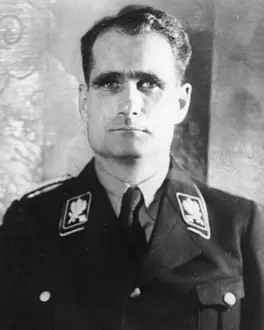
Deputy Führer of the Nazi Party (1933–1941); Reichsminister without portfolio (1933–1941)
Rudolf Hess was Hitler's Deputy Führer and a close confidant until 1941. He argued for a single leader with unrestricted power against parliamentary majorities, backed the Nazi party's rule, the 1935 Nuremberg Laws and the annexations of Austria, the Sudetenland and Poland, and called for the destruction of Marxist and Bolshevik organisations. In May 1941 he flew to Scotland carrying peace terms, and he was later convicted at Nuremberg on the counts of crimes against peace and conspiracy.
Closest ideologies
Based on the 60 statements where Rudolf Hess has a known position.
- Neo-Legionarism (93% match)
- Neo-fascism (89% match)
- Völkisch movement (88% match)
- Positive Christianity (88% match)
- Italian fascism (88% match)
Similar people
- Heinrich Himmler (89% alike)
- Henry VIII of England (88% alike)
- Hermann Göring (88% alike)
- Nick Fuentes (88% alike)
- Charlemagne (88% alike)
Known positions
- Strongly: A lord's political authority should be grounded in the personal loyalty sworn by followers.
- Strongly: The ruler should not be bound by the country's laws, including those made by that ruler and by earlier ones.
- Strongly: People of different races should be discouraged from forming a family together, whether through marriage or having children.
- Strongly: One ideologically correct party should hold state leadership without competing parties having a right to replace it.
- Strongly: A minority group is working in secret to harm the nation.
- Strongly: The leader should bypass parties and organised interest groups in dealing with the people.
- Strongly: God is the ultimate source of the right to exercise political authority.
- Strongly: The government should stop its political opponents from organising, speaking or competing for power.
- Strongly: The presence of people belonging to the same nation gives a state a legitimate territorial claim outside its borders.
- Strongly: It is acceptable to praise a national leader openly as the one who stands for the whole nation.
- Strongly: A nation should be mainly one ethnic people.
- Strongly: Peoples who share an ethnic heritage, such as the Slavic, Arab or Turkic peoples, should come together in one state, even across present borders.
- Strongly: Government should depend more on leaders setting a good example than on enforcing laws with penalties.
- Strongly: The country would benefit from a strong leader with the power to act despite deadlock among its political institutions.
- Strongly: Workers' solidarity with their own nation should take priority over solidarity with workers across borders.
- Strongly: A country should press its neighbour to give back land taken from it in an old war.
- Strongly: Democracy is not the best form of government when voters choose badly.
- Strongly: The political goal should be victory over communism ahead of accommodation with it.
- Strongly: Political power may be concentrated in one body.
- Strongly: Trade unions may be subject to state direction of their affairs.
- Strongly: Politics should prioritise a single common good identified by reasoning over compromises among organised interests.
- Strongly: The nation has decayed and must be reborn.
- Strongly: Foreign powers sometimes have a right to intervene in a country's internal affairs.
- Strongly: Belonging to the nation ties a person's life to a sacred community that goes on after their death.
- Strongly: What you owe your community matters more than your personal rights.
- Strongly: After members debate and adopt a party decision, every member should have to help implement it, including those who opposed it.
- Strongly: Another body may have the final say over what the legislature passes.
- Strongly: Employers and workers should treat each other as partners whose cooperation comes before conflict, even where their interests differ.
- Strongly: Where they conflict, religious faith should count for at least as much as evidence and reasoning.
- Strongly: People who give their lives for the nation deserve to be remembered as martyrs, with reverence beyond ordinary thanks.
- Strongly: A healthy society depends on the traditional family, such as a married mother and father raising their children.
- Strongly: Schools should cultivate patriotic feeling: loyalty to and pride in the nation, expressed for example through respect for its flag and anthem.
- Strongly: The nation's cause and the cause of its ordinary working people are one and the same.
- Strongly: A people split by an imposed border should be brought together in a single state.
- Strongly: A state should take responsibility for the welfare of its national communities across neighbouring borders.
- Strongly: International criminal trials should not be required for every political leader responsible for atrocities.
- Strongly: Historical change does not come mainly from changes in how society produces and exchanges goods.
- Strongly: Being the law gives a rule a moral claim to be obeyed.
- Strongly: Member states should keep the final decision on whether to follow UN decisions.
- Strongly: Politics should support people's spiritual well-being.
- Strongly: Political violence is sometimes justified.
- Strongly: Religion does not offer illusory comfort for material suffering.
- Strongly: Looking after your own interests is not a moral good in itself.
- Strongly: At least some revolutions have been justified.
- Strongly: Keeping a nation's inherited culture alive, including its language, customs and traditions, matters.
- Leans: Law should require people of different races to use separate public spaces, such as schools and public facilities.
- Leans: Colonies should be run mainly to supply markets, materials and outlets for the ruling country.
- Leans: An armed minority's actions are capable of bringing about conditions that enable a broader revolutionary uprising.
- Leans: A powerful country should bring more land within its borders.
- Leans: War develops virtues in a nation, such as courage and discipline.
- Leans: Fewer tariffs and trade barriers make all countries better off over time.
- Leans: When national priorities conflict with working together internationally, my country should choose its own priorities.
- Leans: The government should steer investment into industries it sees as key to the country's future.
- Leans: Direct action does not have to take the place of elections and parliament as the way to achieve political change.
- Leans: It is legitimate to take pride in the racial group one belongs to.
- Leans: World power should be distributed among several independent major powers, without one dominant power.