Political Ideology Atlas · All people · Take the test
Africa · born 1892, historical
Haile Selassie I
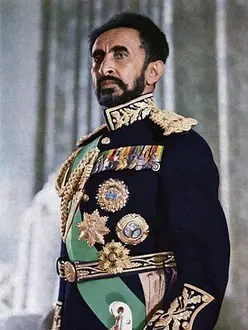
Regent (1916-30) and Emperor of Ethiopia (1930-74)
Haile Selassie ruled Ethiopia personally for nearly six decades as a hereditary, divinely anointed emperor, granting constitutions in 1931 and 1955 that kept sovereignty in his own hands while creating a partly elected Parliament. He pursued top-down modernization through education, planning and foreign capital, centralized the state (including the 1962 annexation of Eritrea), and defended the Orthodox Church as the established church. Abroad he championed collective security, the UN, disarmament, African unity and the end of colonialism and racial discrimination, and kept Ethiopia formally non-aligned.
Closest ideologies
Based on the 104 statements where Haile Selassie I has a known position.
- Person Dignity Theory (87% match)
- German nationalism (86% match)
- Confucianism (86% match)
- Japanese nationalism (86% match)
- Platonism (86% match)
Similar people
- Mohammad Reza I of Iran (87% alike)
- Mahathir Mohamad (86% alike)
- William Ewart Gladstone (86% alike)
- Napoleon III (86% alike)
- Mohammed bin Salman Al Saud (85% alike)
Known positions
- Strongly: The person holding the highest state office should be treated as holy.
- Strongly: Someone who actually governs a state may hand that power on to their own child, whether as a king or as a republic's leader.
- Strongly: God is the ultimate source of the right to exercise political authority.
- Strongly: The UN should have authority to compel member states to comply with its decisions.
- Strongly: Consent of the governed is not the only basis of legitimate political authority.
- Strongly: Special ranks held by birth, such as noble titles and hereditary crowns, may continue to exist.
- Strongly: Countries should hand part of their decision-making power to a union of nations, such as the European Union.
- Strongly: The national church is recognised in law above other religions.
- Strongly: The head of state should not have to be chosen by election.
- Strongly: A ruler's unconstitutional acts do not give people a right to resist.
- Strongly: The state should make one language the only common language of government, schooling and public life, limiting the use of others.
- Strongly: Real authority to command the military should rest with the head of state.
- Strongly: The state may give legal precedence to one stream of a religion over the others.
- Strongly: Many political decisions should rest with national or wider authorities, even where a smaller community could handle them.
- Strongly: Working together internationally should count at least as much as my country's own priorities.
- Strongly: Besides its directly elected parliament, a legislature should have a second chamber, such as a senate.
- Strongly: Distance and nationality do not weaken the duty of the rich to help the poor abroad.
- Strongly: Countries should maintain only the weapons needed for national safety.
- Strongly: Allies are bound to defend one another against armed attack.
- Strongly: Religious values and institutions should shape laws, schools and public life.
- Strongly: Some institutional ties between government and religion are acceptable.
- Strongly: Defeating communism should not take priority over coexistence with it.
- Strongly: The government should be able to require citizens to serve in the military.
- Strongly: Another body may have the final say over what the legislature passes.
- Strongly: The head of state should not be elected directly by the voters.
- Strongly: Today's nation is the same people as its ancient and medieval forebears.
- Strongly: Where they conflict, religious faith should count for at least as much as evidence and reasoning.
- Strongly: A country may keep a region that wants to leave.
- Strongly: Being the law gives a rule a moral claim to be obeyed.
- Strongly: Trade, finance and debt rules should be changed to give poorer countries a fairer share.
- Strongly: Politics should support people's spiritual well-being.
- Strongly: The law should treat everyone as an equal, whatever their birth, sex, race or status.
- Strongly: Poor countries should retain economic ties with rich countries.
- Strongly: Most of the average difference in ability between racial groups does not come from genes.
- Strongly: Religion does not offer illusory comfort for material suffering.
- Strongly: Keeping a nation's inherited culture alive, including its language, customs and traditions, matters.
- Strongly: Industrial society has done at least as much good as harm to humanity.
- Strongly: No society has the right to rule another for its supposed improvement, however advanced it is.
- Strongly: Society needs government of some kind.
- Strongly: Countries should keep their armed forces.
- Strongly: Government should have other tasks besides protecting people from physical violence.
- Strongly: Collecting taxes does not in itself amount to stealing people's money.
- Strongly: Voting should not be limited to members of one ethnic group.
- Strongly: Overseas territories need not be run mainly for the ruling country's economic benefit.
- Strongly: State schools need not steer pupils away from belief in God.
- Strongly: Public spaces such as schools and facilities should not be separated by race under the law.
- Strongly: Courts need not be handed over to private businesses.
- Leans: Only people born in the country should hold public office.
- Leans: The state should keep the colonial-era boundaries it inherits at independence.
- Leans: The government should have authority over religious institutions' internal affairs.
- Leans: Owners' rights to their property should almost never be overridden, even for public goals.
- Leans: Cultures do not rank above one another in overall worth.
- Leans: A national emergency sometimes justifies temporarily withdrawing normal legal safeguards against people the government regards as internal enemies, such as protections against detention without trial.
- Leans: Public institutions do not need to help minority languages be used in public life.
- Leans: Fewer tariffs and trade barriers make all countries better off over time.
- Leans: A country's constitution should not automatically take precedence over international law.
- Leans: Changes to society should be introduced a little at a time.
- Leans: A poor country should rely on foreign money at least as much as on its own resources.
- Leans: A country should press its neighbour to give back land taken from it in an old war.
- Leans: At least some unjust laws impose a moral duty of obedience.
- Leans: Judge policies by what they achieve, independently of whether they match an ideology.
- Leans: Countries that feel dominated by Western powers may handle their relations with them separately.
- Leans: Outside governments have no entitlement to interfere in another country's internal affairs for any purpose.
- Leans: A country has the right to stop a region becoming independent by using its military.
- Leans: Political power may be concentrated in one body.
- Leans: The worst crimes can be punished by death.
- Leans: The global economic system keeps poorer countries poor by directing their wealth toward richer countries.
- Leans: Past abuses by a state's security forces may be put behind it without anyone answering for them in court.
- Leans: Armed forces may sometimes be used for purposes beyond defending the country against attack.
- Leans: My country should stay neutral and join neither of the opposing great-power alliances.
- Leans: Every treaty and agreement between governments should be made public.
- Leans: The government should steer investment into industries it sees as key to the country's future.
- Leans: Society should take active steps to make up for the harm done by past racial injustices.
- Leans: A country may join permanent military alliances.
- Leans: A constitution does not have to be drafted by an assembly elected for that purpose.
- Leans: Parties and offices should cut across religious lines.
- Leans: An elected legislature must approve the government's budget before the government spends public money.
- Leans: Elected politicians should be able to serve any number of terms in any office.
- Leans: Deeply divided societies should not guarantee every major community a share of executive power.
- Leans: A healthy society depends on the traditional family, such as a married mother and father raising their children.
- Leans: Being free requires having the practical resources to act on one's choices, such as an adequate livelihood.
- Leans: Schools should cultivate patriotic feeling: loyalty to and pride in the nation, expressed for example through respect for its flag and anthem.
- Leans: It is legitimate to take pride in the racial group one belongs to.
- Leans: Women should be able to vote and stand for office on the same terms as men.
- Leans: Each country should hold ultimate authority over its natural resources, without foreign interests controlling them.
- Leans: We have a duty to leave the planet in good condition for those who come after us.
- Leans: At least some revolutions have been justified.
- Leans: Political violence is sometimes justified.
- Leans: Looking after your own interests is not a moral good in itself.
- Leans: A people with a shared national identity is entitled to its own self-governing state.
- Leans: A mother country and its colonies may trade with the outside world.