Political Ideology Atlas · All people · Take the test
Europe · born 1809, historical
William Ewart Gladstone
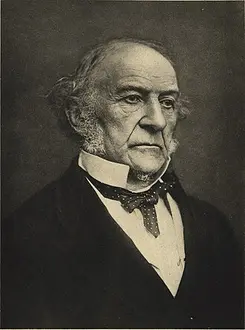
British Liberal prime minister (four terms, 1868-1894)
Gladstone was a free-trader and fiscal economiser who moved from High Church Toryism to leading the Liberal Party. He extended the franchise, disestablished the Irish Church, legislated on Irish land and sought Home Rule for Ireland within the Empire, while defending constitutional monarchy, the family and the limits of women's public role. In foreign affairs he stressed the Concert of Europe, the equal rights of nations, arbitration and restraint in armaments and annexation.
Closest ideologies
Based on the 41 statements where William Ewart Gladstone has a known position.
- Confucianism (89% match)
- Integral humanism (87% match)
- Person Dignity Theory (87% match)
- Christian Democracy (87% match)
- Illiberal democracy (87% match)
Similar people
- Santiago Peña Palacios (90% alike)
- Dwight D. Eisenhower (89% alike)
- William McKinley (88% alike)
- Imran Khan (88% alike)
- Abraham Lincoln (88% alike)
Known positions
- Strongly: Women's political rights may differ from men's.
- Strongly: It is acceptable for a monarch who inherits the throne to be the country's symbolic head while others govern.
- Strongly: Civil servants should be recruited according to their performance in competitive examinations.
- Strongly: The representative legislature should have the final say on legislation.
- Strongly: Fewer tariffs and trade barriers make all countries better off over time.
- Strongly: The nation's figurehead should be non-partisan and belong to everyone.
- Strongly: Countries should maintain only the weapons needed for national safety.
- Strongly: Tariffs should not be used to protect domestic industry from foreign competition.
- Strongly: Ending a marriage should not be possible without proving fault.
- Strongly: An elected legislature must approve the government's budget before the government spends public money.
- Strongly: A healthy society depends on the traditional family, such as a married mother and father raising their children.
- Strongly: The law should treat everyone as an equal, whatever their birth, sex, race or status.
- Strongly: People without property should also have the right to vote.
- Leans: A person's sex should affect the public roles legally assigned to them.
- Leans: The best government combines a governing role for a few with a governing role for the wider population.
- Leans: Each main community should have a guaranteed place in government, even against a numerical majority.
- Leans: A national emergency sometimes justifies temporarily withdrawing normal legal safeguards against people the government regards as internal enemies, such as protections against detention without trial.
- Leans: Changes to society should be introduced a little at a time.
- Leans: A country should not tie itself to other countries through lasting military alliances.
- Leans: The national parliament stays the final authority and can take powers back from the regions.
- Leans: Working together internationally should count at least as much as my country's own priorities.
- Leans: Besides its directly elected parliament, a legislature should have a second chamber, such as a senate.
- Leans: Property should belong to many people in small holdings.
- Leans: State schools may teach pupils a religious faith, for example through lessons in its beliefs and practice.
- Leans: Industries such as energy, rail and utilities should be owned by the state or public bodies, not private companies.
- Leans: My country may keep a military no stronger than its rivals'.
- Leans: Military intervention abroad is sometimes necessary to protect human rights.
- Leans: Political decisions should rest with the smallest local community able to handle them, with wider authorities handling matters that need a wider reach.
- Leans: Governments should not borrow heavily, spending much more than they collect in taxes, to boost the economy.
- Leans: Every treaty and agreement between governments should be made public.
- Leans: Government should impose strict rules on how corporations operate.
- Leans: Land that a state declares its own against its people's will is still illegally occupied by that state.
- Leans: Purchases of basic necessities should carry no consumption tax.
- Leans: People are entitled to resist a ruler's unconstitutional exercise of power.
- Leans: Owners' rights to their property need not be protected against being overridden for public goals.
- Leans: The people living in a disputed territory should choose by voting which country it joins.
- Leans: Rulers must act under lasting, publicly known laws administered by recognised courts.
- Leans: Rulers have a right to rule only because the people they rule have agreed to it.