Political Ideology Atlas · All people · Take the test
Europe · born 1874, historical
G. K. Chesterton
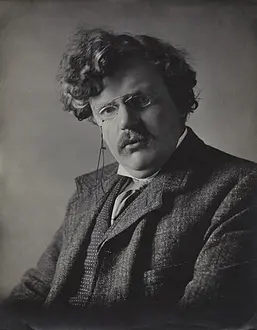
English writer, journalist and Catholic apologist; leading voice of distributism (1874–1936)
Chesterton was an English Liberal-turned-distributist who wanted property spread widely among small owners, opposing both industrial capitalism and socialism, which he thought would concentrate power in a few hands or the State. A Catholic traditionalist, he defended the family, local self-government, the jury and ordinary people's judgement over experts and eugenic legislation, and opposed imperialism while backing small nations' independence. He also opposed votes for women and wrote about Jews as a separate nation in terms that were later widely criticised as antisemitic.
Closest ideologies
Based on the 35 statements where G. K. Chesterton has a known position.
- Distributism (92% match)
- Zionism (88% match)
- Christian Democracy (87% match)
- Christian corporatism (86% match)
- Melanesian socialism (86% match)
Similar people
- Imran Khan (89% alike)
- Mahmoud Ahmadinejad (88% alike)
- Óscar Romero (88% alike)
- John Paul II (88% alike)
- Pius XII (87% alike)
Known positions
- Strongly: Jews, as a people, are entitled to a country of their own in the Land of Israel.
- Strongly: Industries such as energy, rail and utilities do not need to be publicly owned.
- Strongly: Businesses should be legally barred from agreements with competitors to suppress competition, such as fixing prices.
- Strongly: Property should belong to many people in small holdings.
- Strongly: Society should follow a third course beyond capitalism and communism.
- Strongly: Ending a marriage should not be possible without proving fault.
- Strongly: Democracy is best even when voters make poor choices.
- Strongly: Formal press freedom is hollow when wealth decides who can actually be heard.
- Strongly: A country can get through deadlock among its institutions without a leader who overrides them.
- Strongly: Where they conflict, religious faith should count for at least as much as evidence and reasoning.
- Strongly: A healthy society depends on the traditional family, such as a married mother and father raising their children.
- Strongly: The general public should have at least as much say in policy as experts.
- Strongly: Very large concentrations of wealth threaten a free society.
- Strongly: An economy directed by a central plan is not capable of working better than one directed by market exchange.
- Strongly: A people with a shared national identity is entitled to its own self-governing state.
- Strongly: Being powerful does not mean a country should bring more land within its borders.
- Strongly: Businesses gain too much influence over government policy from their lobbying.
- Strongly: The law should treat everyone as an equal, whatever their birth, sex, race or status.
- Strongly: No society has the right to rule another for its supposed improvement, however advanced it is.
- Strongly: Public policy should not be used to reduce the passing on of inherited disabilities.
- Strongly: Killing another person can be right in self-defence or in defence of others.
- Leans: Women's political rights may differ from men's.
- Leans: Charging interest on loans is banned by law.
- Leans: A person's sex should affect the public roles legally assigned to them.
- Leans: Recovering how society used to be matters more than moving forward.
- Leans: The farmers who work large estates should take ownership from the landowners, with the transfer compulsory if owners refuse.
- Leans: Political decisions should rest with the smallest local community able to handle them, with wider authorities handling matters that need a wider reach.
- Leans: Government should impose strict rules on how corporations operate.
- Leans: Workers are better off for having labor unions.
- Leans: Animals can suffer, and that suffering counts in how we treat them.
- Leans: Rulers have a right to rule only because the people they rule have agreed to it.
- Leans: Most people in political office look after themselves first and the public second.
- Leans: Member states should keep the final decision on whether to follow UN decisions.
- Leans: Politics should support people's spiritual well-being.