Political Ideology Atlas · All people · Take the test
Middle East & North Africa · born 1956
Mahmoud Ahmadinejad
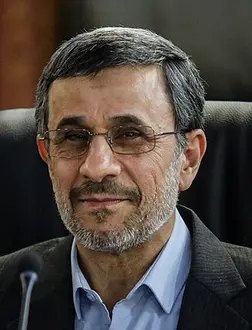
President of Iran (2005–2013); mayor of Tehran (2003–2005)
Ahmadinejad is an Iranian populist and Shia Islamist conservative who combined welfare transfers, housing and price interventions for poorer Iranians with hostility to capitalism and Western domination. He backed Iran's nuclear programme while denying it sought a bomb, rejected Israel's legitimacy, questioned the Holocaust, and promoted a larger population and traditional family. After leaving office he clashed with Iran's establishment, calling for free elections and criticising corruption.
Closest ideologies
Based on the 60 statements where Mahmoud Ahmadinejad has a known position.
- Islamic Socialism (90% match)
- Distributism (88% match)
- Religious democracy (88% match)
- Pancasila (88% match)
- Sahrawi nationalism (87% match)
Similar people
- Imran Khan (90% alike)
- Joseph Smith (89% alike)
- G. K. Chesterton (88% alike)
- Bassirou Diomaye Faye (88% alike)
- Mahathir Mohamad (88% alike)
Known positions
- Strongly: Settlers from abroad who displace a land's people and found a state there are carrying out colonialism.
- Strongly: Government should support building nuclear power plants.
- Strongly: Religious values and institutions should shape laws, schools and public life.
- Strongly: Some institutional ties between government and religion are acceptable.
- Strongly: The state should give families money to have more children, such as through payments and tax breaks.
- Strongly: Countries that feel dominated by Western powers should band together to resist them.
- Strongly: A state of their own in the Land of Israel is not something Jews are owed as a people.
- Strongly: Human rights come from the nature that all human beings share.
- Strongly: Where they conflict, religious faith should count for at least as much as evidence and reasoning.
- Strongly: A healthy society depends on the traditional family, such as a married mother and father raising their children.
- Strongly: Meeting poor people's needs should be the first consideration in public policy.
- Strongly: Other things drive humanity forward at least as much as rivalry and conflict between peoples.
- Strongly: Population growth may be left to run its course.
- Strongly: Politics should support people's spiritual well-being.
- Strongly: A people with a shared national identity is entitled to its own self-governing state.
- Strongly: Being powerful does not mean a country should bring more land within its borders.
- Strongly: The law should treat everyone as an equal, whatever their birth, sex, race or status.
- Strongly: Religion does not offer illusory comfort for material suffering.
- Strongly: Looking after your own interests is not a moral good in itself.
- Strongly: Keeping a nation's inherited culture alive, including its language, customs and traditions, matters.
- Strongly: No society has the right to rule another for its supposed improvement, however advanced it is.
- Strongly: A weaker state need not formally treat a stronger power as its superior.
- Leans: The mass murder of Europe's Jews by Nazi Germany was invented or greatly exaggerated.
- Leans: Behind their different forms, the great religions point to one shared truth.
- Leans: A person's sex should affect the public roles legally assigned to them.
- Leans: Every adult should get a regular payment from the state, whether or not they work.
- Leans: At its core, politics is a struggle between spiritual good and evil.
- Leans: Capitalism did not build the productive power and wealth that a better society can rest on.
- Leans: Governments should set legal price ceilings on essential foods when supplies are scarce.
- Leans: Force is for self-defence alone.
- Leans: Outside governments have no entitlement to interfere in another country's internal affairs for any purpose.
- Leans: Working together internationally should count at least as much as my country's own priorities.
- Leans: Distance and nationality do not weaken the duty of the rich to help the poor abroad.
- Leans: Countries should maintain only the weapons needed for national safety.
- Leans: Property should belong to many people in small holdings.
- Leans: A general collapse of capitalism is unavoidable.
- Leans: Society should follow a third course beyond capitalism and communism.
- Leans: The worst crimes can be punished by death.
- Leans: Government surveillance is not acceptable, even to prevent terrorism.
- Leans: The global economic system keeps poorer countries poor by directing their wealth toward richer countries.
- Leans: Government should serve people's good while respecting each person as more than an instrument of the state or community.
- Leans: My country should stay neutral and join neither of the opposing great-power alliances.
- Leans: People who became refugees during a conflict should be permitted to return to the homes they themselves left.
- Leans: Hate speech should be legal.
- Leans: The people living in a disputed territory should choose by voting which country it joins.
- Leans: A country should not be ready to use military force abroad without UN Security Council authorization.
- Leans: Officials decide what gets made and who gets it at least as well as prices and competition do.
- Leans: Each country should hold ultimate authority over its natural resources, without foreign interests controlling them.
- Leans: Constantly seeking additional possessions is harmful overall, despite any benefits it brings.
- Leans: Population growth does not mainly drive lasting poverty.
- Leans: Trade, finance and debt rules should be changed to give poorer countries a fairer share.
- Leans: Most people in political office look after themselves first and the public second.
- Leans: World power should be distributed among several independent major powers, without one dominant power.
- Leans: Whatever their circumstances, everyone should be able to count on the state for enough to live decently, through benefits, pensions or public services.
- Leans: At least some revolutions have been justified.
- Leans: Poor countries should retain economic ties with rich countries.
- Leans: Elected governments need not leave monetary policy to central banks acting on their own.
- Leans: Businesses gain too much influence over government policy from their lobbying.